. 2020 Jul 24:11:1360.
doi: 10.3389/fpsyg.2020.01360. eCollection 2020.

Expertise-Related Differences in Wrist Muscle Co-contraction in Drummers

Affiliations

Expertise-Related Differences in Wrist Muscle Co-contraction in Drummers

Scott Beveridge et al. Front Psychol. .

Erratum in

Abstract

Background and Aim: Drumming requires excellent motor control and temporal coordination. Deploying specific muscle activation patterns may help achieve these requirements. Muscle activation patterns that involve reciprocal contraction of antagonist muscles are particularly favorable as they enable a high level of muscular economy while maintaining performance. In contrast, simultaneous contraction of antagonist muscles is an inefficient muscle activation pattern. In drumming, co-contraction can lead to increased movement variability and greater fatigue over time. In this study we examine how muscle activation patterns develop with increased drumming expertise. Methods: Eleven expert drummers (ED) and eleven amateur drummers (AD) were recorded using 3D motion capture while performing five different uni-manual and bi-manual repetitive drumming tasks across different tempi. Electromyography was used to record muscle activation of wrist flexor and extensor muscles. Results: Findings indicate that reduced co-contraction resulted in more even drumming performance. Co-contraction also increased in extremely slow and very high tempi. Furthermore, regardless of task or tempo, muscle co-contraction was decreased in participants with higher levels of expertise. In addition to anti-phasic activity of wrist flexor and extensor muscles, expert drummers exhibited a flexor dominance, suggesting more efficient usage of rebound. Conclusion: Taken together, we found that higher levels of drumming expertise go hand in hand with specific muscle activation patterns that can be linked to more precise and efficient drumming performance.

Keywords: coordination abilities; drummers; electromyography; expertise; motor control; muscle co-contraction; musicians; practice.


Conflict of interest statement

The authors declare that the research was conducted in the absence of any commercial or financial relationships that could be construed as a potential conflict of interest.

Figures
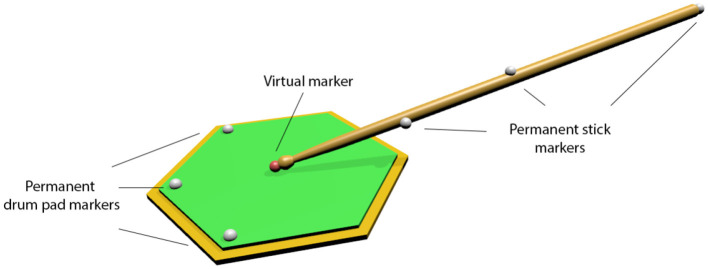
Figure 1
Figure 1
Schematic of the positions of the infrared-reflective markers on the drum stick and drum pad. Three permanent markers at the drumstick allowed modeling a “virtual marker” at the tip of the drumstick (red sphere). Three permanent markers on the surface of the drum pad allowed for precise 6DOF tracking of the interaction between stick tip and drum pad surface.
Figure 2
Figure 2
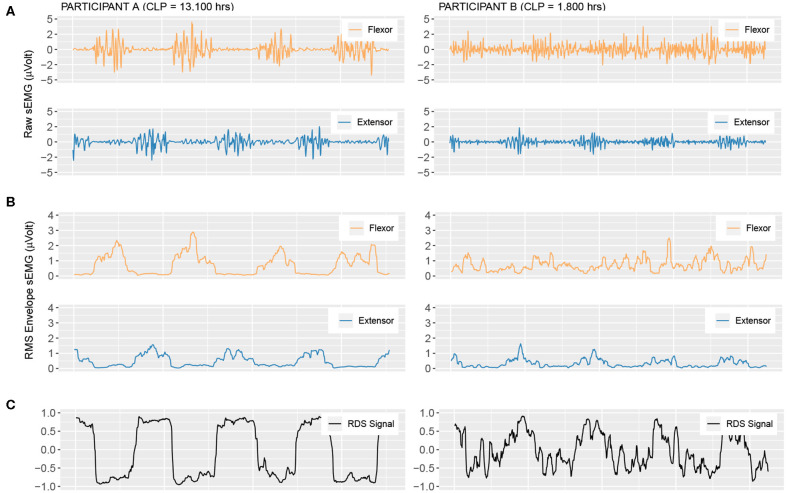
Surface electromyography signals for the single right-hand solo exercise (RHSolo) at 400 HPM. Participant A (left-hand column) is a member of the Expert group (ED) with a Cumulative Lifetime Practice (CLP) of 13,100 h. Participant B (right-hand column) is a member of the Amateur group (AD), with a Cumulative Lifetime Practice (CLP) of 1,800 h. (A) The raw sEMG signals of both flexor and extensor (B) The corresponding RMS Envelope signals. (C) The resultant relative difference signal (RDS).
Figure 3
Figure 3
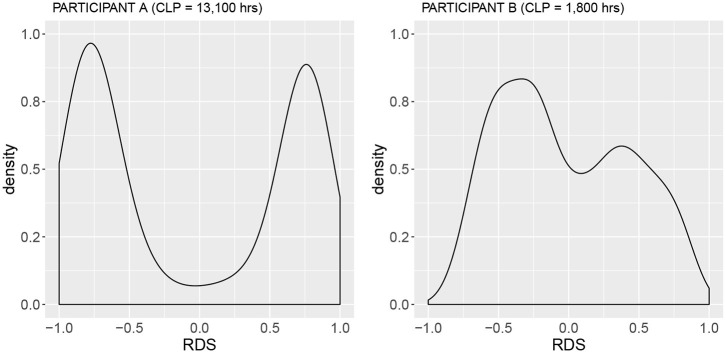
Density plots of the RDS signal for Participant A, Cumulative Lifetime Practice, CLP = 13,100 h, sdRDS = 0.74 and Participant B, Cumulative Lifetime Practice, CLP = 1,800 h) sdRDS =0.46. RDS signals from both plots were derived from the single right-hand only exercise (RHSolo) at 400 HPM (see Figure 2). Note the bi-modal distribution of Participant A, that accounts for the large standard deviation (sdRDS).
Figure 4
Figure 4
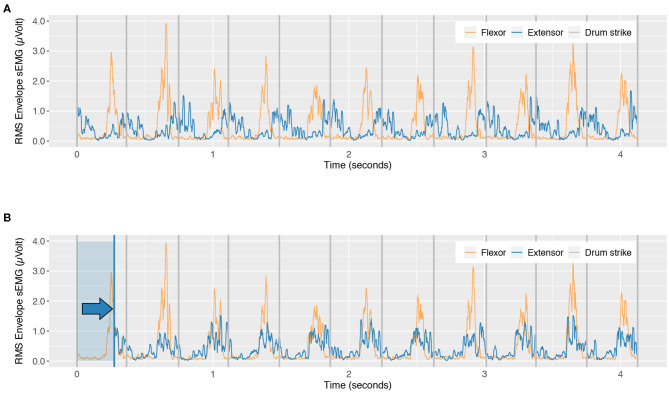
Derivation of phase shift from flexor/extensor cross correlation procedure. (A) Original signal envelopes. (B) Time shifted extensor signal showing the phase at peak cross-correlation of extensor and flexor (Blue shaded box and arrow shows the amount of phase shift).
Figure 5
Figure 5
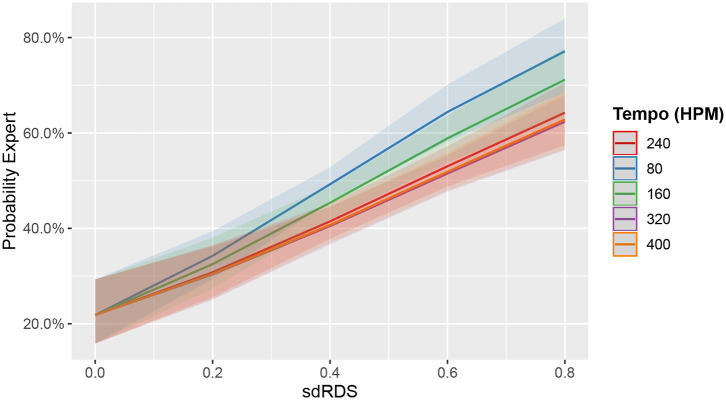
Marginal effects plot of sdRDS and tempo on the predicted probability that an observation derives from an expert drummer. Line color indicates tempo. The 240 HPM tempo is at the top of the legend, as it represents the model's baseline. The model attributes higher sdRDS to drumming expertise. This is particularly visible at 80 HPM (blue line), which shows the steepest slope. Bands represent 95% CIs.
Figure 6
Figure 6
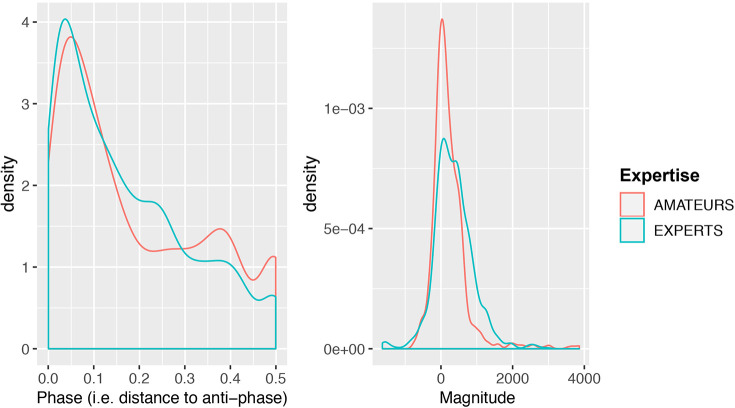
Density plot of relative phase (coded as distance to anti-phase) and magnitude in flexor and extensor muscles between the two expertise groups.
Figure 7
Figure 7
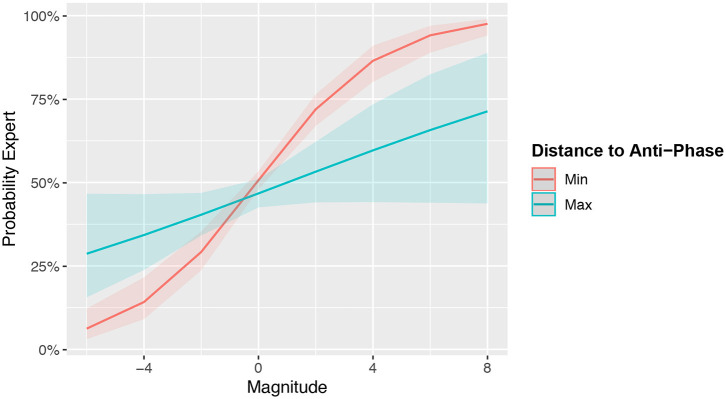
Marginal effects plot the Magnitude and Distance to Anti-Phase interaction on the predicted probability that an observation belongs to an expert. The model attributes muscle activity toward anti-phase and stronger flexor compared to extensor activity to expert drummers. Bands represent 95% CIs.
Figure 8
Figure 8
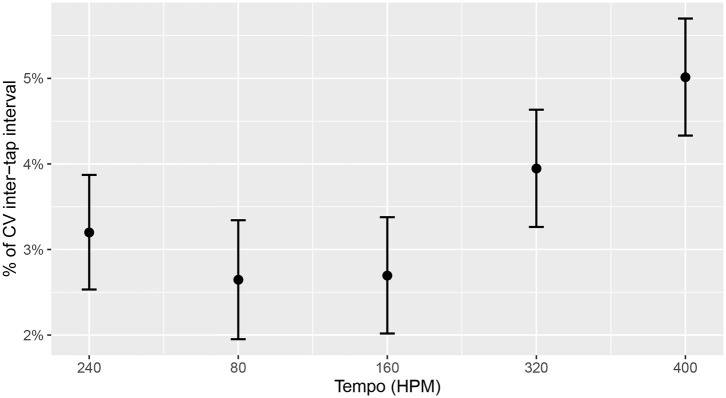
Predicted change in CV-ITI based on Tempo. Higher tempi show significantly less stable performances. Error bars represent 95% CIs.
Figure 9
Figure 9
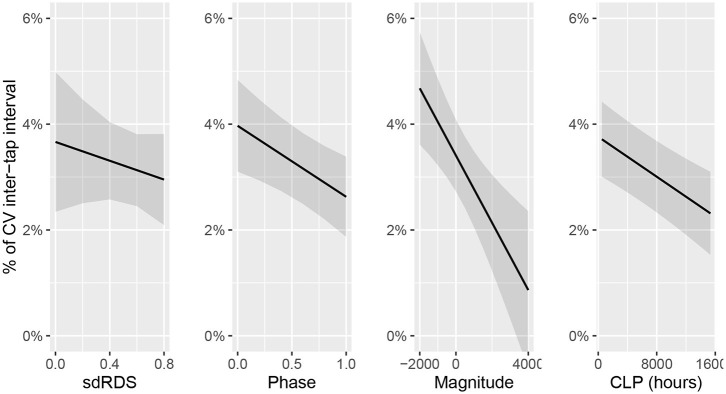
Predicted change in CV-ITI based on sdRDS, Phase, Magnitude, and CLP. The plot shows that more CLP predict lower CV-ITI. Stronger relative flexor activity compared to extensor activity, as well as engagement of flexor and extensor muscles in anti-phase also predict steadier performance. The predictive power of sdRDS seems to be better captured in Phase and Magnitude separately. Bands represent 95% CIs.
Figure A1
Figure A1
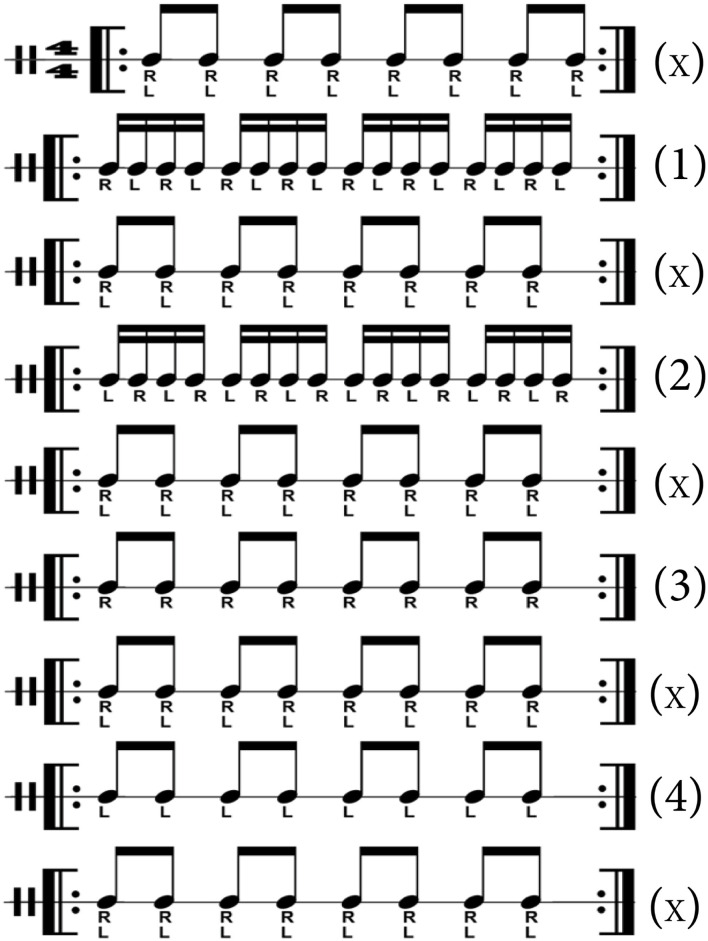
Drum patterns included in the 18-bar exercise (1) both hands alternating (BHRLead), with the right hand leading (i.e., right hand down stroke coinciding with the first beat of a measure), (2) both hands alternating (BHLLead), with the left hand leading (i.e., left hand down stroke coinciding with the first beat of a measure), (3) right hand solo (RHSolo), (4) left hand solo (LHSolo), (X) both hands simultaneously (BH), filler condition.

References

    1. Bååth R., Madison G. (2012). “The subjective difficulty of tapping to a slow beat,” in 12th International Conference on Music Perception and Cognition (Thessaloniki: ).
    1. Barr D. J., Levy R., Scheepers C., Tilyc H. J. (2013). Random effects structure for confirmatory hypothesis testing: keep it maximal. J. Mem. Lang. 255–278. 10.1016/j.jml.2012.11.001 - DOI - PMC - PubMed
    1. Bartlett R. (2007). Introduction to Sports Biomechanics: Analysing Human Movement Patterns. Abingdon, UK: Routledge. 10.4324/9780203462027 - DOI
    1. Bernstein N. A. (1967). The co-ordination and Regulation of Movements. Oxford, UK: Pergamon Press Ltd.
    1. Chatfield C. (1984). The Analysis of Time Series: An Introduction. New York, NY: Chapman and Hall. 10.1007/978-1-4899-2921-1 - DOI

LinkOut - more resources