. 2020 Jul;8(13):816.
doi: 10.21037/atm-20-4235.

A bibliometric analysis using VOSviewer of publications on COVID-19

Affiliations

A bibliometric analysis using VOSviewer of publications on COVID-19

Yuetian Yu et al. Ann Transl Med. 2020 Jul.

Abstract

Background: As a global pandemic, COVID-19 has aroused great concern in the last few months and a growing number of related researches have been published. Therefore, a bibliometric analysis of these publications may provide a direction of hot topics and future research trends.

Methods: The global literatures about COVID-19 published between 2019 and 2020 were scanned in the Web of Science collection database. "COVID-19" "Novel Coronavirus" "2019-nCoV" and "SARS-CoV-2" were used as the keywords to reach the relevant publications. VOSviewer was applied to perform the bibliometric analysis of these articles.

Results: Totally 3,626 publications on the topic of COVID-19 were identified and "COVID-19" with a total link strength of 2,649 appeared as the most frequent keyword, which had a strong link to "pneumonia" and "epidemiology". The mean citation count of the top 100 most cited articles was 96 (range, 26-883). Most of them were descriptive studies and concentrated on the clinical features. The highest-ranking journal was British medical journal with 211 publications and the most cited journal was Lancet with 2,485 citation counts. Eleven articles written by Christian Drosten from Berlin Institute of Virology have been cited for 389 times and 40 articles from Chinese Academy of Sciences have been cited for 1,597 times which are the most cited author and organization. The number of collaborators with China is 44 and the total link strength is 487. The main partners of China are USA, England and Germany. The published literatures have focused on three topics: disease management, clinical features and pathogenesis.

Conclusions: The current growth trends predict a large increase in the number of global publications on COVID-19. China made the most outstanding contribution within this important field. Disease treatment, spike protein and vaccine may be hotspots in the future.

Keywords: Bibliometric analysis; SARS-CoV-2; coronavirus disease 2019 (COVID-19); novel coronavirus; trends.


Conflict of interest statement

Conflicts of Interest: All authors have completed the ICMJE uniform disclosure form (available at http://dx.doi.org/10.21037/atm-20-4235). YY serves as an unpaid section editor of Annals of Translational Medicine from Oct 2019 to Sep 2020. The other authors have no conflicts of interest to declare.

Figures
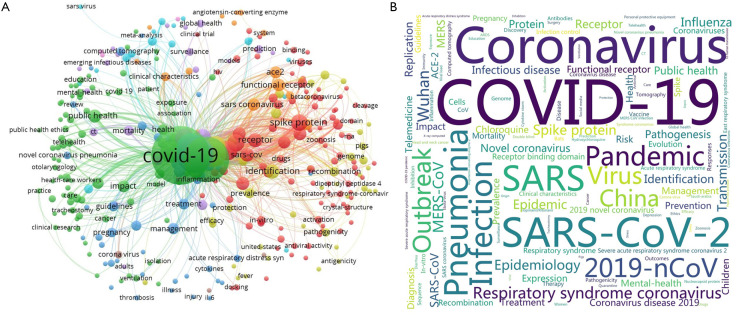
Figure 1
Figure 1
Bibliometric analysis of the keywords in publications of COVID-19. (A) Co-occurrence of keywords. The size of nodes indicates the frequency of occurrence. The curves between the nodes represents their co-occurrence in the same publication. The shorter the distance between two nodes, the larger the number of co-occurrence of the two keywords. (B) Word cloud. 137 keywords which occurred for more than 10 times were enrolled. The font size represents the frequency of occurrence. Keywords such as “Coronavirus”, “COVID-19” and “epidemiology” occurred most common. “Prediction” and “Isolation” are rare.
Figure 2
Figure 2
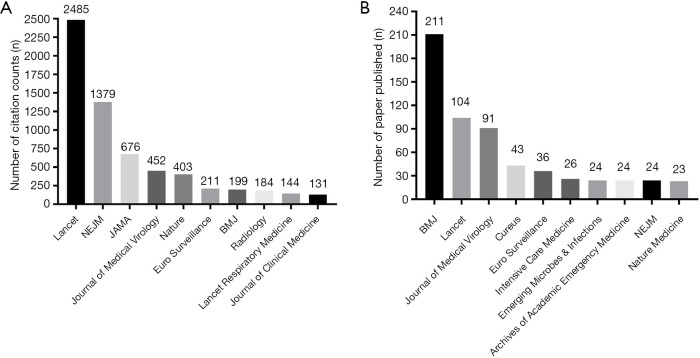
The top ten most active journals. (A) The top ten journals with most-cited articles in the field of COVID-19; (B) the top ten journals with most published articles in the field of COVID-19.
Figure 3
Figure 3
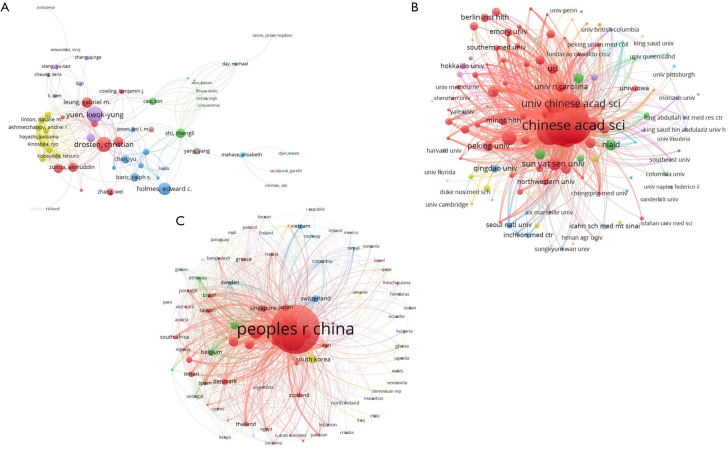
Bibliometric analysis of the citations. (A) The citations of authors. Eight clusters were shown in different colours. Yuen Kwok-Yung in the purple cluster is the most cited author (191 times); (B) the citations of organizations. Chinese Academy of Sciences in red cluster is the most cited organization (1,036 times); (C) the citations of countries. Different colours indicate different clusters and the size of circles indicates the counts of citations.
Figure 4
Figure 4
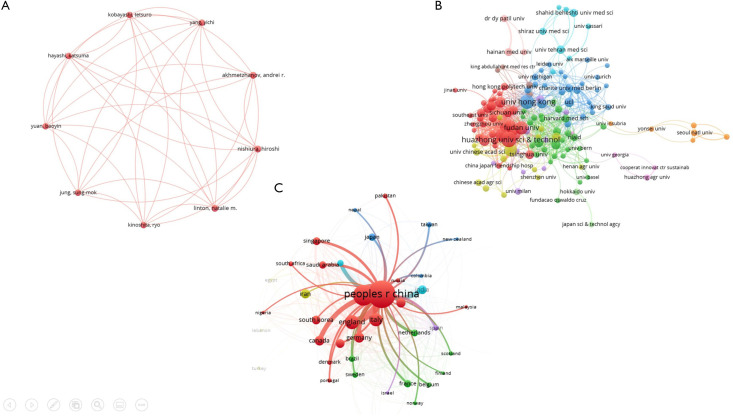
Bibliometric analysis of the co-authorship. (A) The co-authorship map of authors which indicates the authors that cooperate in the field of COVID-19 transmission; (B) the co-authorship map of organizations. Huazhong University of Science and Technology has published 51 related papers and cooperates with other 27 institutions; (C) the co-authorship map of countries. The number of collaborators with China is 44 and the total link strength is 290. Different colours indicate different clusters and the size of circles indicates the number of publications. The thickness of the lines represents the link strength of the countries.
Figure 5
Figure 5
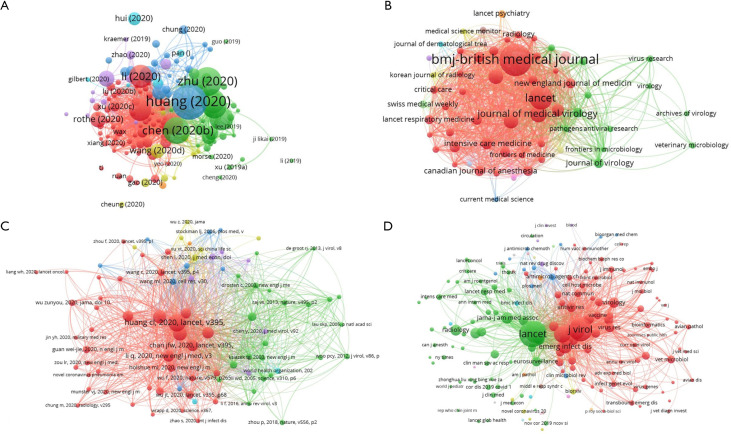
Bibliometric analysis of the bibliographic coupling and co-citation. (A) Bibliographic coupling of documents; (B) bibliographic coupling of sources; (C) co-citation of documents; (D) co-citation of sources. Different colour indicates different research areas. The size of the circles represents the counts of co-citations. The distance between the two circles indicates their correlation.
Figure 6
Figure 6
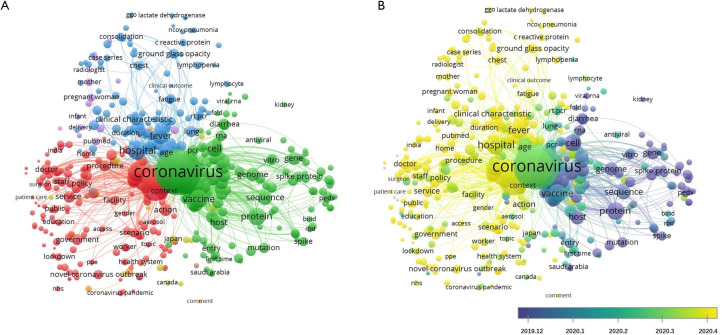
Bibliometric analysis of themes. (A) Distribution of the themes. Three clusters are shown in the map. The red cluster indicates risk factors and pathogenesis. The blue cluster involved clinical trials investigating COVID-19 diagnosis and clinical features. The green cluster represents COVID-19 management and emergency preparedness. (B) Network map of the trend topics according to the keywords used from December 2019 to April 2020. Indicator shows the current publications from purple to yellow. More studies focused on vaccine, drug treatment and spike protein have been published recently. The size of the circles represents the frequency of appearance as the keywords. The distance between the two circles indicates their correlation.

References

    1. Wang C, Horby PW, Hayden FG, et al. A novel coronavirus outbreak of global health concern. Lancet 2020;395:470-3. 10.1016/S0140-6736(20)30185-9 - DOI - PMC - PubMed
    1. World Health Organization Coronavirus Disease (COVID-19) Dashboard. Available online:https://who.sprinklr.com/
    1. Chen C, Dubin R, Kim MC, et al. Emerging trends and new developments in re-generative medicine: A scientometric update (2000–2014). Expert Opin Biol Ther 2014;14:1295-317. 10.1517/14712598.2014.920813 - DOI - PubMed
    1. Stephan P, Veugelers R, Wang J. Reviewers are blinkered by bibliometrics. Nature 2017;544:411-2. 10.1038/544411a - DOI - PubMed
    1. Brown A, Horton R. A planetary health perspective on COVID-19: a call for papers. Lancet 2020;395:1099. 10.1016/S0140-6736(20)30742-X - DOI - PMC - PubMed