Review
. 2020 Aug 14;11(1):356.
doi: 10.1186/s13287-020-01866-6.

Potential therapeutic application of mesenchymal stem cell-derived exosomes in SARS-CoV-2 pneumonia

Affiliations
Review

Potential therapeutic application of mesenchymal stem cell-derived exosomes in SARS-CoV-2 pneumonia

Ali Akbari et al. Stem Cell Res Ther. .

Abstract

Background: The outbreak of a new virus known as severe acute respiratory syndrome coronavirus 2 (SARS-CoV-2) has now become the main health concern all over the world. Since effective antiviral treatments have not been developed until now, SARS-CoV-2 is severely affecting countries and territories around the world.

Methods: At the present review, articles in PubMed were searched with the following terms: mesenchymal stem cells, exosomes, coronavirus, and SARS-CoV-2, either alone or in a combination form. The most relevant selected functions were mesenchymal stem cell-derived exosomes and SARS-CoV-2 virus infection.

Results: SARS-CoV-2 could damage pulmonary cells and induce secretion of different types of inflammatory cytokines. In the following, these cytokines trigger inflammation that damages the lungs and results in lethal acute respiratory distress syndrome (ARDS). The main characteristic of ARDS is the onset of inflammation in pulmonary, hyaline formation, pulmonary fibrosis, and edema. Mesenchymal stem cell-derived exosomes (MSC-Exo) are believed to have anti-inflammatory effects and immune-modulating capacity as well as the ability to induce tissue regeneration, suggesting a significant therapeutic opportunity that could be used to SARS-CoV-2 pneumonia treatment. Besides, exosomes may serve as a biomarker, drug delivery system, and vaccine for the management of the patient with SARS-CoV-2.

Conclusion: MSC-Exo may serve as a promising tool in the treatment of SARS-CoV-2 pneumonia. However, further work needs to be carried out to confirm the efficacy of exosomes in the treatment of SARS-CoV-2 pneumonia.

Keywords: Exosomes; Mesenchymal stem cells; SARS-CoV-2; Virus pneumonia.


Conflict of interest statement

The authors have no competing interests to declare.

Figures

Fig. 1
Fig. 1
The SARS-CoV-2 entry and life cycle in human lung cells. The S proteins of SARS-CoV-2 bind to the angiotensin-converting enzyme 2 (ACE2) located on the cellular membrane and enters the target cells through an endosomal pathway (1). Then, viral components such as RNA are uncoated in the cytoplasm (2). In keeping, the genome encodes RNA-dependent RNA polymerase (RdRp) (3), which, in turn, participates to producing full-length (+) RNA and full length (−) RNA copies (4). During replication, genome RNA and RNAs which belong to viral structural components are produced. Then, RNAs are translated into viral components and processed by the endoplasmic reticulum (ER)–Golgi apparatus (GA) (5). Once SARS-CoV-2 structural proteins are formed, nucleocapsids initially are assembled in the cytoplasm, and then they are budding into the lumen of the ER and GA (6). Finally, mature viruses are secreted out of the infected cell via exocytosis (7). EE, early endosome
Fig. 2
Fig. 2
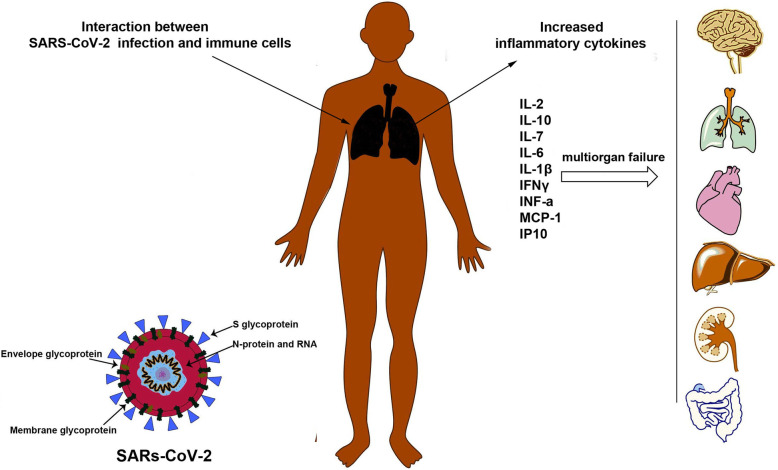
Pathogenesis of SARS-CoV-2 virus. During SARS-CoV-2 infection, immune cells produce several pro-inflammatory cytokines. Inflammatory cytokines trigger lethal acute respiratory distress syndrome (ARDS) and failure in multi-organs
Fig. 3
Fig. 3
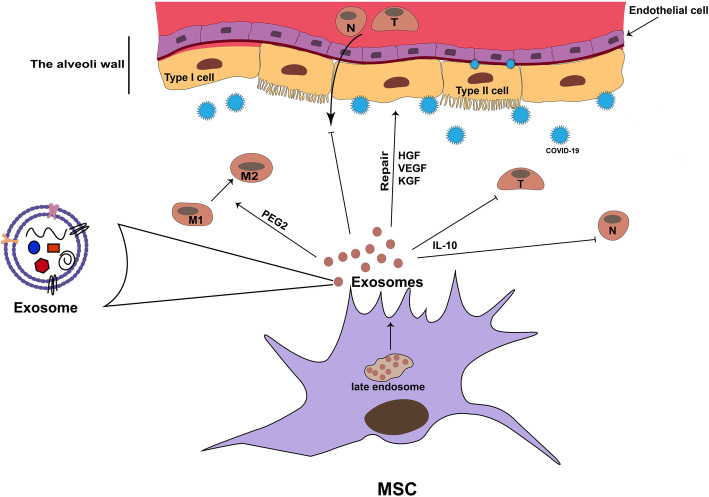
Possible mechanisms, by which mesenchymal stem cell-derived exosomes may improve adverse effects of SARS-CoV-2 virus infection. These exosomes contain different molecules that can suppress inflammatory responses and repair damage tissue. MSC, mesenchymal stem cell; N, neutrophil; M1, macrophage type I; M2, macrophage type II; T, T lymphocyte
Fig. 4
Fig. 4
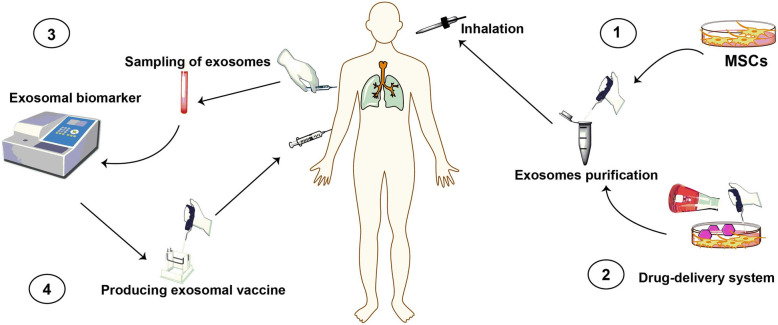
Therapeutic application of exosomes in the treatment of SARS-CoV-2 virus infection

References

    1. WHO Coronavirus Disease (COVID-19) Dashboard. https://covid19.who.int/. Accessed 8 July 2020.
    1. Gattinoni L, Coppola S, Cressoni M, Busana M, Rossi S, Chiumello D. Covid-19 does not lead to a “typical” acute respiratory distress syndrome. Am J Respir Crit Care Med. 2020;201:1299–1300. - PMC - PubMed
    1. HuiDS IAE, Madani T, Ntoumi F, Koch R, Dar O. The continuing 2019-nCoV epidemic threat of novel coronaviruses to global health: the latest 2019 novel coronavirus outbreak in Wuhan, China. Int J Infect Dis. 2020;91:264–266. - PMC - PubMed
    1. Abraham A, Krasnodembskaya A. Mesenchymal stem cell-derived extracellular vesicles for the treatment of acute respiratory distress syndrome. Stem Cells Transl Med. 2020;9:28–38. - PMC - PubMed
    1. Shah TG, Predescu D, Predescu S. Mesenchymal stem cells-derived extracellular vesicles in acute respiratory distress syndrome: a review of current literature and potential future treatment options. Clin Transl Med. 2019;8:25. - PMC - PubMed

LinkOut - more resources