


Synthesis, Anticonvulsant and Antinociceptive Activity of New Hybrid Compounds: Derivatives of 3-(3-Methylthiophen-2-yl)-pyrrolidine-2,5-dione
- PMID: 32796594
- PMCID: PMC7461116
- DOI: 10.3390/ijms21165750
Synthesis, Anticonvulsant and Antinociceptive Activity of New Hybrid Compounds: Derivatives of 3-(3-Methylthiophen-2-yl)-pyrrolidine-2,5-dione
Abstract
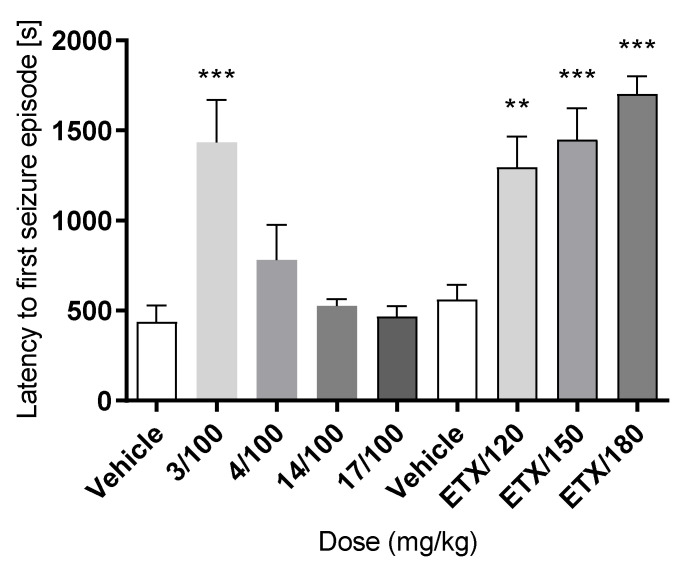
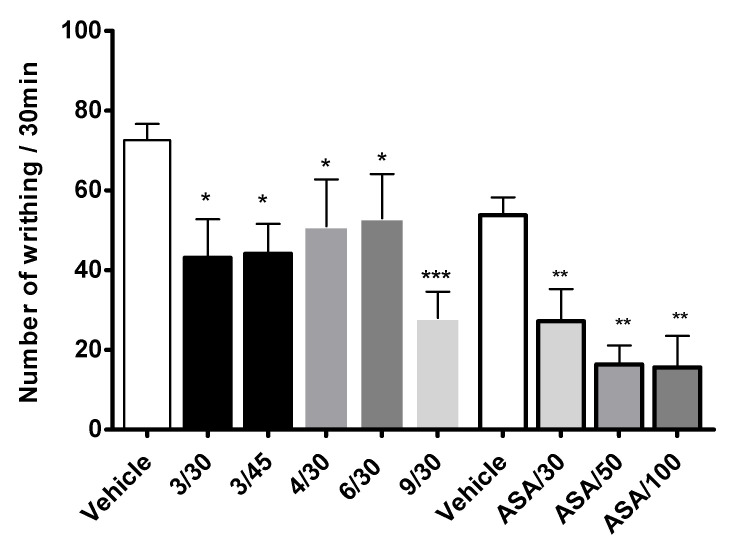
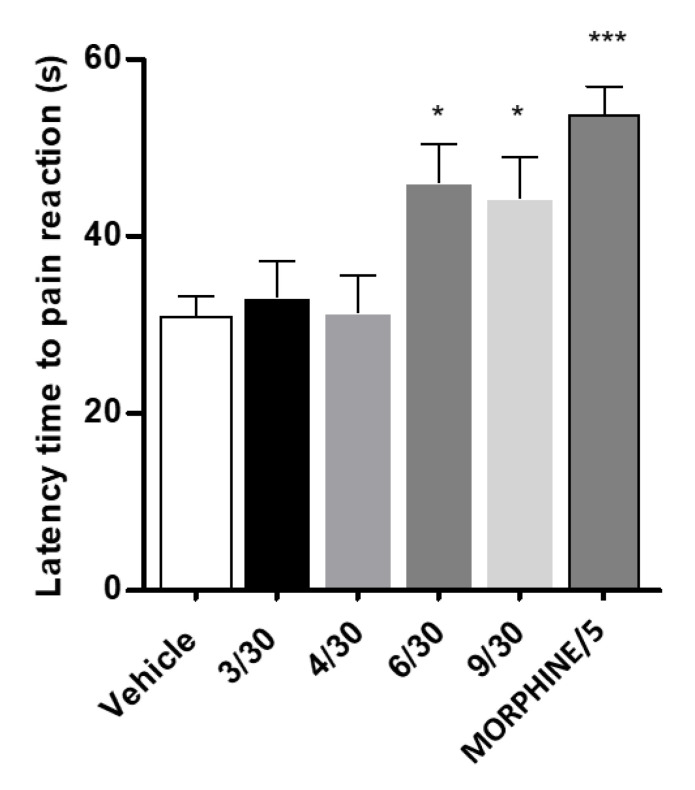
The present study aimed to design and synthesize a new series of hybrid compounds with pyrrolidine-2,5-dione and thiophene rings in the structure as potential anticonvulsant and antinociceptive agents. For this purpose, we obtained a series of new compounds and evaluated their anticonvulsant activity in animal models of epilepsy (maximal electroshock (MES), psychomotor (6 Hz), and subcutaneous pentylenetetrazole (scPTZ) seizure tests). To determine the mechanism of action of the most active anticonvulsant compounds (3, 4, 6, 9), their influence on the voltage-gated sodium and calcium channels as well as GABA transporter (GAT) was assessed. The most promising compound 3-(3-methylthiophen-2-yl)-1-(3-morpholinopropyl)pyrrolidine-2,5-dione hydrochloride (4) showed higher ED50 value than those of the reference drugs: valproic acid (VPA) and ethosuximide (ETX) (62.14 mg/kg vs. 252.7 mg/kg (VPA) in the MES test, and 75.59 mg/kg vs. 130.6 mg/kg (VPA) and 221.7 mg/kg (ETX) in the 6 Hz test, respectively). Moreover, in vitro studies of compound 4 showed moderate but balanced inhibition of the neuronal voltage-sensitive sodium (site 2) and L-type calcium channels. Additionally, the antinociceptive activity of the most active compounds (3, 4, 6, 9) was also evaluated in the hot plate test and writhing tests, and their hepatotoxic properties in HepG2 cells were also investigated. To determine the possible mechanism of the analgesic effect of compounds 3, 6, and 9, the affinity for the TRPV1 receptor was investigated.
Keywords: anticonvulsant; antinociceptive; pirrolidyne-2,5-dione; thiophene.
Conflict of interest statement
The authors declare no conflict of interest relevant to the ideas or the contents of this manuscript.
Figures



References
-
- Fisher R.S., Cross J.H., French J.A., Higurashi N., Hirsch E., Jansen F.E., Lagae L., Moshé S.L., Peltola J., Roulet Perez E., et al. Operational classification of seizure types by the International League Against Epilepsy: Position Paper of the ILAE Commission for Classification and Terminology. Epilepsia. 2017;58:522–530. doi: 10.1111/epi.13670. - DOI - PubMed
-
- World Health Organization. [(accessed on 25 February 2020)]; Available online: https://www.who.int/news-room/fact-sheets/detail/epilepsy.
-
- De Oliveira Pedrosa M., Duarte da Cruz R.M., De Oliveira Viana J., De Moura R.O., Ishiki H.M., Barbosa Filho J.M., Diniz M.F.F.M., Scotti M.T., Scotti L., Bezerra Mendonca F.J. Hybrid Compounds as Direct Multitarget Ligands: A Review. Curr. Top. Med. Chem. 2017;17:1044–1079. doi: 10.2174/1568026616666160927160620. - DOI - PubMed
-
- Andersen K.E., Braestrup C., Grønwald F.C., Jørgensen A.S., Nielsen E.B., Sonnewald U., Sørensen P.O., Suzdak P.D., Knutsen L.J. The synthesis of novel GABA uptake inhibitors. 1. Elucidation of the structure-activity studies leading to the choice of (R)-1-[4,4-bis(3-methyl-2-thienyl)-3-butenyl]-3-piperidinecarboxylic acid (tiagabine) as an anticonvulsant drug candidate. J. Med. Chem. 1993;36:1716–1725. doi: 10.1021/jm00064a005. - DOI - PubMed
MeSH terms
Substances
Grants and funding
LinkOut - more resources
Full Text Sources
Miscellaneous
