Review
. 2020 Aug 14;7(1):9.
doi: 10.1186/s40348-020-00101-9.

Osteogenesis imperfecta-pathophysiology and therapeutic options

Affiliations
Review

Osteogenesis imperfecta-pathophysiology and therapeutic options

Julia Etich et al. Mol Cell Pediatr. .

Abstract

Osteogenesis imperfecta (OI) is a rare congenital disease with a wide spectrum of severity characterized by skeletal deformity and increased bone fragility as well as additional, variable extraskeletal symptoms. Here, we present an overview of the genetic heterogeneity and pathophysiological background of OI as well as OI-related bone fragility disorders and highlight current therapeutic options.The most common form of OI is caused by mutations in the two collagen type I genes. Stop mutations usually lead to reduced collagen amount resulting in a mild phenotype, while missense mutations mainly provoke structural alterations in the collagen protein and entail a more severe phenotype. Numerous other causal genes have been identified during the last decade that are involved in collagen biosynthesis, modification and secretion, the differentiation and function of osteoblasts, and the maintenance of bone homeostasis.Management of patients with OI involves medical treatment by bisphosphonates as the most promising therapy to inhibit bone resorption and thereby facilitate bone formation. Surgical treatment ensures pain reduction and healing without an increase of deformities. Timely remobilization and regular strengthening of the muscles by physiotherapy are crucial to improve mobility, prevent muscle wasting and avoid bone resorption caused by immobilization. Identification of the pathomechanism for SERPINF1 mutations led to the development of a tailored mechanism-based therapy using denosumab, and unraveling further pathomechanisms will likely open new avenues for innovative treatment approaches.

Keywords: Bisphosphonates; Genetic heterogeneity; Osteogenesis imperfecta; Pathophysiology; Therapy.


Conflict of interest statement

All authors state that no conflict of interests exists.

Figures
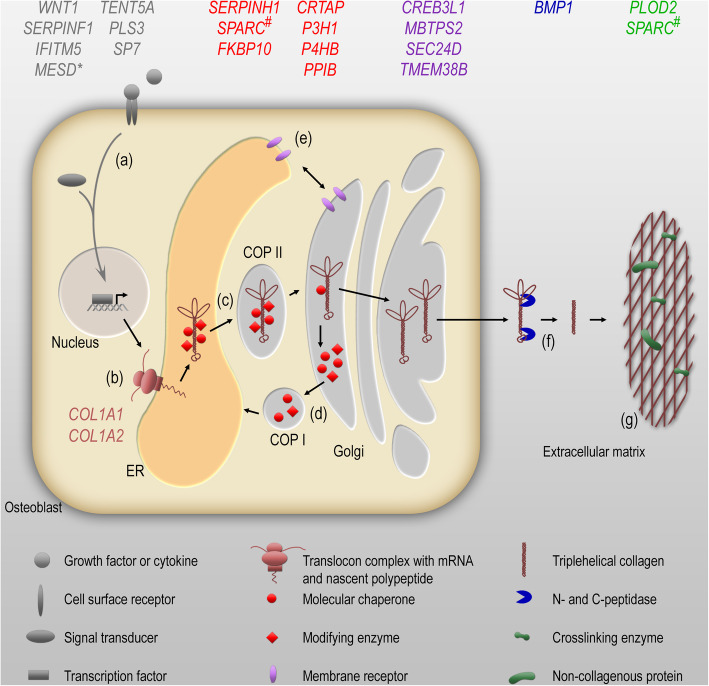
Fig. 1
Fig. 1
OI genes involved in collagen biosynthesis and maintenance of bone homeostasis. Growth factors and cytokine signal through cell surface receptors to initiate an intracellular signal cascade (a). The transduction of the signal results in the nuclear translocation of transcription factors to regulate the expression of genes involved in osteoblast differentiation or function and collagen biosynthesis. Several regulated genes encode proteins that upon secretion influence osteoclast formation and activity (RANKL, osteoprotegerin, sclerostin; not shown). The α1- and α2-chains of collagen type I, the main collagen produced in osteoblasts, are translated into the rough endoplasmic reticulum (ER) (b). Molecular chaperones support the folding of collagen chains enabling hydroxylation of proline and lysine residues by hydroxylases as well as subsequent glycosylation that is indispensable for proper formation of triplehelical collagen (c). The procollagen is secreted by a coat protein complex II (COP II)-mediated vesicular transport through the Golgi network into the extracellular space. Molecular chaperones and modifying enzymes dissociate pH-dependently from procollagen in the Golgi intermediate compartment and circulate COP I-mediated back to the ER (d). Integral proteins in the ER and Golgi membranes, such as ion channels or ER stress sensors, maintain the intracellular homeostasis and in that way preserve the secretory pathway (e). The N- and C-propeptides of the secreted procollagen are cleaved off by extracellular peptidases (f) and the processed, mature collagen molecules form a collagen network that is crosslinked and mineralized. Several collagenous and non-collagenous proteins interact with type I collagen to form the bone extracellular matrix (ECM) (g). Genes, in which mutations have been linked to osteogenesis imperfecta or related diseases, are indicated. These genes are involved in signal transduction and gene expression (grey), translation (brown), post-translational modification (red), ER homeostasis (purple), proteolytic processing (blue) or ECM structure, and mineralization (green). *MESD is an ER-resident chaperone for LRP proteins, co-receptors of the WNT signaling pathway. #SPARC can act as a chaperone in the ER as well as support mineralization of the collagen matrix extracellularly

References

    1. Rehberg M, Etich J, Leßmeier L, Sill H, Netzer C, Semler O. Osteogenesis imperfecta – Pathophysiologie und aktuelle Behandlungsstrategien. Med Genet. 2019;31(4):372–382.
    1. Van Dijk FS, Sillence DO. Osteogenesis imperfecta: clinical diagnosis, nomenclature and severity assessment. Am J Med Genet A. 2014;164A(6):1470–1481. doi: 10.1002/ajmg.a.36545. - DOI - PMC - PubMed
    1. Marini JC, Forlino A, Bachinger HP, Bishop NJ, Byers PH, Paepe A, et al. Osteogenesis imperfecta. Nat Rev Dis Primers. 2017;3:17052. doi: 10.1038/nrdp.2017.52. - DOI - PubMed
    1. Wenstrup RJ, Willing MC, Starman BJ, Byers PH. Distinct biochemical phenotypes predict clinical severity in nonlethal variants of osteogenesis imperfecta. Am J Hum Genet. 1990;46(5):975–982. - PMC - PubMed
    1. Kang H, Aryal ACS, Marini JC. Osteogenesis imperfecta: new genes reveal novel mechanisms in bone dysplasia. Transl Res. 2017;181:27–48. doi: 10.1016/j.trsl.2016.11.005. - DOI - PubMed

LinkOut - more resources
