. 2020 Dec;7(4):775-792.
doi: 10.1007/s40744-020-00226-3. Epub 2020 Aug 14.

Clinical Utility and Cost Savings in Predicting Inadequate Response to Anti-TNF Therapies in Rheumatoid Arthritis

Affiliations

Clinical Utility and Cost Savings in Predicting Inadequate Response to Anti-TNF Therapies in Rheumatoid Arthritis

Martin J Bergman et al. Rheumatol Ther. 2020 Dec.

Abstract

Introduction: The PrismRA® test identifies rheumatoid arthritis (RA) patients who are unlikely to respond to anti-tumor necrosis factor (anti-TNF) therapies. This study evaluated the clinical and financial outcomes of incorporating PrismRA into routine clinical care of RA patients.

Methods: A decision-analytic model was created to evaluate clinical and economic outcomes in the 12-month period following first biologic treatment. Two treatment strategies were compared: (1) observed clinical decision-making based on a 175-patient cohort receiving an anti-TNF therapy as their first biologic after failure of conventional synthetic disease-modifying antirheumatic drugs (csDMARDs) and (2) modeled clinical decision-making of the same population using PrismRA results to inform first-line biologic treatment choice. Modeled costs include biologic drug pharmacy, non-biologic pharmacy, and total medical costs. The odds of inadequate response to anti-TNF therapies and various components of patient care were calculated based on PrismRA results.

Results: Identifying predicted inadequate responders to anti-TNF therapies resulted in a modeled 38% increase in ACR50 response to first-line biologic therapies. The fraction of patients who achieved an ACR50 response to any therapy (TNFi and others) within the 12-month period was 33% higher in the PrismRA-stratified population than in the unstratified population (59 vs. 44%, respectively). When therapy prescriptions were modeled according to PrismRA results, cost savings were modeled for all financial variables: overall costs (4% decreased total, 19% decreased on ineffective treatments), total biologic drug pharmacy (4% total, 23% ineffective), non-biologic pharmacy (2% total, 19% ineffective), and medical costs (6% total, 19% ineffective). Female sex was the clinical metric that showed the greatest association with inadequate response to anti-TNF therapies (odds ratio 2.42, 95% confidence interval 1.20, 4.88).

Conclusions: If PrismRA is implemented into routine clinical care as modeled, predicting which RA patients will have an inadequate response to anti-TNF therapies could save > $7 million in overall ineffective healthcare costs per 1000 patients tested and increase targeted DMARD response rates in RA.

Keywords: Anti-TNF therapies; Budget impact; Clinical utility; Precision medicine; Rheumatoid arthritis.


Conflict of interest statement

Lixia Zhang, Anna Jeter, and Johanna B. Withers are all full-time employees of and have stock ownership in Scipher Medicine Corporation. Martin J. Bergman is a shareholder of Johnson & Johnson; has received fees as a consultant from AbbVie, Amgen, AstraZeneca, BMS, Genentech/Roche, Gilead, Janssen, Merck, Novartis, Pfizer, Regeneron, Sandoz, Sanofi; and has served as a speaker for AbbVie, Amgen, AstraZeneca, Gilead, Novartis, Regeneron, Sanofi. Alan J. Kivitz is a shareholder of Amgen, Gilead Sciences, Inc., GlaxoSmithKline, Novartis, Pfizer and Sanofi; has received fees as a consultant from AbbVie, Boehringer Ingelheim, Flexion, Gilead Sciences, Inc., Janssen, Pfizer, Regeneron, Sanofi and SUN Pharma Advanced Research; and has served as a speaker for AbbVie, Celgene, Flexion, Genzyme, Horizon, Merck, Novartis, Pfizer, Regeneron, Sanofi, and UCB. Dimitrios A. Pappas and Joel M. Kremer are employees and shareholders of CORRONA, LLC. Martin Scipher Medicine and PrismRA are trademarks of Scipher Medicine Corporation. The PrismRA predictive model is proprietary to Scipher Medicine Corporation.

Figures

Fig. 1
Fig. 1
PrismRA result. Biologic-naïve RA patients are stratified by PrismRA results: < 9.4 means a signal of inadequate response to TNF inhibitors is absent, at or above 9.4 is a moderate signal of inadequate response associated with ≥ 85% likelihood of inadequate response, ≥ 11.5 is a high signal of inadequate response associated with ≥ 90% likelihood of inadequate response, and ≥ 16.6 is a very high signal of inadequate response associated with ≥ 95% likelihood of inadequate response. In the decision-analytic model in this study, patients with ≥ 90% likelihood of inadequate response to anti-TNF therapies (PrismRA result ≥ 11.8) were defined as predicted inadequate responders
Fig. 2
Fig. 2
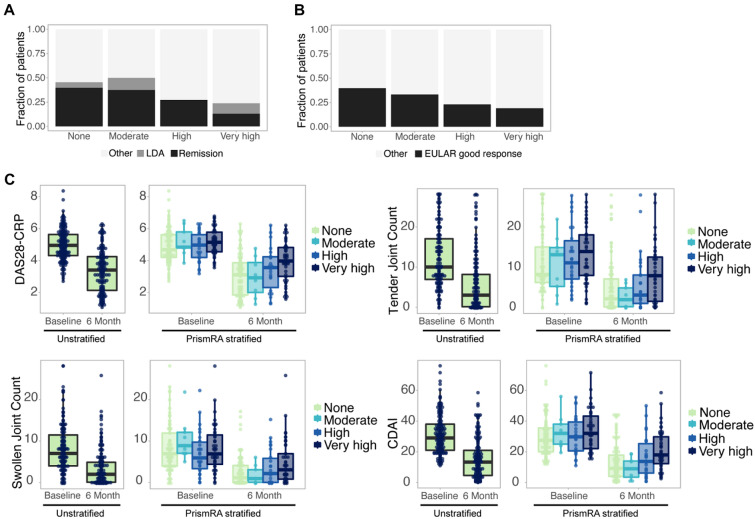
Predicted inadequate responders are less likely to achieve LDA or remission. a Patients were stratified according to their PrismRA scores (none, low, moderate, and high signals of inadequate response to TNF inhibitors). a The fraction of patients in each group that achieved LDA or remission was determined using DAS28-CRP (LDA = 2.4–2.9; remission ≤ 2.4). b Predicted inadequate responders had a lower likelihood of achieving a EULAR good response (improvement > 1.2 in DAS28-CRP and a final DAS28-CRP ≤ 2.4). c DAS28-CRP, tender 28-joint counts, swollen 28-joint counts and CDAI scores at baseline and 6 months of anti-TNF therapy in the unstratified and PrismRA stratified patient populations. Box plots indicate the interquartile range, median, 95% confidence interval, and outliers
Fig. 3
Fig. 3
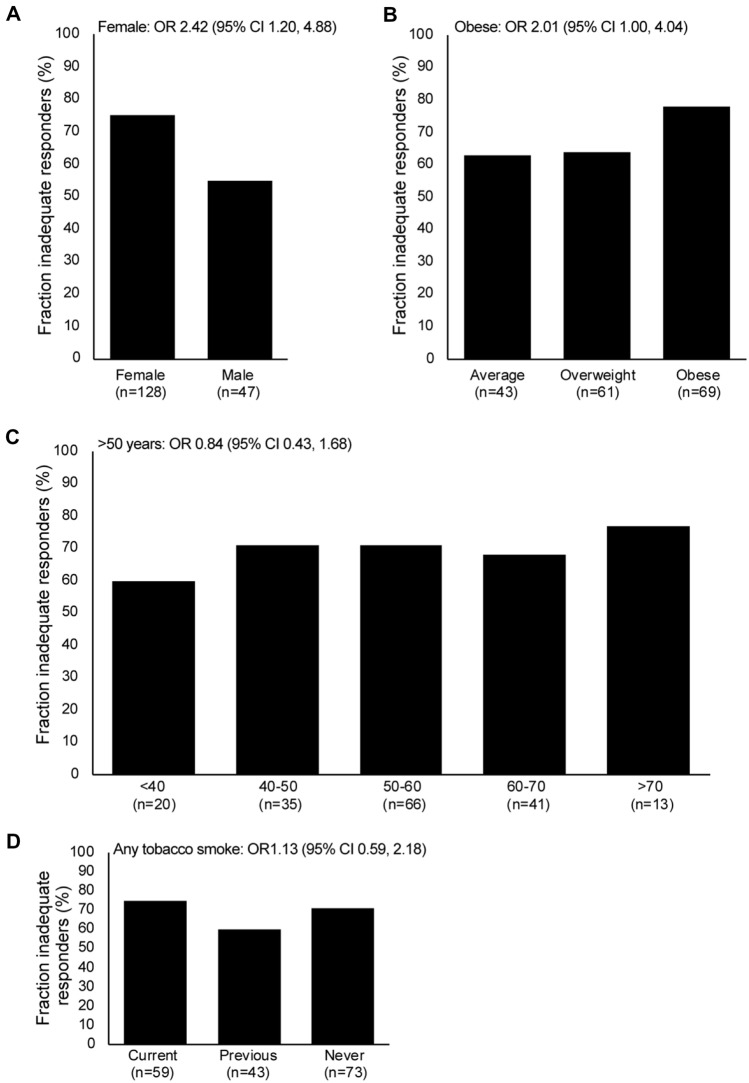
The percentage of inadequate anti-TNF therapy responders in relation to clinical metrics. For each clinical metric, the percentage of patients who inadequately respond to anti-TNF therapies (ACR50 criteria) is indicated at 6 months. The number of patients assessed in each category is reported below the category label. Clinical metrics evaluated include a sex, b BMI, c age, and d active tobacco smoking history. The OR and CI for female sex, obese BMI (≥ 30 kg/m2), age under 50 years old, and tobacco smoke exposure (current and previous) are indicated
Fig. 4
Fig. 4
Decision-analytic model comparing two treatment strategies within a 12-month period from the start of the first biologic therapy. A decision-analytic model compared two treatment strategies within a 12-month period from the start of the first biologic therapy. The strategies are a observed clinical decision-making based on a 175-patient biologic-naïve RA patient cohort receiving an anti-TNF therapy as the first biologic after failure of csDMARDs and b a clinical decision-making model of the same population using PrismRA prediction of inadequate response to anti-TNF therapies to stratify the first-line biologic. ACR50 responses were modeled at 6 and 12 months post-therapy initiation. Inadequate response is defined as a failure to achieve an ACR50 response. The percentages of the patients directed through each arm of the modeled strategy are indicated. The second targeted therapy was modeled as 60% to a second anti-TNF therapy and 40% to an alternative MOA (a biologic or targeted therapy other than a TNF inhibitor)
Fig. 5
Fig. 5
Decision-analytic model estimated reduction in ineffective treatment costs within a 12-month period. The cost of non-biologic pharmacy (orange), total medical cost (green), and biologic drug pharmacy (blue) is shown for the RA patient populations modeled by the two treatment strategies of the decision-analytic model. Ineffective treatment costs are indicated by the hashed pattern in the same color for each category. Data for a the entire 175-patient cohort and b the Medicare-eligible patient subcohort (≥ 65 years old) are shown

References

    1. Emery P, Horton S, Dumitru RB, et al. Pragmatic randomised controlled trial of very early etanercept and MTX versus MTX with delayed etanercept in RA: the VEDERA trial. Ann Rheum Dis. 2020;79:464–471. doi: 10.1136/annrheumdis-2019-216539. - DOI - PMC - PubMed
    1. Bijlsma JWJ, Welsing PMJ, Woodworth TG, et al. Early rheumatoid arthritis treated with tocilizumab, methotrexate, or their combination (U-Act-Early): a multicentre, randomised, double-blind, double-dummy, strategy trial. Lancet. 2016;388(10042):343–355. doi: 10.1016/S0140-6736(16)30363-4. - DOI - PubMed
    1. Jin Y, Desai RJ, Liu J, et al. Factors associated with initial or subsequent choice of biologic disease-modifying antirheumatic drugs for treatment of rheumatoid arthritis. Arthritis Res Ther. 2017;19(1):159. doi: 10.1186/s13075-017-1366-1. - DOI - PMC - PubMed
    1. Curtis JR, Zhang J, Xie F, et al. Use of oral and subcutaneous methotrexate in rheumatoid arthritis patients in the United States. Arthritis Care Res (Hoboken) 2014;66(11):1604–1611. doi: 10.1002/acr.22383. - DOI - PubMed
    1. Rein P, Mueller RB. Treatment with biologicals in rheumatoid arthritis: an overview. Rheumatol Ther. 2017;4(2):247–261. doi: 10.1007/s40744-017-0073-3. - DOI - PMC - PubMed

LinkOut - more resources