Case Reports
. 2020 Nov;52(9):2620-2625.
doi: 10.1016/j.transproceed.2020.07.009. Epub 2020 Jul 16.

Telemedicine in the Care of Kidney Transplant Recipients With Coronavirus Disease 2019: Case Reports

Affiliations
Case Reports

Telemedicine in the Care of Kidney Transplant Recipients With Coronavirus Disease 2019: Case Reports

Mohammad Abuzeineh et al. Transplant Proc. 2020 Nov.

Abstract

Kidney transplant recipients who develop symptoms consistent with coronavirus disease 2019 (COVID-19) are bringing unique challenges to health care professionals. Telemedicine has surged dramatically since the pandemic in effort to maintain patient care and reduce the risk of COVID-19 exposure to patients, health care workers, and the public. Herein we present reports of 3 kidney transplant recipients with COVID-19 who were managed using telemedicine via synchronous video visits integrated with an electronic medical record system, from home to inpatient settings. We demonstrate how telemedicine helped assess, diagnose, triage, and treat patients with COVID-19 while avoiding a visit to an emergency department or outpatient clinic. While there is limited information about the duration of viral shedding for immunosuppressed patients, our findings underscore the importance of using telemedicine in the follow-up care for kidney transplant recipients with COVID-19 who have recovered from symptoms but might have persistently positive nucleic acid tests. Our experience emphasizes the opportunities of telemedicine in the management of kidney transplant recipients with COVID-19 and in the maintenance of uninterrupted follow-up care for such immunosuppressed patients with prolonged viral shedding. Telemedicine may help increase access to care for kidney transplant recipients during and beyond the pandemic as it offers a prompt, safe, and convenient platform in the delivery of care for these patients. Yet, to advance the practice of telemedicine in the field of kidney transplantation, barriers to increasing the widespread implementation of telemedicine should be removed, and research studies are needed to assess the effectiveness of telemedicine in the care of kidney transplant recipients.


Figures

Fig 1
Fig 1
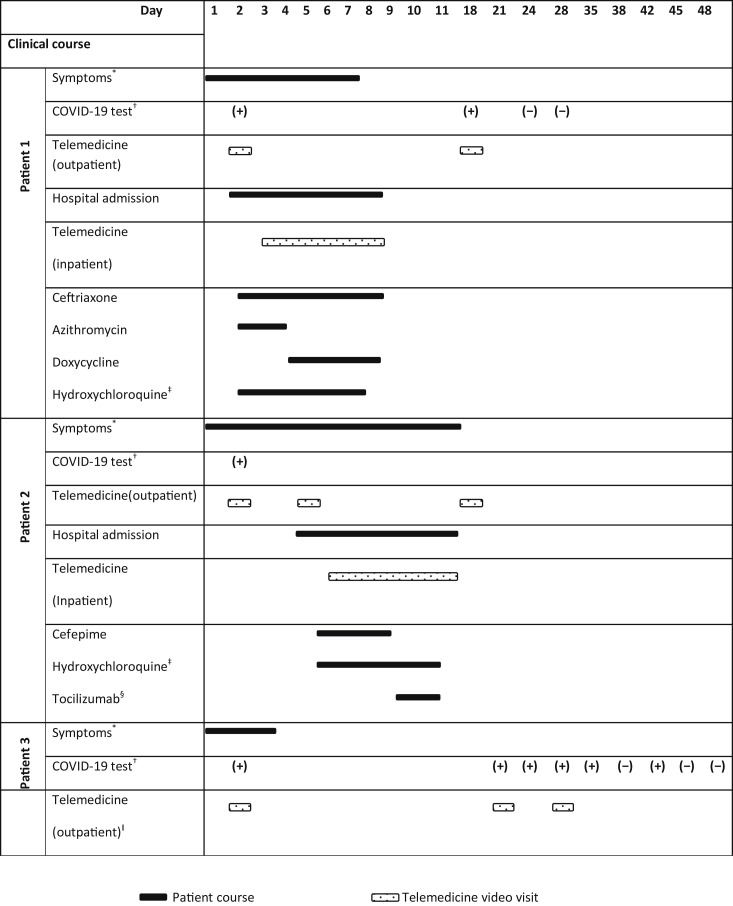
Summary of the clinical course of the 3 kidney transplant patients with coronavirus disease 2019 (COVID-19) who were managed via telemedicine. ∗Patient 1 had low-grade fever, dry cough, chills, nausea and vomiting, watery diarrhea, and loss of the sense of smell. During hospitalization, patient developed shortness of breath and hypoxia. Patient 2 had dry cough, chest tightness, and rhinorrhea, and subsequently developed high-grade fever and diarrhea. During hospitalization, patient developed shortness of breath and hypoxia. Patient 3 had mild headache, rhinorrhea, and fatigue; symptoms were improving gradually without specific treatment. Naso-oropharyngeal swab, nucleic acid test (NAT) was used to detect COVID-19 RNA by polymerase chain reaction (PCR): (+) COVID-19 RNA detected, (−) COVID-19 RNA not detected. Hydroxychloroquine 400 mg twice daily for the first day, then 400 mg once daily for days 2, 3, 4, and 5. §Tocilizumab 4 mg/kg per dose once daily for a total of 2 doses. ǁPatient was also followed by a transplant coordinator via telephone calls twice weekly.
Fig 2
Fig 2
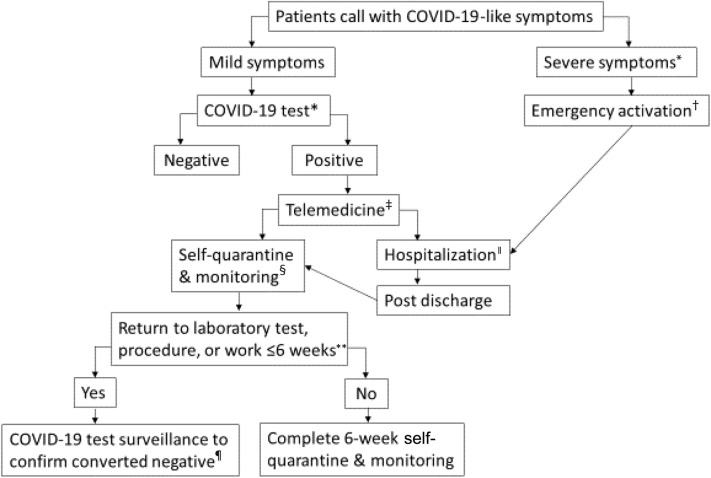
Practical workflow process for coronavirus disease 2019 (COVID-19) test and surveillance. ∗COVID-19 Test: Naso-oropharyngeal swab, nucleic acid test (NAT) to detect COVID-19 RNA by polymerase chain reaction (PCR), in a designated drive-through area. Severe symptoms: Severe shortness of breath, hypoxia, hypotension, acute chest pain, or confusion. To call 911 for a transfer to hospital emergency department. Telemedicine via a synchronous video visit for clinical assessment and management. ǁHospitalization through an emergency department admission or an arranged direct admission to COVID-19 inpatient unit. §To self-quarantine per Centers for Disease Control and Prevention (CDC) guidelines and to keep home log of vital signs twice daily in the first 2 weeks. Patients are instructed to seek immediate medical attention if symptoms worsening. To be followed-up by a transplant coordinator via telephone calls twice weekly and transplant nephrologist via telemedicine video visits close to two-week post COVID-19 diagnosis and thereafter as clinically determined. ∗∗Patient needs to return to laboratory test, procedure, or work that cannot be performed remotely and that will occur within 6 weeks of symptom onset. Decisions regarding the duration of self-quarantine are subject to change in consultation with infectious disease experts. To repeat COVID-19 NAT at 2 weeks post–COVID-19 diagnosis twice weekly until it is converted negative on 2 consecutive occasions before returning to laboratory test, procedure, or work.

References

    1. UNOS COVID-19 and solid organ transplant. https://unos.org/covid/ [accessed 12.04.20]
    1. Michaels M.G., La Hoz R.M., Danziger-Isakov L., Blumberg E.A., Kumar D., Green M. Coronavirus disease 2019: implications of emerging infections for transplantation. Am J Transplant. 2020;20:1768–1772. - PMC - PubMed
    1. Centers for Disease Control and Prevention Coronavirus disease 2019 (COVID-19): cases in U.S. Atlanta, GA: US Department of Health and Human Services. https://www.cdc.gov/coronavirus/2019-ncov/cases-updates/cases-in-us.html [accessed 03.08.20]

    1. Ning L., Liu L., Li W., Liu H., Wang J., Yao Z. Novel coronavirus (SARS-CoV-2) infection in a renal transplant recipient: case report. Am J Transplant. 2020;20:1864–1868. - PMC - PubMed
    1. Zhu L., Xu X., Ma K., Yang J., Guan H., Chen S. Successful recovery of COVID-19 pneumonia in a renal transplant recipient with long-term immunosuppression. Am J Transplant. 2020;20:1859–1863. - PMC - PubMed

Publication types

MeSH terms