. 2020 Nov 1;15(11):1805903.
doi: 10.1080/15592324.2020.1805903. Epub 2020 Aug 15.

Functional characterization of a starch synthesis-related gene AmAGP in Amorphophallus muelleri

Affiliations

Functional characterization of a starch synthesis-related gene AmAGP in Amorphophallus muelleri

Hong-Di Shi et al. Plant Signal Behav. .

Abstract

has attracted tremendous interest because of its high contents of glucomannan and starch. Very few genes regulating glucomannan and starch were reported in Amorphophallus. In this study, an ADP-glucose pyrophosphorylase (AGP) gene that plays a significant role in plant starch synthesis was cloned from Amorphophallus muelleri. It was shown that it encoded a predicted protein containing a conserved plant ADP-Glucose-PP repeat domain and seven potential ligand-binding sites. The real-time quantitative PCR showed that AmAGP was most abundant in tubers, and it was positively correlated with starch content. Additionally, its influencers about temperature and exogenous plant hormone were also discussed, showing that AmAGP expressed highly in tubers under treatments using 25°C and IAA. Furthermore, starch content was closely related to AmAGP expression level, suggesting that AmAGP was involved in the regulation of starch synthesis in A. muelleri. Therefore, identifying the sequence of AmAGP and its expression pattern during tuber enlarging and the changes of its transcript levels in response to temperature and plant hormones would contribute to a better understanding of starch synthesis, and also providing a reference information for future preferable breeding for obtaining more starch or more glucomannan in Amorphophallus.

Keywords: Amorphophallus muelleri; ADP-glucose pyrophosphorylase; plant hormone; starch; temperature.


Figures
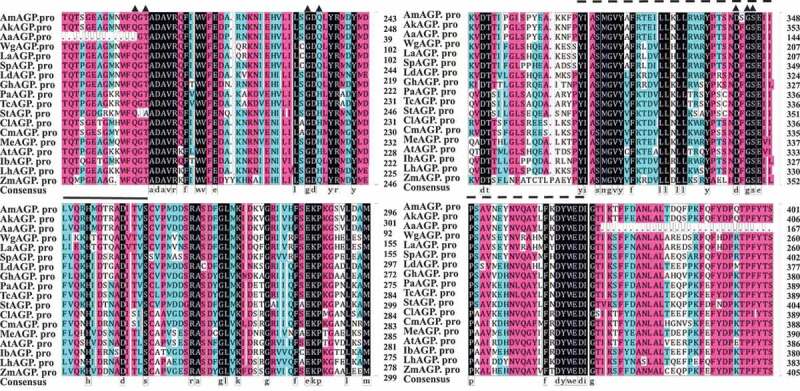
Figure 1.
Figure 1.
Sequence analysis of the predicted AmAGP protein and comparison of its sequence with other AGP protein sequences. Ak, Amorphophallus konjac (JF727266.1); Aa, Amorphophallus albus (AF316326.1); Wg, Wolffia globosa (KR263899.1); La, Lemna aequinoctialis (KR263896.1); Sp, Spirodela polyrhiza (JN180633.1); Ld, Lilium davidii var. unicolor (AJG44462.1); Gh, Gladiolus hybrid cultivar (AIO11223.1); Pa, Populus alba (TKS10148.1); Tc, Theobroma cacao (EOY14815.1); St, Solanum tuberosum (CAA52917.1); Cl, Citrullus lanatus (AF032472.1); Cm, Cucumis melo (NM_001297522.2); Me, Manihot esculenta (KU243122.1); At, Arabidopsis thaliana (AY096657.1); Ib, Ipomoea batatas (JQ797692.1); Lh, Lycopersicon hirsutum (AF184345.1); and Zm, Zea mays (CAA 86227.1). Two ADP-Glucose-PP repeat domains are highlighted with solid and dashed lines, respectively. The potential ligand-binding sites are highlighted with triangle
Figure 2.
Figure 2.
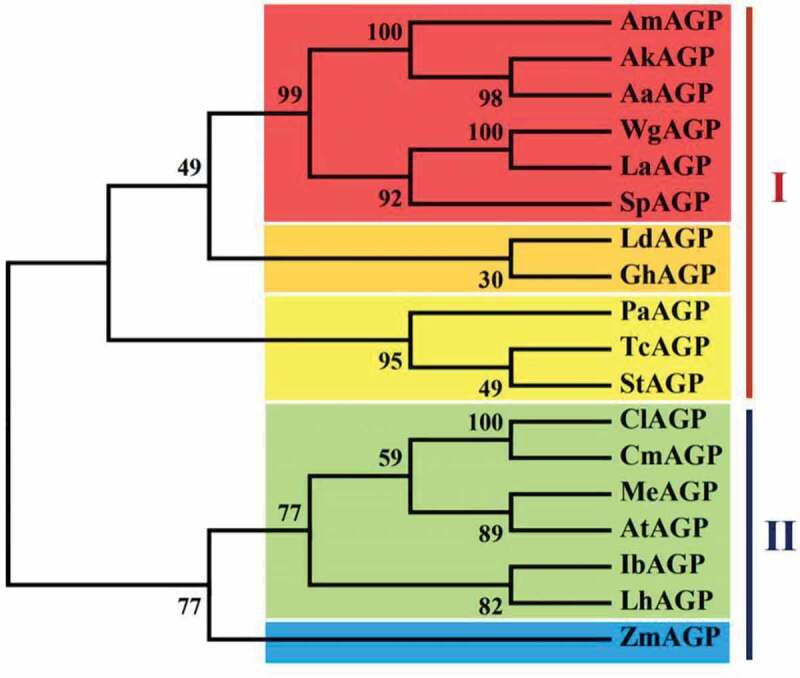
Phylogenetic analysis of the AmAGP protein and other homologous proteins, including Ak, Amorphophallus konjac (JF727266.1); Aa, Amorphophallus albus (AF316326.1); Wg, Wolffia globosa (KR263899.1); La, Lemna aequinoctialis (KR263896.1); Sp, Spirodela polyrhiza (JN180633.1); Ld, Lilium davidii var. unicolor (AJG44462.1); Gh, Gladiolus hybrid cultivar (AIO11223.1); Pa, Populus alba (TKS10148.1); Tc, Theobroma cacao (EOY14815.1); St, Solanum tuberosum (CAA52917.1); Cl, Citrullus lanatus (AF032472.1); Cm, Cucumis melo (NM_001297522.2); Me, Manihot esculenta (KU243122.1); At, Arabidopsis thaliana (AY096657.1); Ib, Ipomoea batatas (JQ797692.1); Lh, Lycopersicon hirsutum (AF184345.1); and Zm, Zea mays (CAA 86227.1). Multiple sequence alignment of AGP proteins was performed using ClustalX2 with default parameters. The unrooted phylogenetic tree was constructed in MEGA 6 with the neighbor-joining (NJ) method and 1000 bootstrap replicates
Figure 3.
Figure 3.
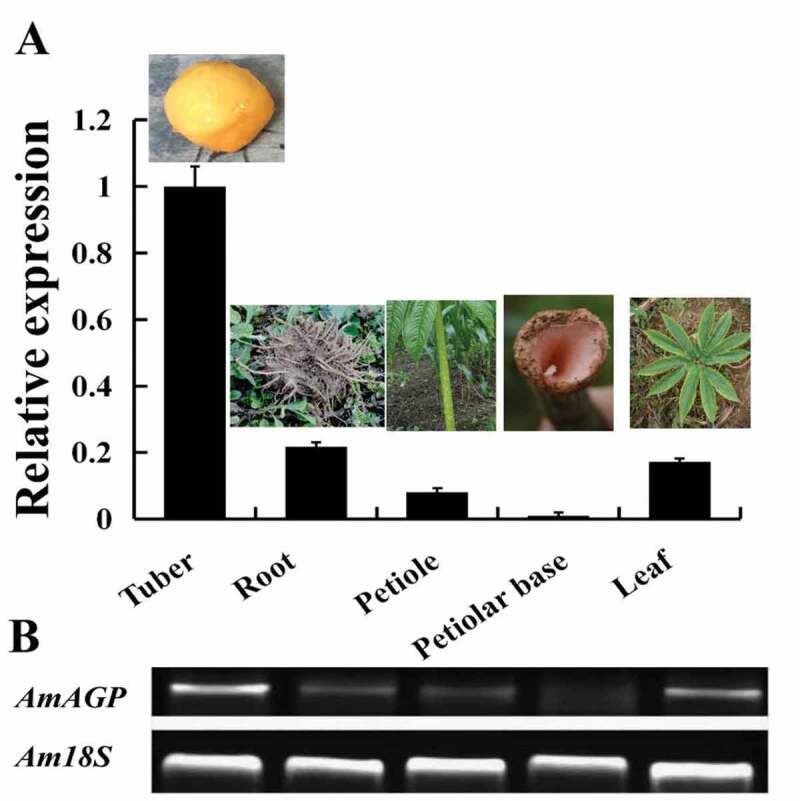
qRT-PCR (a) and sqRT-PCR (b) analysis of AmAGP in different tissues. Am18S was used as a loading reference
Figure 4.
Figure 4.
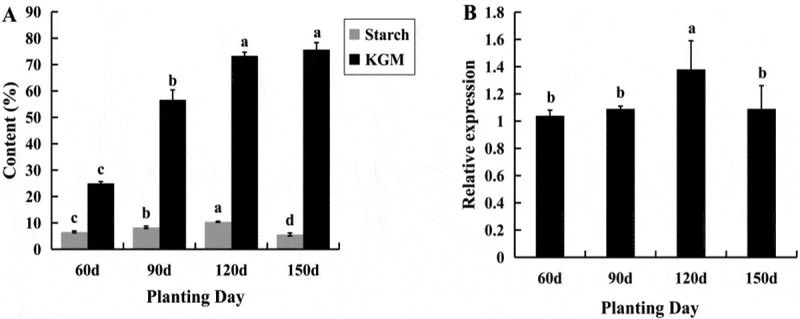
Starch and glucomannan content (a) and AmAGP transcript level (b) during tuber expansion in A. muelleri. For a given substance, values that share a letter do not differ significantly (P < .05, N = 3 biological replicates). Error bars represent standard errors
Figure 5.
Figure 5.
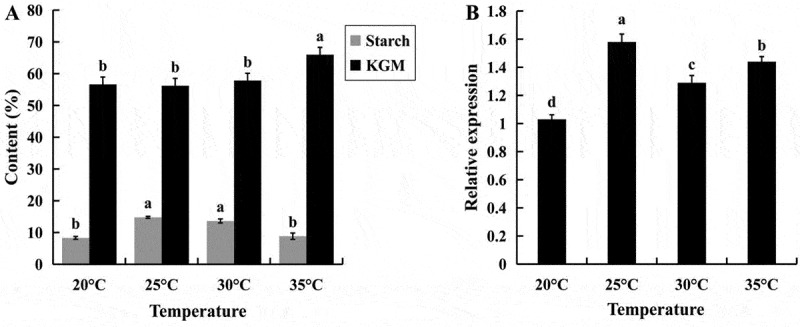
Analysis of starch and glucomannan content (a) and AmAGP transcript levels (b) in 90 DAP tubers under different temperature treatments. Values that share a letter do not differ significantly (P < .05, N = 3 biological replicates). Error bars represent standard errors
Figure 6.
Figure 6.
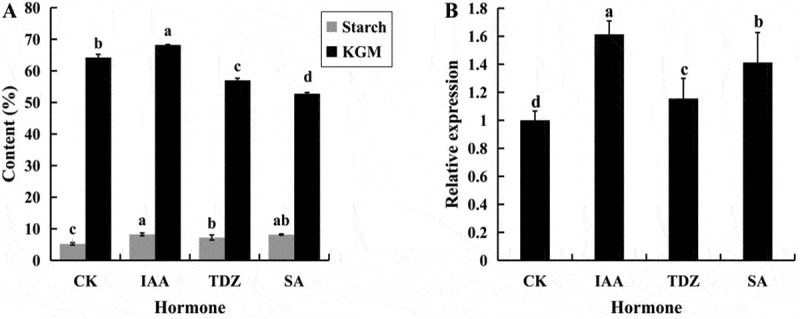
Analysis of starch and glucomannan content (a) and AmAGP transcript levels (b) in 90 DAP tubers under different hormone treatments. Tubers sprayed with water were used as controls. Values that share a letter do not differ significantly (P < .05, N = 3 biological replicates). Error bars represent standard errors

References

    1. Liu PY. Konjac. 1st ed. Beijing (China): China Agriculture Press; 2004. p. 1–8.
    1. Zhang DH, Zhao JR, Zhou F, Wang QP.. Promising kind of konjac, Amorphophallus Bulbifer with great potentiality from the areas between China and Burma. Resour Dev Market. 2005;21:136–138.
    1. Zhai K, Qin HB, Hong Y.. Study on physico–chemical properties of konjac starch. Food Sci. 2008;29:59–61.
    1. Behera SS, Ray RC.. Konjac glucomannan, a promising polysaccharide of Amorphophallus konjac K. Koch in health care. Int J Biol Macromol. 2016;92:942–956. doi:10.1016/j.ijbiomac.2016.07.098. - DOI - PubMed
    1. Goren A, Ashlock D, Tetlow IJ. Starch formation inside plastids of higher plants. Protoplasma. 2018;255(6):1855–1876. doi:10.1007/s00709-018-1259-4. - DOI - PubMed

Publication types

MeSH terms

Substances