


Prevalence and distribution of schistosomiasis in human, livestock, and snail populations in northern Senegal: a One Health epidemiological study of a multi-host system
- PMID: 32800151
- PMCID: PMC7443702
- DOI: 10.1016/S2542-5196(20)30129-7
Prevalence and distribution of schistosomiasis in human, livestock, and snail populations in northern Senegal: a One Health epidemiological study of a multi-host system
Abstract
Background: Schistosomiasis is a neglected tropical disease of global medical and veterinary importance. As efforts to eliminate schistosomiasis as a public health problem and interrupt transmission gather momentum, the potential zoonotic risk posed by livestock Schistosoma species via viable hybridisation in sub-Saharan Africa have been largely overlooked. We aimed to investigate the prevalence, distribution, and multi-host, multiparasite transmission cycle of Haematobium group schistosomiasis in Senegal, West Africa.
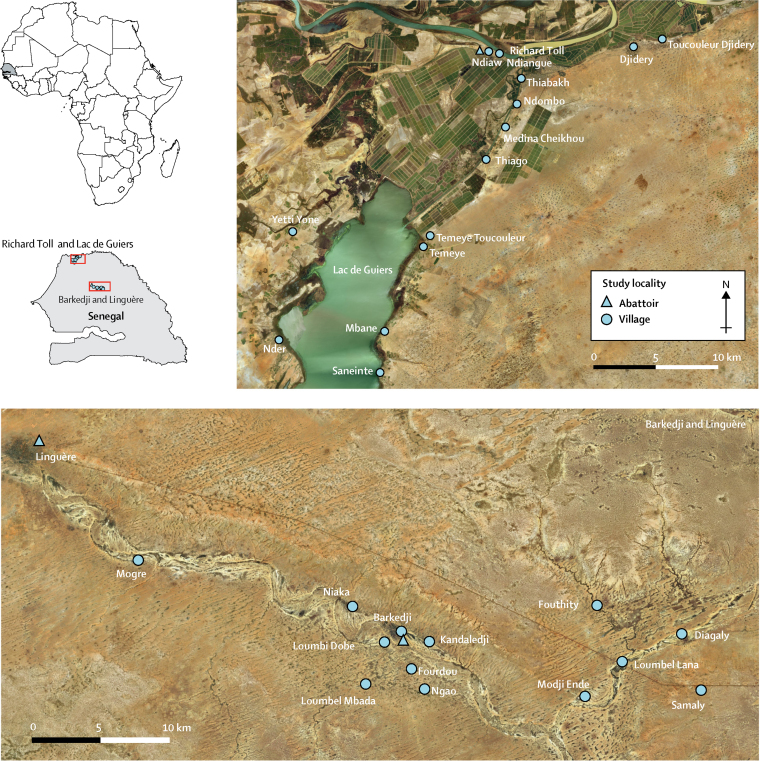
Methods: In this epidemiological study, we carried out systematic surveys in definitive hosts (humans, cattle, sheep, and goats) and snail intermediate hosts, in 2016-18, in two areas of Northern Senegal: Richard Toll and Lac de Guiers, where transmission is perennial; and Barkedji and Linguère, where transmission is seasonal. The occurrence and distribution of Schistosoma species and hybrids were assessed by molecular analyses of parasitological specimens obtained from the different hosts. Children in the study villages aged 5-17 years and enrolled in school were selected from school registers. Adults (aged 18-78 years) were self-selecting volunteers. Livestock from the study villages in both areas were also randomly sampled, as were post-mortem samples from local abattoirs. Additionally, five malacological surveys of snail intermediate hosts were carried out at each site in open water sources used by the communities and their animals.
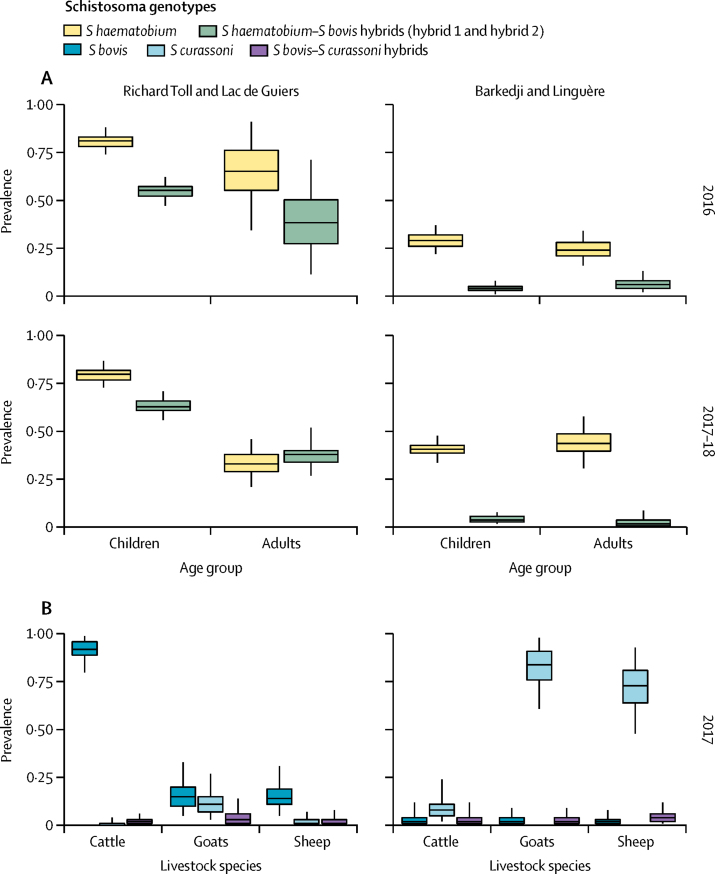
Findings: In May to August, 2016, we surveyed 375 children and 20 adults from Richard Toll and Lac de Guiers, and 201 children and 107 adults from Barkedji and Linguère; in October, 2017, to January, 2018, we surveyed 386 children and 88 adults from Richard Toll and Lac de Guiers, and 323 children and 85 adults from Barkedji and Linguère. In Richard Toll and Lac de Guiers the prevalence of urogenital schistosomiasis in children was estimated to be 87% (95% CI 80-95) in 2016 and 88% (82-95) in 2017-18. An estimated 63% (in 2016) and 72% (in 2017-18) of infected children were shedding Schistosoma haematobium-Schistosoma bovis hybrids. In adults in Richard Toll and Lac de Guiers, the prevalence of urogenital schistosomiasis was estimated to be 79% (52-97) in 2016 and 41% (30-54) in 2017-18, with 88% of infected samples containing S haematobium-S bovis hybrids. In Barkedji and Linguère the prevalence of urogenital schistosomiasis in children was estimated to be 30% (23-38) in 2016 and 42% (35-49) in 2017-18, with the proportion of infected children found to be shedding S haematobium-S bovis hybrid miracidia much lower than in Richard Toll and Lac de Guiers (11% in 2016 and 9% in 2017-18). In adults in Barkedji and Linguère, the prevalence of urogenital schistosomiasis was estimated to be 26% (17-36) in 2016 and 47% (34-60) in 2017-18, with 10% of infected samples containing S haematobium-S bovis hybrids. The prevalence of S bovis in the sympatric cattle population of Richard Toll and the Lac de Guiers was 92% (80-99), with S bovis also found in sheep (estimated prevalence 14% [5-31]) and goats (15% [5-33]). In Barkedji and Linguère the main schistosome species in livestock was Schistosoma curassoni, with an estimated prevalence of 73% (48-93) in sheep, 84% (61-98) in goats and 8% (2-24) in cattle. S haematobium-S bovis hybrids were not found in livestock. In Richard Toll and Lac de Guiers 35% of infected Bulinus spp snail intermediate hosts were found to be shedding S haematobium-S bovis hybrids (68% shedding S haematobium; 17% shedding S bovis); however, no snails were found to be shedding S haematobium hybrids in Barkedji and Linguère (29% shedding S haematobium; 71% shedding S curassoni).
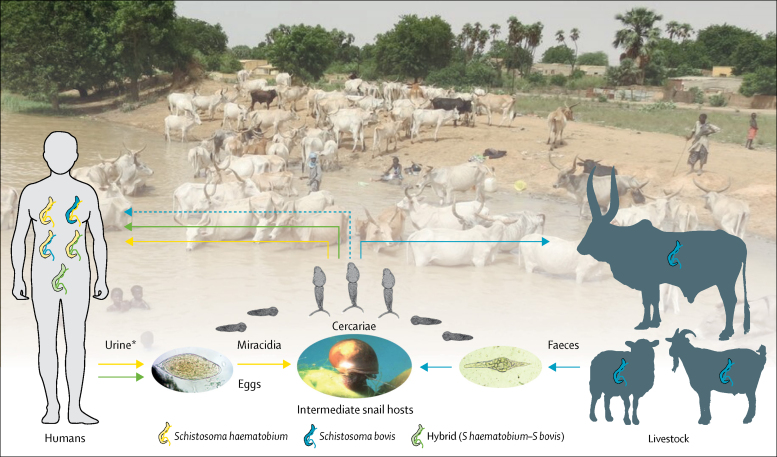
Interpretation: Our findings suggest that hybrids originate in humans via zoonotic spillover from livestock populations, where schistosomiasis is co-endemic. Introgressive hybridisation, evolving host ranges, and wider ecosystem contexts could affect the transmission dynamics of schistosomiasis and other pathogens, demonstrating the need to consider control measures within a One Health framework.
Funding: Zoonoses and Emerging Livestock Systems programme (UK Biotechnology and Biological Sciences Research Council, UK Department for International Development, UK Economic and Social Research Council, UK Medical Research Council, UK Natural Environment Research Council, and UK Defence Science and Technology Laboratory).
Copyright © 2020 The Author(s). Published by Elsevier Ltd. This is an Open Access article under the CC BY 4.0 license. Published by Elsevier Ltd.. All rights reserved.
Figures
References
Publication types
MeSH terms
Grants and funding
LinkOut - more resources
Full Text Sources
Research Materials
Miscellaneous
