


Restrictive versus liberal transfusion strategy in upper gastrointestinal bleeding: A randomized controlled trial
- PMID: 32801255
- PMCID: PMC8083250
- DOI: 10.4103/sjg.SJG_152_20
Restrictive versus liberal transfusion strategy in upper gastrointestinal bleeding: A randomized controlled trial
Abstract
Background: The study aimed at comparing restrictive and liberal transfusion strategy in reducing mortality in patients with upper gastrointestinal bleeding (UGIB).
Methods: This was a single-center, prospective, open-label, non-inferiority, randomized controlled trial conducted over two years. Patients presenting with UGIB were randomized into restrictive (hemoglobin (Hb) <7 g/dl) or liberal (Hb <8 g/dl) transfusion strategy groups. Transfusion was given till patients achieved target Hb of 9 g/dl in restrictive and 10 g/dl in the liberal arms. Patients with exsanguinating bleeding, transfusion within 90 days, recent history of trauma or surgery were excluded. Primary outcome was mortality rate and the secondary outcomes were morbidity, re-bleeding episodes and the need for intervention.
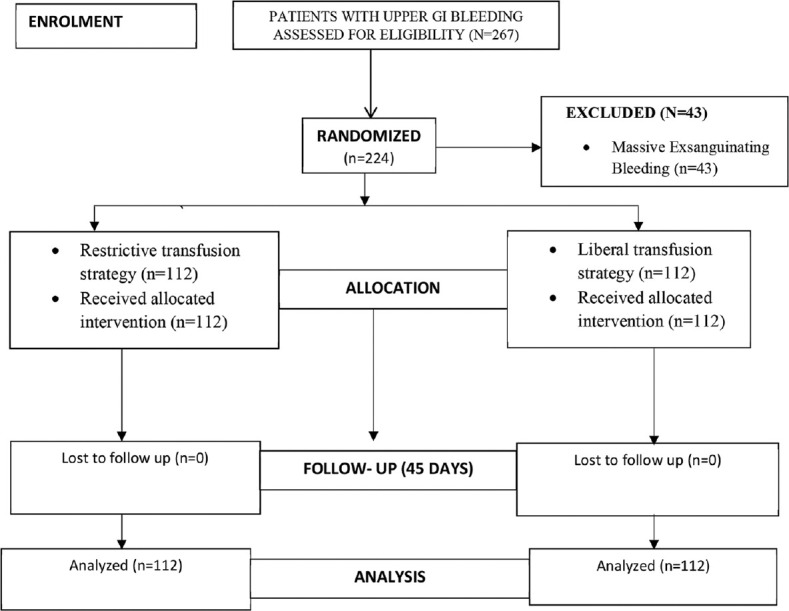
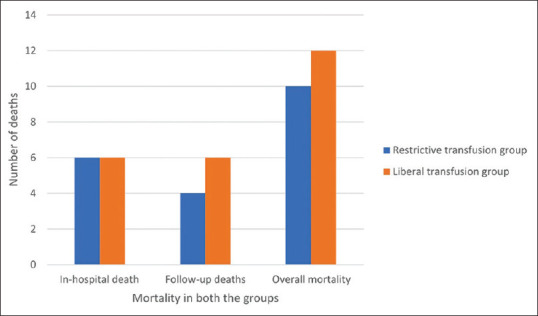
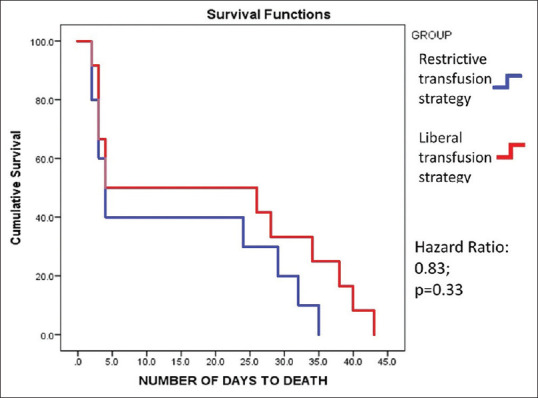
Results: A total of 224 patients were randomized to 112 patients in each group. Demographic characteristics were comparable. 45-day mortality was similar between the two groups (restrictive vs. liberal; 10/112 vs. 12/112; P = 0.65). The number of in-hospital bleeding episodes (12 vs. 9; P = 0.25), incidence of re-bleeding during the 45-day follow-up (13 vs. 14; P = 0.84), need for endoscopic banding for varices (37/112 vs. 39/112, P = 0.99), mean hospital stay (days) (3.21 ± 2.78 vs. 2.73 ± 1.29; P = 0.10) were similar between the two groups.
Conclusion: Restrictive transfusion strategy is non-inferior to liberal transfusion strategy in patients with UGIB.
Keywords: Liberal transfusion; restrictive transfusion; upper gastrointestinal bleeding.
Conflict of interest statement
None
Figures
Comment in
-
Improving outcomes in patients with acute upper gastrointestinal bleeding.Saudi J Gastroenterol. 2021 Jan-Feb;27(1):1-2. doi: 10.4103/sjg.sjg_552_20. Saudi J Gastroenterol. 2021. PMID: 33642349 Free PMC article. No abstract available.
References
-
- Gralnek IM, Barkun AN, Bardou M. Management of acute bleeding from a peptic ulcer. N Engl J Med. 2008;359:928–37. - PubMed
-
- Anand CS, Tandon BN, Nundy S. The causes, management and outcome of upper gastrointestinal haemorrhage in an Indian hospital. Br J Surg. 1983;70:209–11. - PubMed
-
- Singh SP, Panigrahi Mk. Spectrum of upper gastrointestinal hemorrhage in coastal Odisha. Trop Gastroenterol. 2013;34:14–7. - PubMed
-
- Simon EG, Chacko A, Dutta AK, Joseph AJ, George B. Acute nonvariceal upper gastrointestinal bleeding—experience of a tertiary care center in southern India. Indian J Gastroenterol. 2013;32:236–41. - PubMed
-
- Castañeda B. Effects of blood volume restitution following a portal hypertensive-related bleeding in anesthetized cirrhotic rats. Hepatology. 2001;33:821–5. - PubMed
Publication types
MeSH terms
Substances
LinkOut - more resources
Full Text Sources
Medical