


Threshold Size of Medical Tablets and Capsules: Based on Information Collected by Japanese Medical Wholesaler
- PMID: 32801655
- PMCID: PMC7398871
- DOI: 10.2147/PPA.S253663
Threshold Size of Medical Tablets and Capsules: Based on Information Collected by Japanese Medical Wholesaler
Abstract
Background: Medical tablets and capsules are superior with regard to portability and are the most common dosage form in Japan. However, their large size often results in difficulties during ingestion, sometimes leading to reduced medication adherence.
Objective: The authors used postmarketing surveillance data to determine the threshold size of medical tablets and capsules that patients feel are too large to ingest.
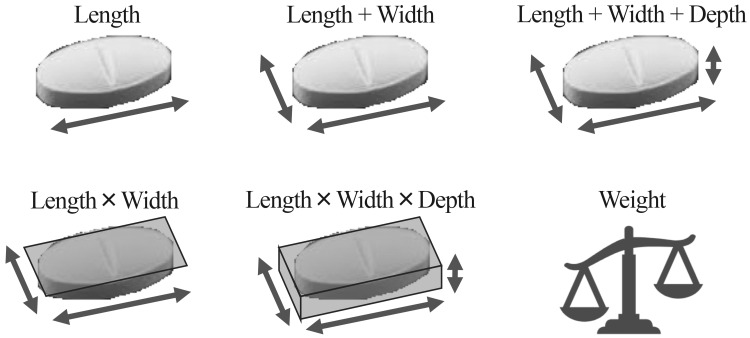
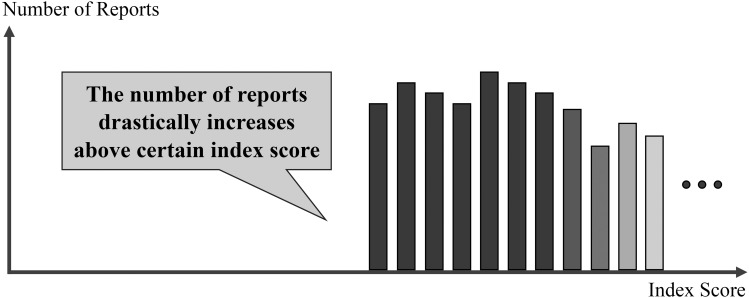
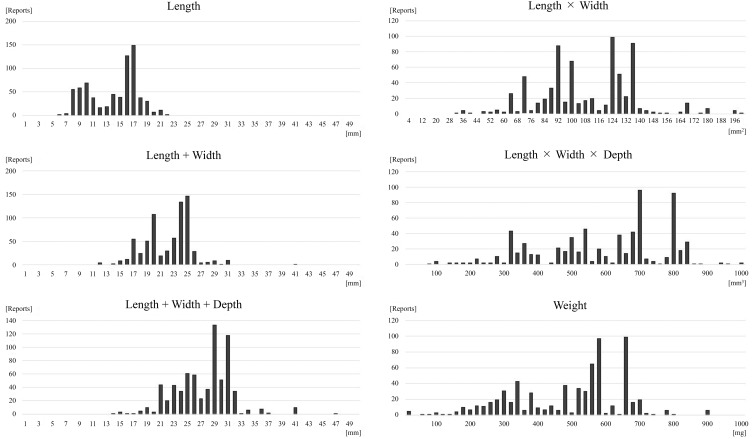
Patients and methods: The marketing specialists of Toho Pharmaceutical Co., Ltd. collected opinions of patients and medical workers (November 2014-April 2016). Regarding 709 reports from patients stating that the tablet or capsule for too large for ingestion, a dataset was prepared from package inserts of the reported drugs. Two analyses were conducted: histogram analysis of size distribution and geometric analysis using linear approximation. Six indices of tablet/capsule size were considered: length; length + width; length + width + depth; length × width; length × width × depth; and weight.
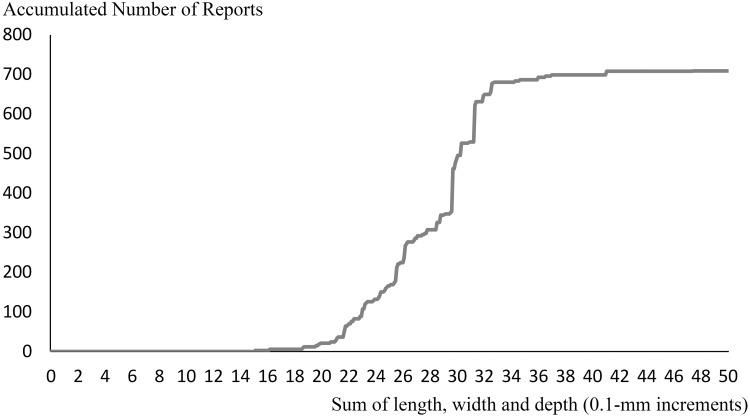
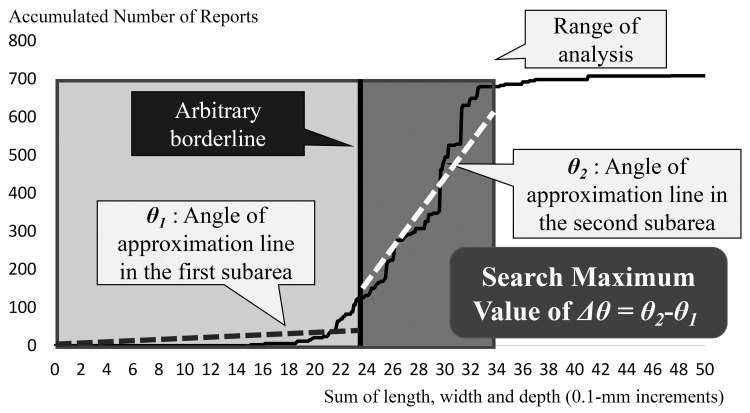
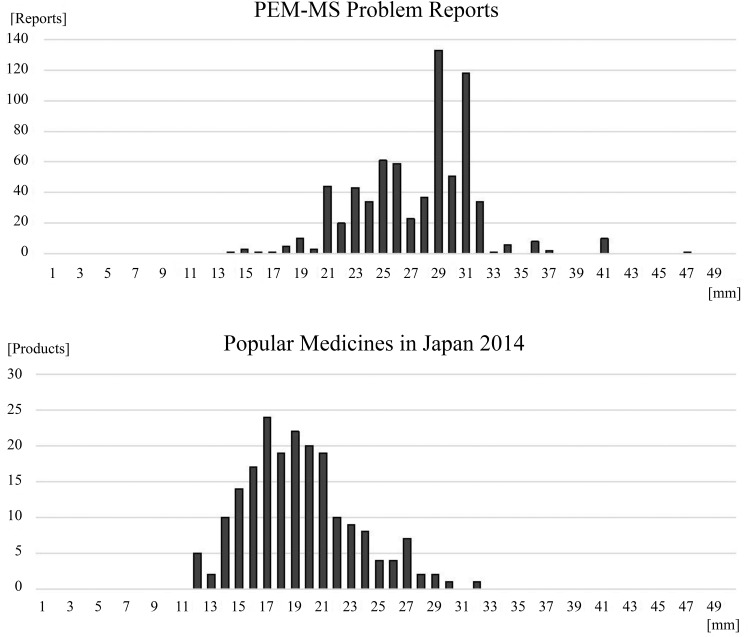
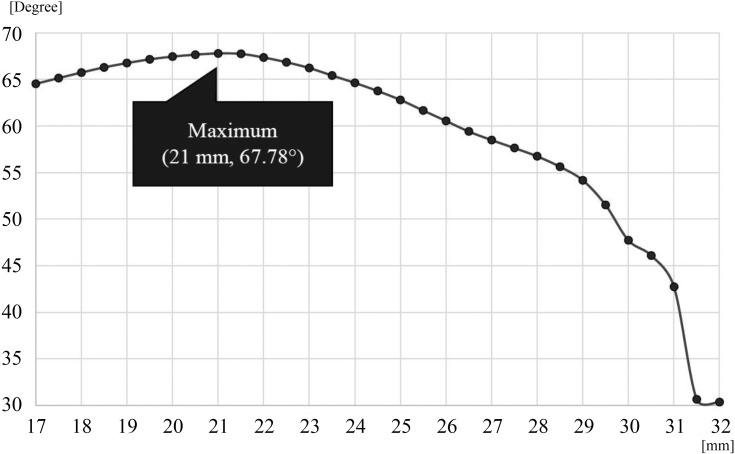
Results: Histogram analysis revealed that length + width + depth is an excellent index of tablet/capsule size, and negative reports on tablet/capsule size drastically increase when this index is ≥21 mm. Geometric analysis using linear approximation also revealed similar results.
Conclusion: The threshold size of tablets/capsules that patients feel are too large to ingest is length + width + depth = 21 mm. Therefore, when designing or altering tablets/capsules, if length + width + depth is ≥21 mm, the drug should be scored, split into smaller doses, or redesigned as an orally disintegrating formulation.
Keywords: capsule; marketing specialist; postmarketing surveillance; shape; size; tablet.
© 2020 Kabeya et al.
Conflict of interest statement
Kenji Kabeya has nothing to disclose. Hiroki Satoh reports that this work was conducted as a joint research with Toho Holdings Co., Ltd., during the conduct of the study; that the Laboratory of Drug Lifetime Management was funded by 11 companies including Toho Holdings Co., Ltd., and personal fees from Torii Pharmaceutical Co., Ltd., and neopharma Japan Co., Ltd., outside the submitted work. Yasumasa Miura reports personal fees from Toho Holdings Co., Ltd., outside the submitted work. Satoko Hori was a member of the Laboratory of Drug Lifetime Management funded by 11 companies including Toho Holdings Co., Ltd., during the early part of this work. Yasufumi Sawada reports that this work was conducted as a joint study with Toho Holdings Co., Ltd., during the conduct of the study; and that the Laboratory of Drug Lifetime Management was funded by 11 companies including Toho Holdings Co., Ltd., outside the submitted work. The authors report no other possible conflicts of interest in this work.
Figures
References
-
- Tsushima Y. Medical tablets easy to ingest: development of new drug formulation toward aging society. Farumashia 1997;33(10):1119–1123. doi: 10.14894/faruawpsj.33.10_1119 - DOI
-
- Imai Y. Home drug management and care cost for the elderly with dementia. J Ther. 2005;87(2):433–442.
-
- Kurata N, Enomoto A, Kato H, Kataoka S. Medicines that are appropriate for elderly persons-evaluation of the size of oral disintegrating tablets that can be ingested. Jpn J Pharm Health Care Sci. 2010;36(6):397–405. doi: 10.5649/jjphcs.36.397 - DOI
-
- Sato H, Saito S, Hayashi T. Shape of tablets for ease of swallowing. Trans Jpn Soc Kansei Eng. 2010;9(2):137–143. doi: 10.5057/jjske.J11-090515-1 - DOI
-
- Sato H, Saito S, Ikeda M. Shape of tablets for ease of swallowing by senior citizens. Trans Jpn Soc Kansei Eng. 2011;10(3):417–423. doi: 10.5057/jjske.10.417 - DOI
LinkOut - more resources
Full Text Sources
Miscellaneous
