


Modified Support Vector Machine for Detecting Stress Level Using EEG Signals
- PMID: 32802030
- PMCID: PMC7416233
- DOI: 10.1155/2020/8860841
Modified Support Vector Machine for Detecting Stress Level Using EEG Signals
Abstract
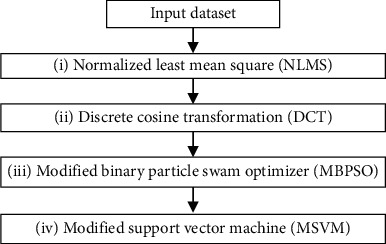
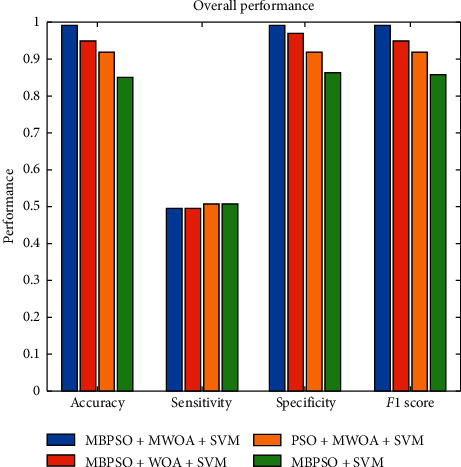
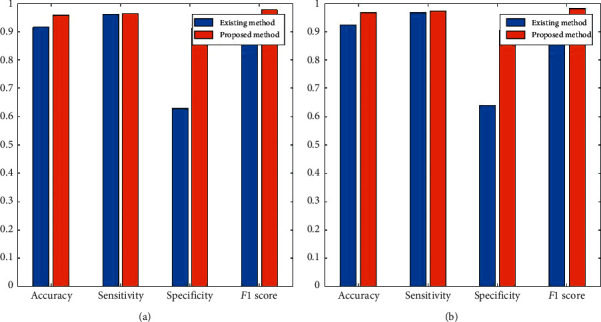
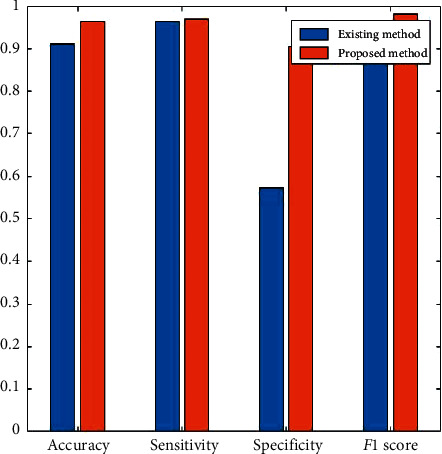
Stress is categorized as a condition of mental strain or pressure approaches because of upsetting or requesting conditions. There are various sources of stress initiation. Researchers consider human cerebrum as the primary wellspring of stress. To study how each individual encounters stress in different forms, researchers conduct surveys and monitor it. The paper presents the fusion of 5 algorithms to enhance the accuracy for detection of mental stress using EEG signals. The Whale Optimization Algorithm has been modified to select the optimal kernel in the SVM classifier for stress detection. An integrated set of algorithms (NLM, DCT, and MBPSO) has been used for preprocessing, feature extraction, and selection. The proposed algorithm has been tested on EEG signals collected from 14 subjects to identify the stress level. The proposed approach was validated using accuracy, sensitivity, specificity, and F1 score with values of 96.36%, 96.84%, 90.8%, and 97.96% and was found to be better than the existing ones. The algorithm may be useful to psychiatrists and health consultants for diagnosing the stress level.
Copyright © 2020 Richa Gupta et al.
Conflict of interest statement
The authors declare that there are no conflicts of interest among authors. Also, the research was conducted in the absence of any commercial or financial relationships that could be construed as a potential conflict of interest.
Figures
References
-
- Rabasa C., Dickson S. L. Impact of stress on metabolism and energy balance. Current Opinion in Behavioral Sciences. 2016;9:71–77. doi: 10.1016/j.cobeha.2016.01.011. - DOI
-
- Khan M., Rizvi Z., Shaikh M. Z., Kazmi W., Shaikh A. Design and implementation of intelligent human stress monitoring system. International Journal of Innovation and Scientific Research. 2014;10(1):179–190.
-
- Rigas G., Goletsis Y., Fotiadis D. I. Real-time driver’s stress event detection. IEEE Transactions on Intelligent Transportation Systems. 2012;13(1):221–234. doi: 10.1109/TITS.2011.2168215. - DOI
-
- Mantri S., Patil V., Mitkar R. EEG based emotional distress analysis—a survey. International Journal of Engineering Research and Development. 2012;4(6):24–28.
-
- Jun G., Smitha K. G. EEG based stress level identification. Proceedings of the IEEE International Conference on Systems, Man, and Cybernetics (SMC); October 2016; Budapest, Hungary. - DOI
MeSH terms
LinkOut - more resources
Full Text Sources
Medical
