


Advances in optical mapping for genomic research
- PMID: 32802277
- PMCID: PMC7419273
- DOI: 10.1016/j.csbj.2020.07.018
Advances in optical mapping for genomic research
Abstract
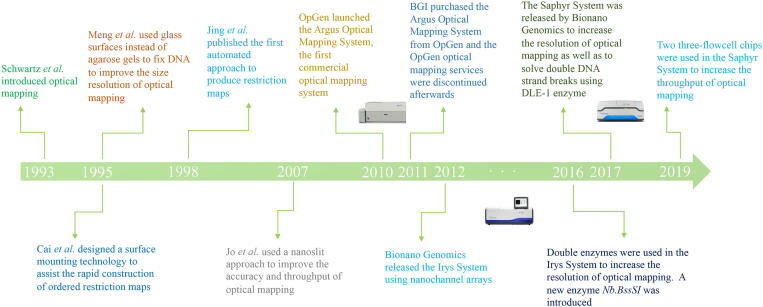
Recent advances in optical mapping have allowed the construction of improved genome assemblies with greater contiguity. Optical mapping also enables genome comparison and identification of large-scale structural variations. Association of these large-scale genomic features with biological functions is an important goal in plant and animal breeding and in medical research. Optical mapping has also been used in microbiology and still plays an important role in strain typing and epidemiological studies. Here, we review the development of optical mapping in recent decades to illustrate its importance in genomic research. We detail its applications and algorithms to show its specific advantages. Finally, we discuss the challenges required to facilitate the optimization of optical mapping and improve its future development and application.
Keywords: 3D, three-dimensional; DBG, de Bruijn graph; DLS, direct label and strain; DNA, deoxyribonucleic acid; Genome assembly; Hi-C, high-throughput chromosome conformation capture; Mb, million base pair; Next generation sequencing; OLC, overlap-layout-consensus; Optical mapping; PCR, polymerase chain reaction; PacBio, Pacific Biosciences; SRS, short-read sequencing; SV, structural variation; Structural variation; bp, base pair; kb, kilobase pair.
© 2020 The Author(s).
Conflict of interest statement
The authors declare that they have no known competing financial interests or personal relationships that could have appeared to influence the work reported in this paper.
Figures
References
Publication types
LinkOut - more resources
Full Text Sources
Other Literature Sources
Miscellaneous