


doi: 10.1038/s41421-020-00197-3.
eCollection 2020.
Absorbed plant MIR2911 in honeysuckle decoction inhibits SARS-CoV-2 replication and accelerates the negative conversion of infected patients
Affiliations
- PMID: 32802404
- PMCID: PMC7406496
- DOI: 10.1038/s41421-020-00197-3
Item in Clipboard
Absorbed plant MIR2911 in honeysuckle decoction inhibits SARS-CoV-2 replication and accelerates the negative conversion of infected patients
Cell Discov.
.
No abstract available
Keywords: DNA synthesis; miRNAs.
Conflict of interest statement
Conflict of interestThe authors declare that they have no conflict of interest.
Figures
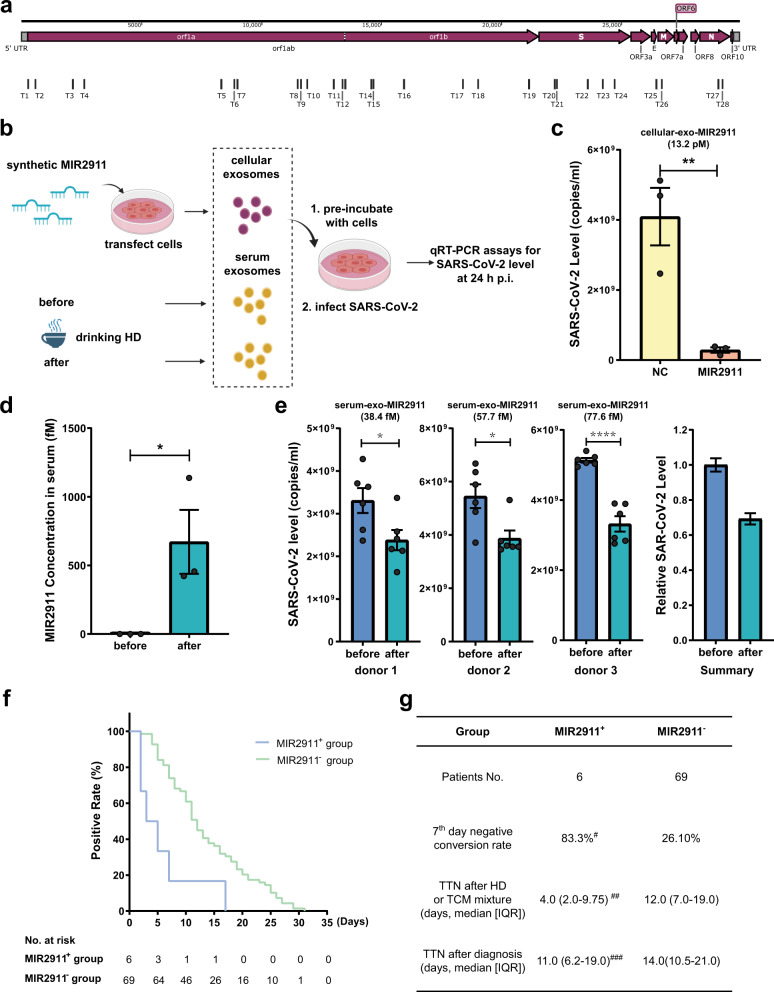
a Diagrams of MIR2911-binding sites on SARS-CoV-2 genome. b Diagrams of the collection of exosomes from cell medium or serum before or after the oral administration of HD and the measurement of the antiviral activities of cellular or serum exosomal miRNAs. c Efficacy of exosomes secreted by HEK293T cells transfected with MIR2911 or ncRNA in inhibiting replication of SARS-CoV-2. Vero E6 cells were pretreated with cellular exosomes for 8 h, and virus was then added to incubate with cells at an MOI of 0.01 for 1 h. Afterwards, exosomes and virus mixture was removed and the cells were cultured with fresh medium until the end of the experiment. Virus yield in the infected cell supernatants was quantified by qRT-PCR (n = 3) at 24 h p.i. d, e Efficiency of exosomal-MIR2911 in human serum to inhibit replication of SARS-CoV-2. Serum exosomes were harvest from three donors before and 2 h after oral administration of HD (10.5 pmol MIR2911/200 ml, once/30 g dry honeysuckle/per donor). MIR2911 concentration in serum were measured by qRT-PCR (d). Vero E6 cells were pretreated with human serum exosomes for 8 h, and virus was then added to incubate with cells at an MOI of 0.01 for 1 h. Afterwards, exosomes and virus mixture was removed and the cells were cultured with fresh medium until the end of the experiment. Virus yield in the infected cell supernatants was quantified by qRT-PCR (e, n = 6) at 24 h p.i. f, g Comparison of TTN (f, g) and 7th day negative conversion rate (g) between MIR2911+ group and MIR2911− group. MIR2911+ group took HD (10.5 pmol MIR2911/oral 100 mL, twice daily/30 g dry honeysuckle/per patient, 600 ml water boiled with 30 g dry honeysuckle for 80 min until obtaining 200 ml HD). MIR2911– group took traditional TCM orally. All included patients are moderate type. MIR2911+ group patients were from a clinic study conducted at Nanjing second hospital. MIR2911– group patients were from the same hospital. Seventh day negative conversion rate defined as the percentage of patients converted to SARS-CoV-2 PCR-negative at the 7th day. The day patients received first dose of HD or TCM mixture was recorded as 1st day. Viral negative results must be confirmed twice of 24-h interval. The data are expressed as means ± SEM. *P < 0.05, ****P < 0.0001 using two-tailed Student’s t test; #P = 0.004 compared with MIR2911− group using χ2 test; ##P = 0.005 compared with MIR2911− group (HR 0.28, 95% CI 0.12–0.67) using Cox regression with the adjustment of sex factor; ###P > 0.05 compared with MIR2911− group (HR 0.61, 95% CI 0.68–3.94) using Cox regression with the adjustment of sex factor. HD honeysuckle decoction, TTN time taken to become SARS-CoV-2 PCR-negative, TCM traditional Chinese medicine, IQR interquartile range, HR Hazard ratios, CI confidence intervals.
References
-
- WHO. Coronavirus disease 2019 (COVID-19) situation report-174.https://www.who.int/docs/default-source/coronaviruse/situation-reports/2... (2020).
Grants and funding
LinkOut - more resources
Full Text Sources
Other Literature Sources
Medical
Miscellaneous
