


Investigating effects of healthcare simulation on personal strengths and organizational impacts for healthcare workers during COVID-19 pandemic: A cross-sectional study
- PMID: 32802743
- PMCID: PMC7365062
- DOI: 10.1016/j.imr.2020.100476
Investigating effects of healthcare simulation on personal strengths and organizational impacts for healthcare workers during COVID-19 pandemic: A cross-sectional study
Abstract
Introduction: This cross-sectional study aimed at evaluating impacts of healthcare simulation training, either in-situ or lab-based, on personal strengths of healthcare workers (HCWs) and organizational outcomes during the COVID-19 pandemic.
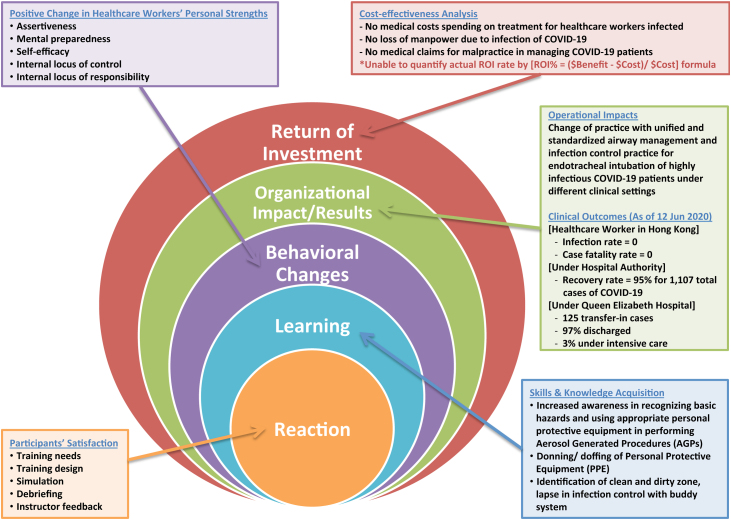
Methods: COVID-19 Taskforce was established to formulate standardized scenario-based simulation training materials in late-January 2020. Post-training questionnaires made up of 5-point Likert scales were distributed to all participants to evaluate their personal strengths, in terms of i) assertiveness, ii) mental preparedness, iii) self-efficacy, iv) internal locus of control, and v) internal locus of responsibility. Independent sample t-tests were used to analyze between-group difference in "In-situ" and "Lab-based" group; and one-sample t-tests were used to compare change in personal strengths with reference point of 3 (Neutral). Kirkpatrick's Model served as the analytical framework for overall training effects.
Results: Between 05 February and 18 March 2020, 101 sessions of simulation training were conducted in "In-Situ" at either Accident & Emergency Department (20, 20%) or Intensive Care Unit (15, 14%) and "Lab-based" for Isolation (30, 30%) and General Wards (36, 36%). 1,415 hospital staff members, including 1,167 nurses (82%), 163 doctors (12%) and 85 patient care assistants (6%), were trained. All domains of personal strengths were scored 4.24 or above and statistically significantly increased when comparing with reference population (p < .001). However, no significant differences between in-situ and lab-based simulation were found (p > .05), for all domains of personal strengths.
Conclusion: Healthcare simulation training enhanced healthcare workers' personal strengths critical to operational and clinical outcomes during the COVID-19 pandemic.
Keywords: COVID-19; Healthcare Worker; In-Situ; Personal Strengths; Simulation Training.
© 2020 Korea Institute of Oriental Medicine. Publishing services by Elsevier B.V.
Figures
References
-
- World Health Organization (WHO) 2003. Summary of probable SARS cases with onset of illness from 1 November 2002 to 31 July 2003.https://www.who.int/csr/sars/country/table2004_04_21/en/ [Cited 20 Mar 2020.]. Available from:
-
- Leung G.M., Ho L.M., Lam T.H., Hedley A.J. Epidemiology of SARS in the 2003 Hong Kong epidemic. Hong Kong Med J. 2009;15(Suppl.9):S12–S16. - PubMed
-
- SARS Expert Committee. Chronology of the SARS Epidemic in Hong Kong; 2004 [Cited 01 Mar 2020]. Available from: https://www.sars-expertcom.gov.hk/english/reports/reports/files/e_app3.pdf.
LinkOut - more resources
Full Text Sources
Miscellaneous
