


The burden of exacerbations in mild asthma: a systematic review
- PMID: 32802826
- PMCID: PMC7418821
- DOI: 10.1183/23120541.00359-2019
The burden of exacerbations in mild asthma: a systematic review
Abstract
Background: Although most patients with asthma have mild disease, data on how mild asthma is defined, and how frequently exacerbations occur in this patient population are scarce, so we aimed to redress this.
Methods: We searched Medline and Medline In-Process (PubMed), and Embase in OVID for English-language publications containing "mild asthma" plus at least one relevant therapy and outcome/keyword, limited to randomised controlled trials (RCTs) and observational studies published between January 1990 and February 2019. Publications were filtered to ensure appropriate data extraction. The main outcomes were the definitions of mild asthma and exacerbations, baseline exacerbation rates and exacerbation data for placebo recipients in prospective studies. Meta-analysis of exacerbation rates was planned.
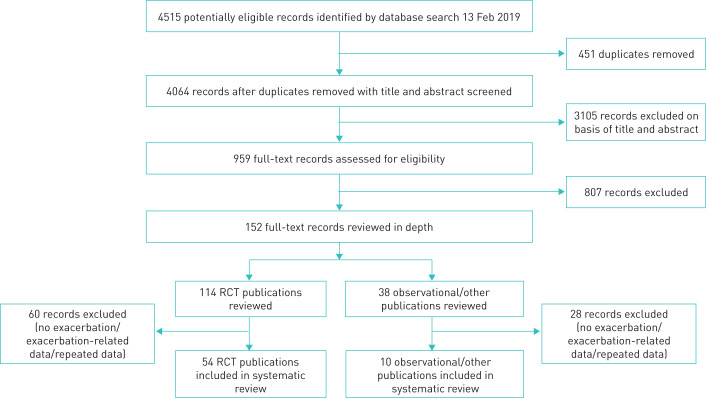
Findings: Of 4064 articles identified, 64 were included in our review (49 743 subjects); 54 RCTs and 10 observational/other studies. Six main types of definitions of mild asthma were identified. While care was taken to ensure inclusion only of patients with mild asthma, marked heterogeneity was revealed in the definitions of mild asthma and hence the study populations. Reporting of exacerbations also varied widely between studies, precluding meta-analysis. Between 0-22% of patients were hospitalised for asthma or had a severe exacerbation in the previous year, according to baseline data from prospective studies. In RCTs, severe exacerbation rates in placebo recipients taking only short-acting β2-agonist therapy ranged from 0.20-2.88 per year.
Conclusions: These data provide new evidence of the burden of exacerbations in mild asthma and highlight the need for standardised definitions of mild asthma and of exacerbations to progress further research.
Copyright ©ERS 2020.
Conflict of interest statement
Conflict of interest: J.M. FitzGerald is a member of the Scientific and Executive Committees of the Global Initiative for Asthma. He also reports research funds paid directly to UBC and personal fees from Astra Zeneca, GSK, Sanofi Regeneron and Novartis, personal fees from Teva, during the conduct of the study. Conflict of interest: P.J. Barnes reports research funding from, scientific advisory boards and consultancy for, and lecture fees from AstraZeneca; research funding from, a scientific advisory board for and lecture fees from Boehringer Ingelheim; a scientific advisory board for and lecture fees from Teva; lecture fees from Novartis; and a scientific advisory board for Pieris, all during the conduct of the study. Conflict of interest: B.E. Chipps reports personal fees for advisory boards and speaker's bureaus from AstraZeneca, Circassia, Genentech, Novartis, Regeneron, Sanofi-Genzyme and Teva, outside the submitted work. Conflict of interest: C.R. Jenkins reports personal fees for attending advisory boards where this paper was discussed from AstraZeneca P/L, and personal fees for attending advisory boards and providing educational materials from GlaxoSmithKline, Novartis, Sanofi and Boehringer Ingelheim, during the conduct of the study. Conflict of interest: P.M. O'Byrne reports grants and personal fees from AstraZeneca, personal fees from GSK, grants from Novartis, grants and personal fees from Medimmune, and personal fees from Chiesi, outside the submitted work. Conflict of interest: I.D. Pavord reports speaker fees, advisory board honoraria, sponsorship to attend scientific meetings and payments for organising educational events from AstraZeneca; speaker fees, advisory board honoraria and sponsorship to attend scientific meetings from Boehringer Ingelheim; a speaker fee from Aerocrine; speaker fees and advisory board honoraria from Almirall and Novartis; speaker fees, advisory board honoraria and sponsorship to attend scientific meetings from GlaxoSmithKline; advisory board honoraria from Genentech and Regeneron; speaker fees, payments for organising educational events and sponsorship to attend scientific meetings from Teva; speaker fees from Chiesi; advisory board honoraria from Sanofi, Circassia and Knopp; and funding as a Senior Investigator from NIHR, all outside the submitted work. Conflict of interest: H.K. Reddel reports attending data safety monitoring (DSMB) and advisory boards for, and an honorarium for providing independent medical education and a grant for a registry from AstraZeneca; attending a DSMB and advisory boards for, an unconditional research grant from, an honorarium for providing independent medical education to, consulting for, and study medication from GlaxoSmithKline; attending a DSMB for Merck; attending a DSMB and an advisory board for, and an honorarium for providing independent medical education and a grant for a registry from Novartis; honoraria for providing independent medical education from Teva and Mundipharma; an honorarium for providing independent medical education from and attending an advisory board for Boehringer Ingelheim; and attending an advisory board for Sanofi-Genzyme, all outside the submitted work. Dr Reddel is also Chair of the GINA Scientific Committee.
Figures
References
-
- Global Initiative for Asthma (GINA) 2020. Global strategy for asthma management and prevention. Date last accessed: 9 July, 2020.
Publication types
LinkOut - more resources
Full Text Sources