Invasive meningococcal disease in Italy: from analysis of national data to an evidence-based vaccination strategy
- PMID: 32802999
- PMCID: PMC7419122
- DOI: 10.15167/2421-4248/jpmh2020.61.2.1589
Invasive meningococcal disease in Italy: from analysis of national data to an evidence-based vaccination strategy
Abstract
Introduction: Invasive meningococcal disease (IMD) is one of the most severe vaccine-preventable disease not yet under control. In Italy, although different anti-meningococcal vaccines are available, their offer among regions is heterogeneous. The aim of this study is to describe the epidemiology of IMD in Italy based on analysis of national surveillance data for 2011-2017 to optimize the vaccination strategy.
Methods: IMD surveillance data from the Italian National Health Institute were analysed. Microsoft Excel was used to present trend analysis, stratifying by age and serogroups.
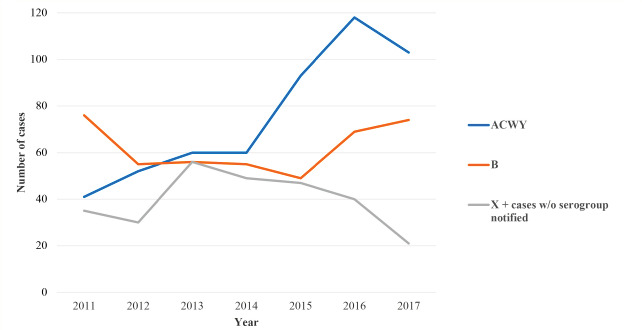
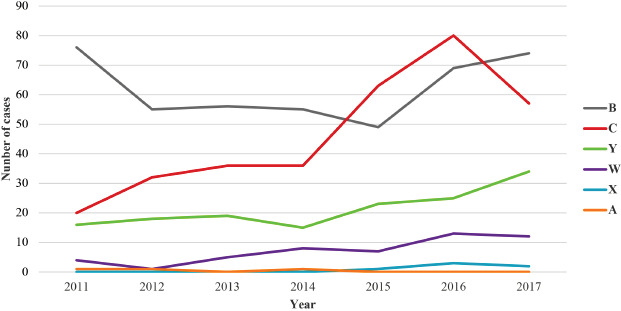
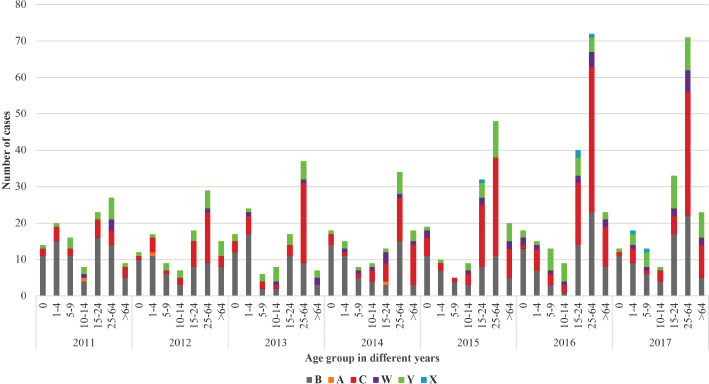
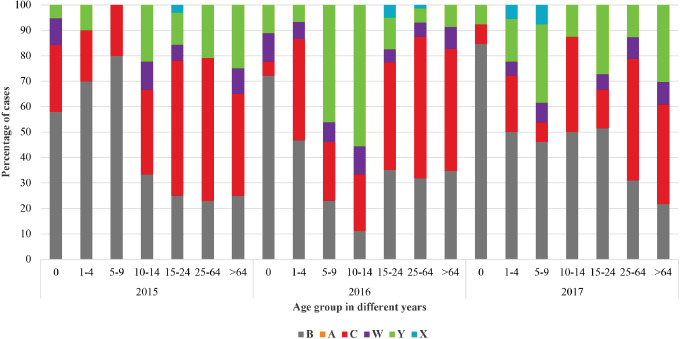
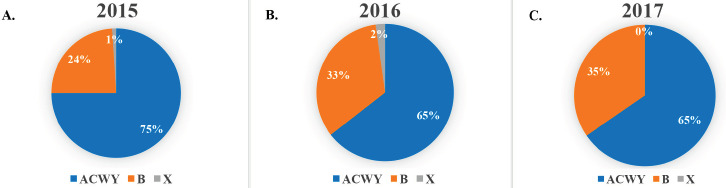
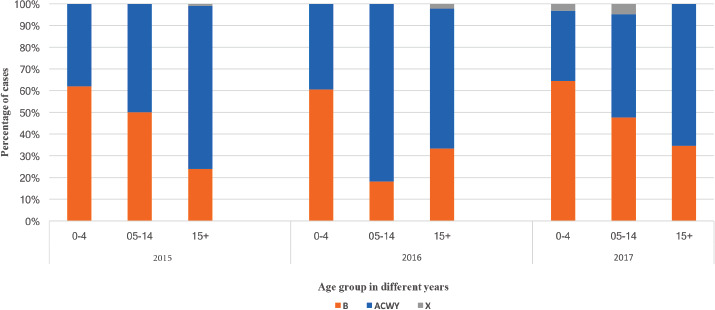
Results: In Italy, during the period 2011-2017, the incidence of IMD increased from 0.25 cases/100,000 inhabitants in 2011 to 0.33 cases/100,000 in 2017. Most cases after 2012 were caused by non-B serogroups. The number of cases in subjects aged 25-64 years increased steadily after 2012 (36 cases in 2011, 79 in 2017), mostly due to non-B serogroups, representing more than 65% of cases in those aged 25+ years.
Conclusions: In the period from 2011 to 2017, the incidence of IMDs increased in Italy. The increase, probably due also to a better surveillance, highlights the importance of the disease in the adult population and the high level of circulation of non-B serogroups in particular after 2012. Our analysis supports an anti-meningococcal vaccination plan in Italy that should include the highest number of preventable serogroups and be aimed at vaccinating a wider population through a multicohort strategy.
Keywords: Anti-meningococcal vaccination strategies; Epidemiology; Invasive meningococcal diseases; Surveillance system.
©2020 Pacini Editore SRL, Pisa, Italy.
Conflict of interest statement
Conflicts of interest statement SI, LB, SP and GCL work for Sanofi Pasteur Italia. The other authors declare no conflict of interest.
Figures

References
-
- Centres for Disease Control and Prevention (CDC). Meningococcal disease. Hamborsky J, Kroger A, Wolfe C, editors. Epidemiology and prevention of vaccine-preventable diseases. 13th ed. Washington, DC: Public Health Foundation; 2015, pp. 231-246.
-
- Soriano-Gabarró M, Wolter J, Hogea C, Vyse A. Carriage of Neisseria meningitidis in Europe: a review of studies undertaken in the region. Expert Rev Anti Infect Ther 2011;9:761-74. https://doi.org/10.1586/eri.11.89 10.1586/eri.11.89 - DOI - PubMed
-
- Christensen H, May M, Bowen L, Hickman M, Trotter CL. Meningococcal carriage by age: a systematic review and meta-analysis. Lancet Infect Dis 2010;10:853-61. https://doi.org/10.1016/S1473-3099(10)70251-6 10.1016/S1473-3099(10)70251-6 - DOI - PubMed
-
- Peterson ME, Li Y, Shanks H, et al. Serogroup-specific meningococcal carriage by age group: a systematic review and meta-analysis. BMJ Open 2019;9:e024343 https://doi.org/10.1136/bmjopen-2018-024343 10.1136/bmjopen-2018-024343 - DOI - PMC - PubMed
-
- Gasparini R, Comanducci M, Amicizia D, et al. Molecular and serological diversity of Neisseria meningitidis carrier strains isolated from Italian students aged 14 to 22 years. J Clin Microbiol 2014;52:1901-10. https://doi.org/10.1128/JCM.03584-13 10.1128/JCM.03584-13 - DOI - PMC - PubMed
MeSH terms
Substances
LinkOut - more resources
Full Text Sources
Medical