Review
. 2020 Aug 15;11(1):93.
doi: 10.1186/s13244-020-00902-6.

Pre- and post-operative imaging of cochlear implants: a pictorial review

Affiliations
Review

Pre- and post-operative imaging of cochlear implants: a pictorial review

Gerlig Widmann et al. Insights Imaging. .

Abstract

Cochlear implants are increasingly used to treat sensorineural hearing disorders in both children and adults. Pre-operative computed tomography and magnetic resonance imaging play a pivotal role in patient selection, to rule out findings that preclude surgery or identify conditions which may have an impact on the surgical procedure. The post-operative position of the electrode array within the cochlea can be reliably identified using cone-beam computed tomography. Recognition of scalar dislocation, cochlear dislocation, electrode fold, and malposition of the electrode array may have important consequences for the patient such as revision surgery or adapted fitting.

Keywords: Cochlear implant; Electrode array position; Post-operative imaging; Pre-operative imaging.


Conflict of interest statement

JS has an active scientific grant with the MedEL Company.

All other authors declare that they do not have any competing interests related to this article.

Figures
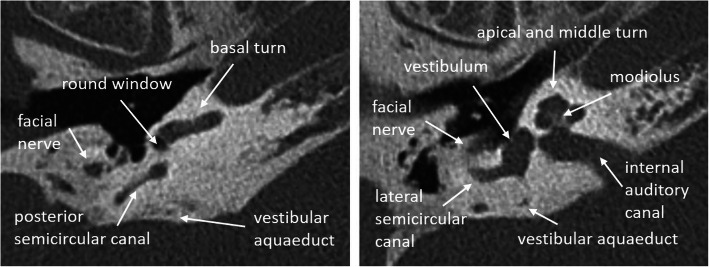
Fig. 1
Fig. 1
HRCT axial images of normal cochlear anatomy in a 74-year-old man
Fig. 2
Fig. 2
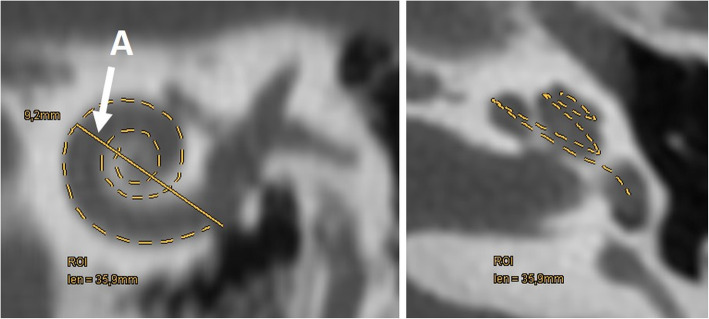
Evaluation of cochlear duct length (CDL) using the formula CDL = 4.16A–2.7 and a 3D segmentation (dashed line). HRCT paracoronal image on the left shows distance A (arrow) from the center of the round window to the far most extension of the basal turn, which measures 9.2 mm. According to the formula the cochlea duct has a length of 35.6 mm. The dashed line in the HRCT paracoronal image and the HRCT paraaxial image on the right shows the 3D segmented cochlear duct which measures 35.9 mm
Fig. 3
Fig. 3
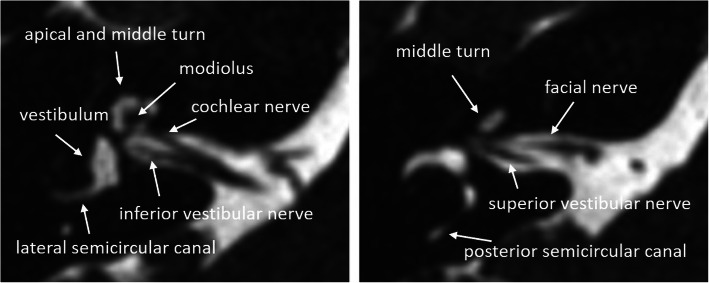
MRI 3D-CISS axial images of normal cochlear anatomy in a 40-year-old woman
Fig. 4
Fig. 4
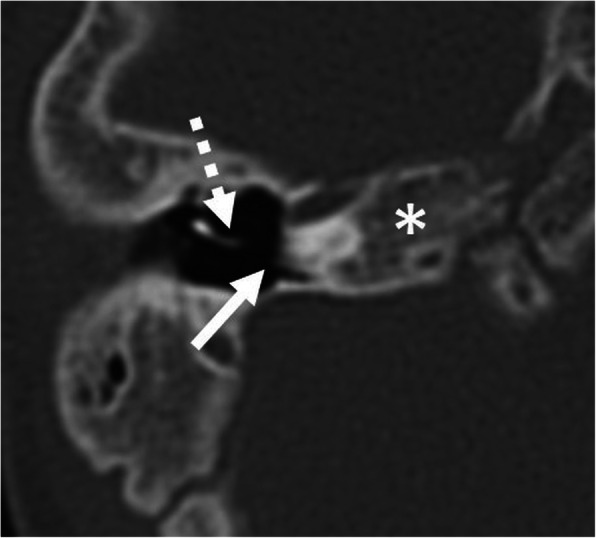
A 1-year-old male patient, with bilateral sensorineural deafness from birth. HRCT axial image shows hypoplastic right petrous bone with a complete absence of the inner ear structures (asterisk), compatible with Michel’s deformity. The medial wall of the middle ear is flat (arrow). Absent round and oval windows. Absent stapes. Normal-looking malleus (dashed arrow)
Fig. 5
Fig. 5
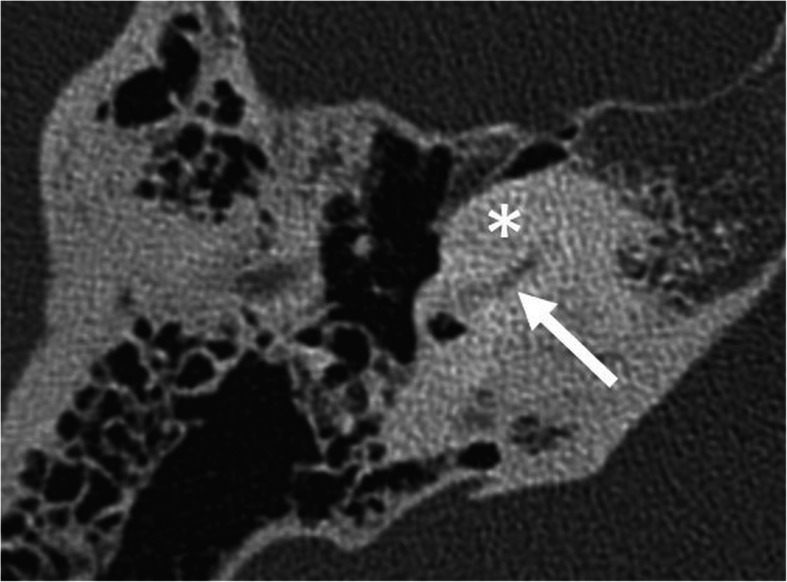
A 38-year-old female patient, with unilateral sensorineural deafness since the age of 12 years. HRCT axial image shows cochlear sclerosis (asterisk). Only a small part of the basal turn of the cochlea can be faintly seen (arrow)
Fig. 6
Fig. 6
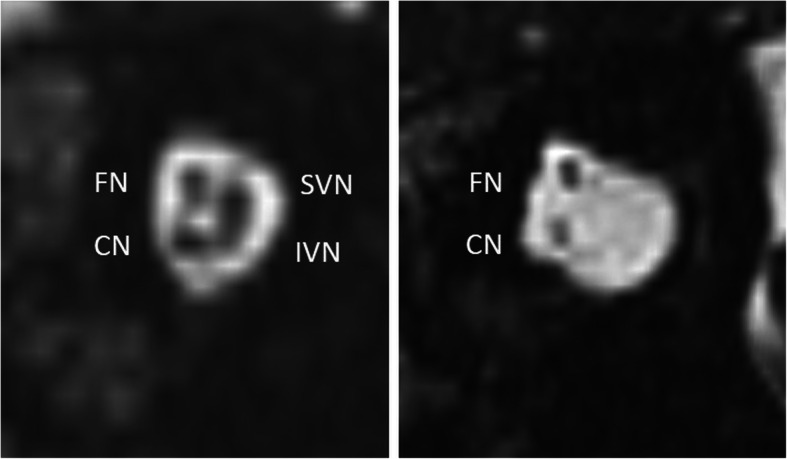
A 57-year-old female patient with unilateral SNHL from birth. MRI 3D-CISS parasagittal image of the internal auditory canal shows regular facial nerve (FN), cochlear nerve (CN), superior vestibular nerve (SVN), and inferior vestibular nerve on the healthy side (left image) and missing SVN and IVN, as well as a hypoplastic CN on the diseased side (right image)
Fig. 7
Fig. 7
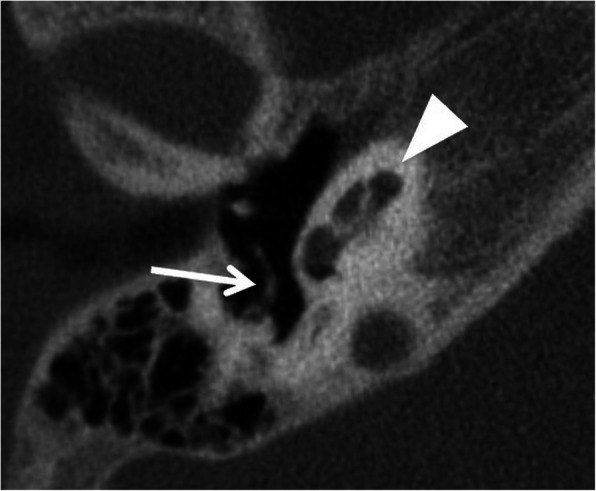
A 5-year-old male patient, with CHARGE syndrome and bilateral severe SNHL from birth. HRCT axial image shows hypoplastic cochlea type III with less than 2 turns (arrowhead). Malformed crus longum incudis and stapes are fused with the posterior tympanic wall (arrow)
Fig. 8
Fig. 8
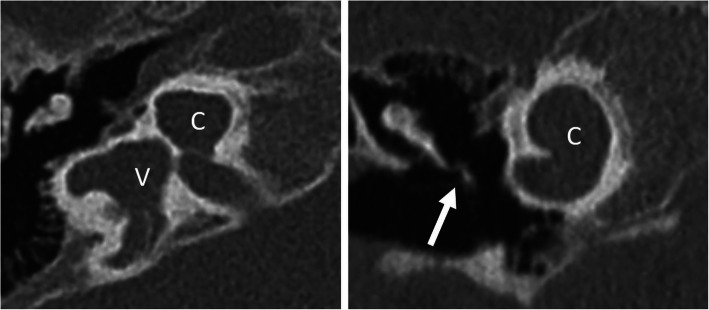
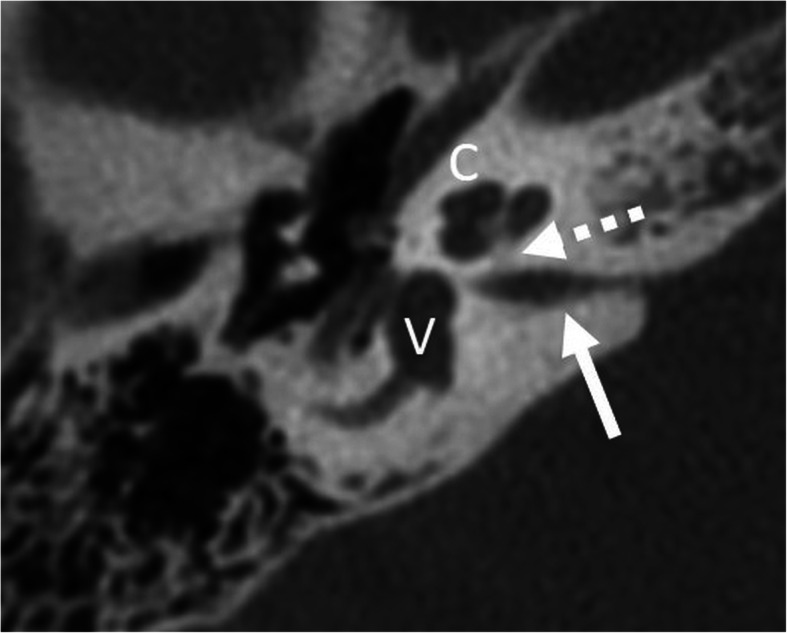
A 1-year-old male patient, with sensorineural deafness from birth. HRCT axial image (left) and coronal image (right) show incomplete partition type I, with empty cystic cochlea (C) and a large dilated vestibulum (V). Stapes is malformed and fused with the incus (arrow)
Fig. 9
Fig. 9
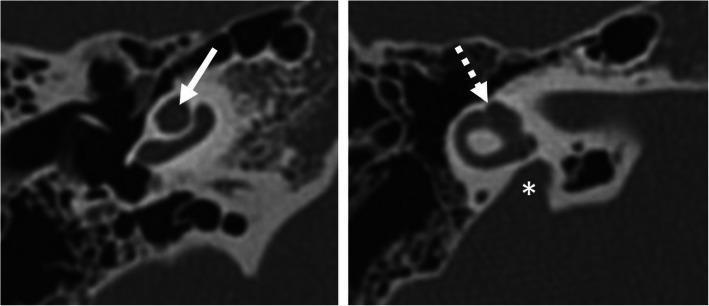
A 12-year-old male patient, with bilateral severe SNLH from birth. HRCT axial images show incomplete partition type II with the cystic apex of the cochlea (arrow) and enlarged vestibular aqueduct (asterisk). Vestibulum is minimally enlarged (dashed arrow), and semicircular canals appear normal
Fig. 10
Fig. 10
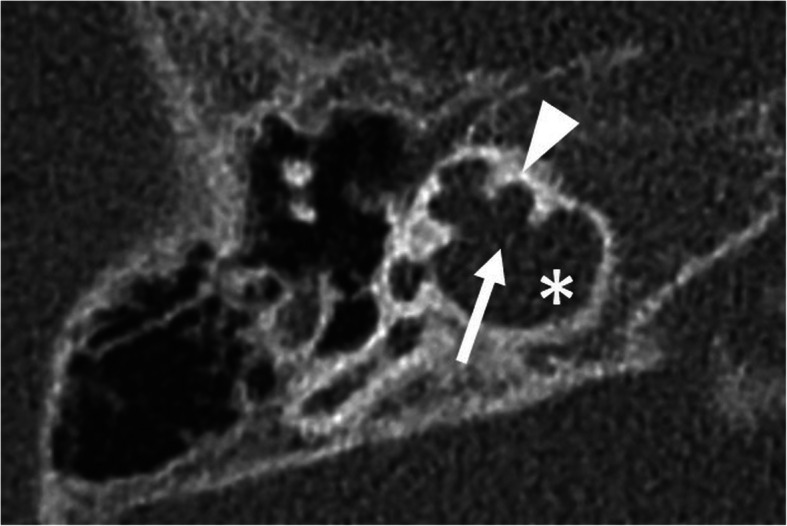
A 1-year-old male patient, with bilateral severe SNLH from birth. HRCT axial image shows incomplete partition type III with empty cochlea with preserved interscalar septa (arrowhead). Modiolus and bony separation of the cochlea and internal auditory canal are absent (arrow). The cochlea is placed directly at the lateral end of the internal auditory canal (asterisk)
Fig. 11
Fig. 11
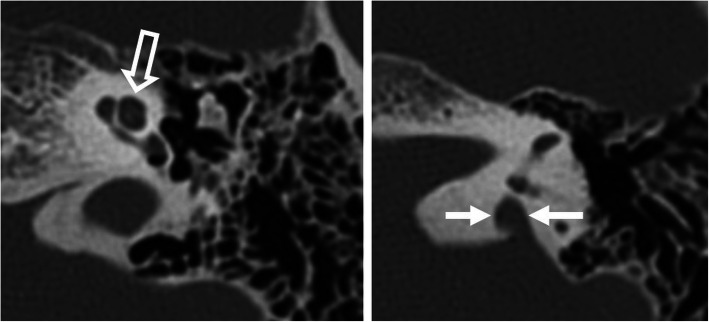
A 56-year-old male patient, with bilateral severe SNLH from birth. HRCT axial images show regular cochlea (open arrow), regular vestibulum and semicircular canals (not shown), and enlarged bony opening for the vestibular aqueduct (arrows), compatible with large vestibular aqueduct syndrome
Fig. 12
Fig. 12
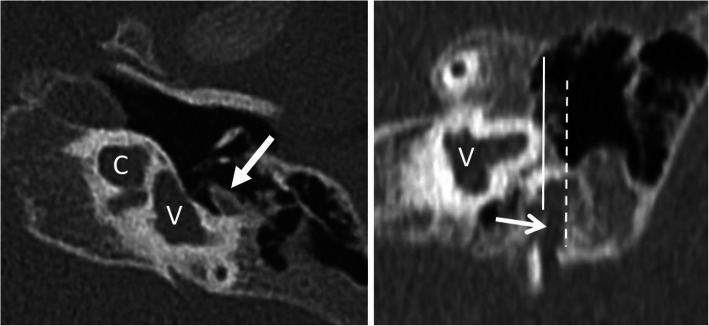
A 1-year-old male patient, with bilateral severe SNHL from birth. HRCT axial image (left image) shows incomplete partition type I with cystic cochlea (C) and vestibulum (V). The horizontal segment of the facial nerve (arrow) is lateralized. HRCT coronal image (right image) shows an interrupted line corresponding to the most lateral aspect of the vertical segment of the facial nerve (open arrow) lateral to the continuous line corresponding to the most lateral bony aspect of the lateral semicircular canal. The normal location of the vertical segment is medial to the lateral semicircular canal
Fig. 13
Fig. 13
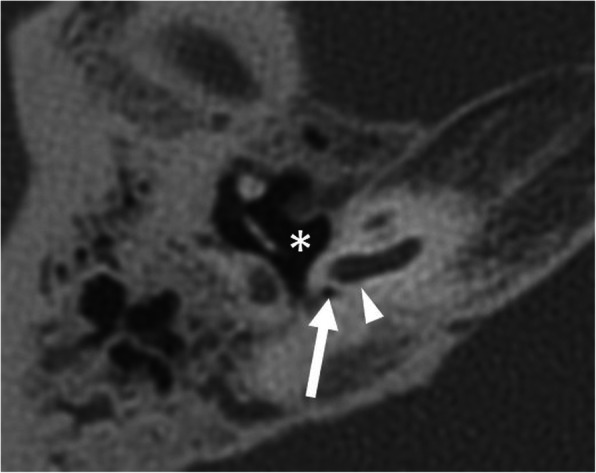
A 65-year-old male patient, with external auditory canal hypoplasia and bilateral SNLH from birth. HRCT axial image shows a hypoplastic round window (arrow) and a small tympanic cavity (asterisk). This condition complicates anatomical orientation and surgical access to the basal turn (arrowhead)
Fig. 14
Fig. 14
A 16-year-old female patient, with unilateral deafness from birth. HRCT axial image shows high-grade stenotic bony cochlear nerve canal (dashed arrow) and the stenotic internal auditory canal (arrow). Cochlea (C) and vestibulum (V) appear normal
Fig. 15
Fig. 15
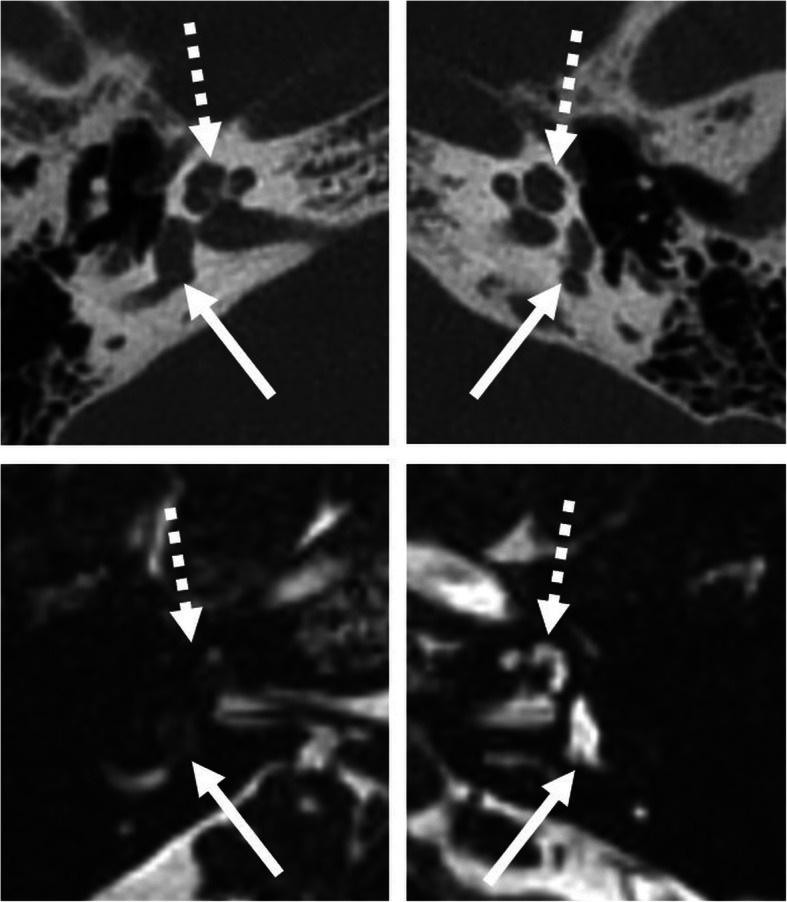
A 51-year-old male patient, with unilateral SNHL from several years. HRCT axial images (upper image) shows normal bony cochlea (dashed arrow) and vestibulum (arrow) on both sides. However, MRI 3D-CISS axial images (lower images) show loss of signal intensity of the right cochlea (dashed arrow) and vestibulum (arrow), compatible with fibrosis in early-stage labyrinthitis ossificans
Fig. 16
Fig. 16
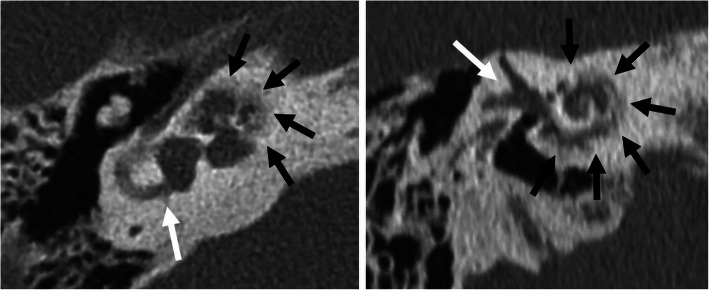
A 70-year-old male patient, with progressive SNHL from advanced otosclerosis. HRCT axial (left image) and paracoronal (right image) image show irregular ossifications affecting the cochlea (black arrows). Vestibulum and semicircular canals (white arrows) are not affected
Fig. 17
Fig. 17
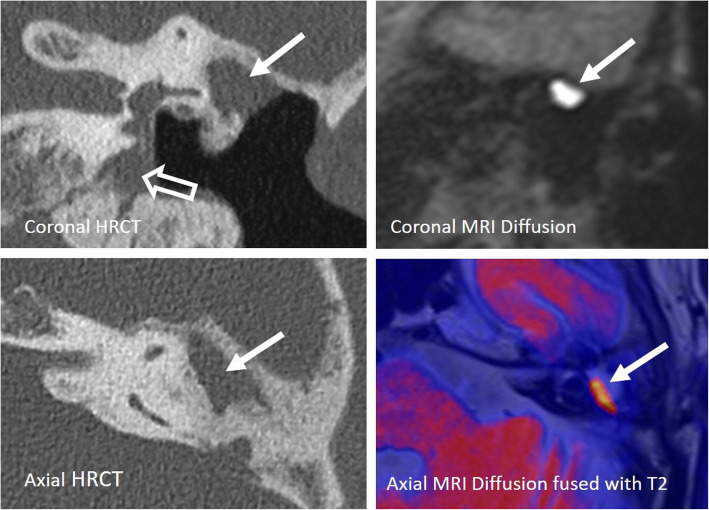
A 80-year-old male patient, with severe SNHL enrolled for cochlear implant surgery. The patient had chronic middle ear infections and cholesteatoma surgery with tympanoplasty type IV several years ago. HRCT coronal and axial images (left images) show opacified antrum (arrow) and opacified hypotympanon (open arrow). A recurrent cholesteatoma cannot be ruled out. Corresponding MRI diffusion coronal image and color-coded axial image fused with T2 (right images) show a high signal intensity in the opacified antrum, typical for cholesteatoma (arrow). The diagnosis was surgically verified, and the patient successfully received a CI one month after revision surgery
Fig. 18
Fig. 18
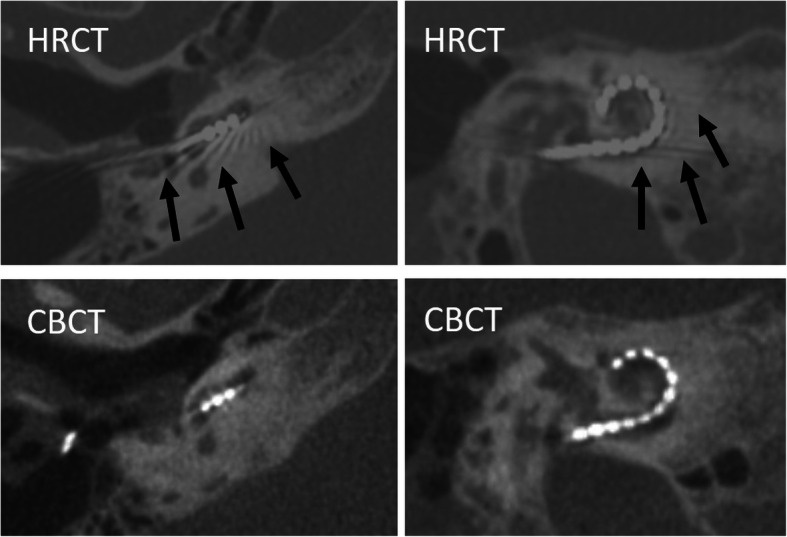
Comparison of postoperative HRCT and CBCT in a 53-year-old female patient. Axial (left images) and paracoronal (right images) images. HRCT images show more metal artifacts (arrows) and blooming artifacts than CBCT images. However, the scalar location and number of electrode contacts can be reliably documented in both modalities
Fig. 19
Fig. 19
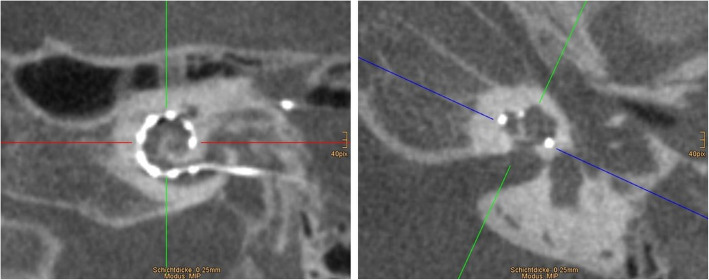
Postoperative evaluation of cochlear implant location using multiplanar mid-modiolar reconstructions. CBCT paracoronal reconstruction at the basal turn (left image) and paraaxial reconstruction through the modiolus (right image). Maximum intensity projections may be used to visualize the entire electrode array
Fig. 20
Fig. 20
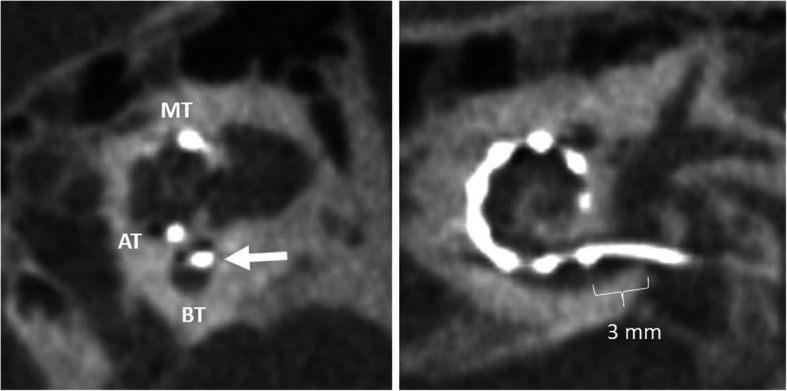
A 15-year-old male patient, with normal postoperative finding after CI surgery. CBCT paracoronal image (left image) shows an electrode array located in the scala tympani (lower segment) of the cochlear duct (white arrow). BT – basal turn. MT – middle turn. AT – apical turn. CBCT paraaxial image (right image) shows the most basal electrode contact for this type of implant correctly located 3 mm below the round window
Fig. 21
Fig. 21
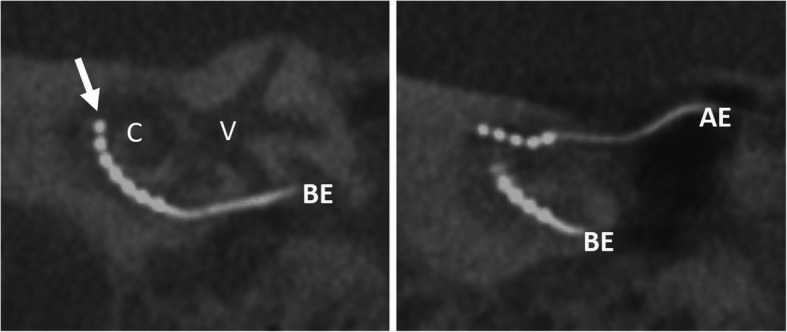
A 70-year-old male patient, with normal postoperative finding after split electrode surgery due to far advanced otosclerosis. CBCT paracoronal image (left) shows basal electrode (BE) with the tip up to the first half of the basal turn (arrow). CBCT paraaxial maximum intensity projection image shows the additional apical electrode (AE) in the middle turn. C – cochlea. V – vestibulum
Fig. 22
Fig. 22
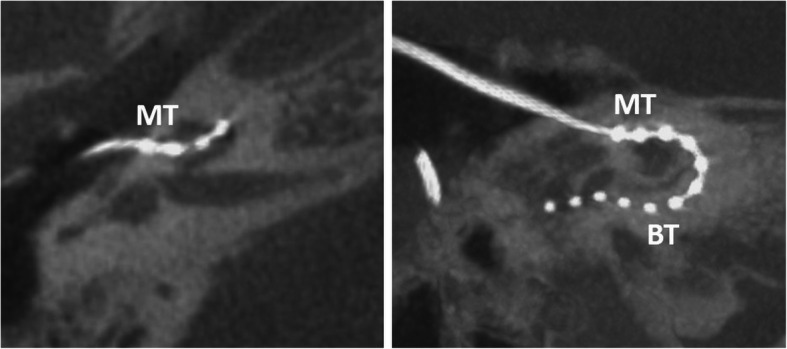
A 51-year-old male patient, with normal postoperative finding after retrograde electrode surgery due to cochlear fibrosis. CBCT axial image (left image) shows electrode entering at the middle turn (MT). CBCT paraaxial maximum intensity projection image (right image) shows the electrode running down the basal turn (BT). The two most distal electrode contacts are in the tympanic space and need to be deactivated
Fig. 23
Fig. 23
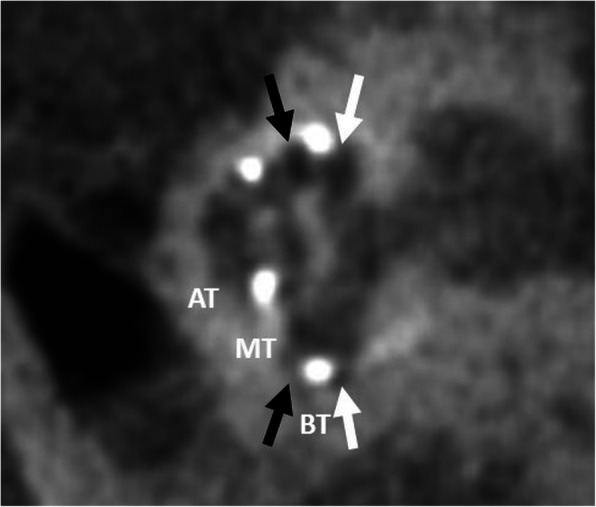
A 72-year-old male patient, with electrode lifting the basilar membrane. CBCT paracoronal image shows the electrode array located in a lateralized and elevated intermediate position between scala vestibuli (black arrow) and scala tympani (white arrow). BT – basal turn. MT – middle turn. AT – apical turn
Fig. 24
Fig. 24
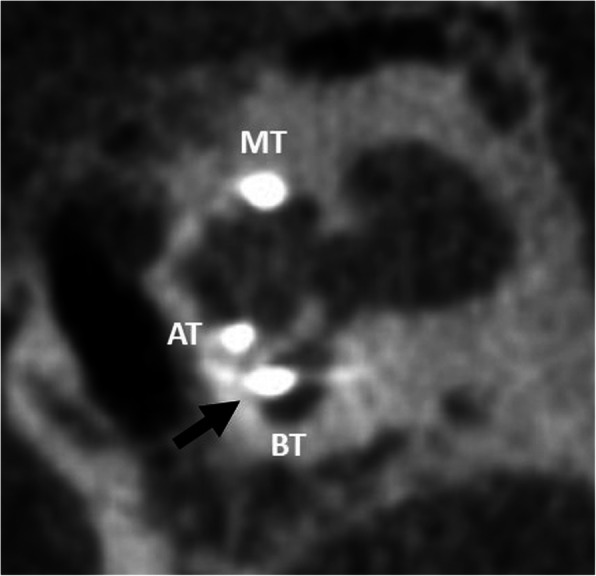
A 70-year-old female patient, with an electrode placed in the scala vestibuli. CBCT paracoronal image shows an electrode array located in the scala vestibuli (upper segment) of the cochlear duct (black arrow). BT – basal turn. MT – middle turn. AT – apical turn
Fig. 25
Fig. 25
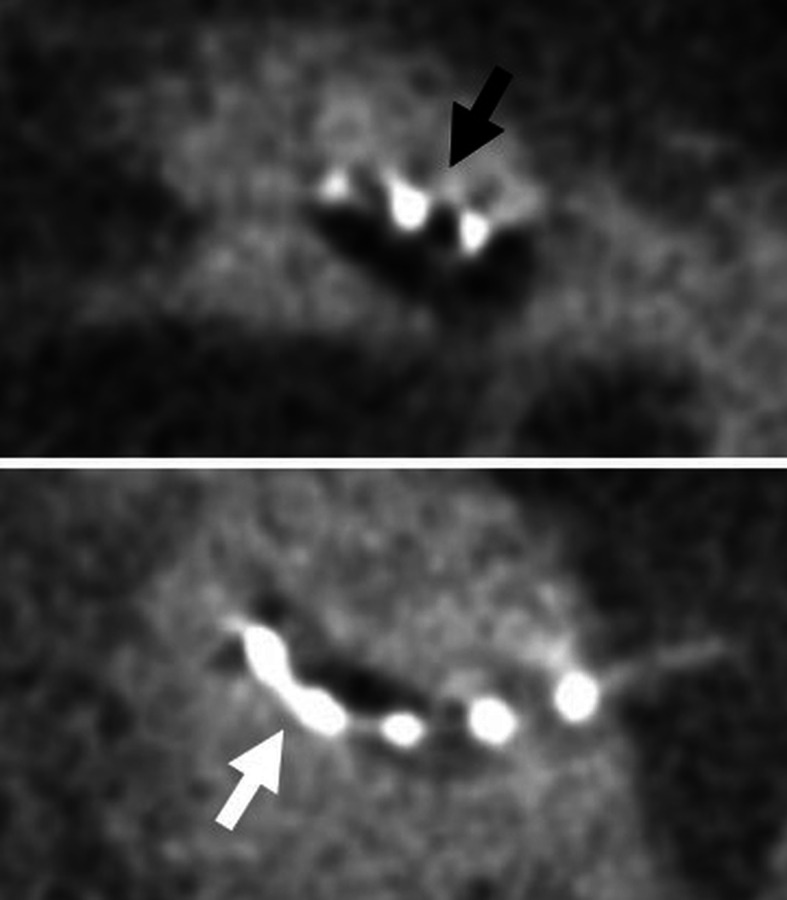
A 62-year-old male patient, with the scalar translocated electrode. CBCT axial images show translocation of the electrode array from scala tympani (white arrow) into scala vestibuli (black arrow). The electrode was inserted via cochleostomy
Fig. 26
Fig. 26
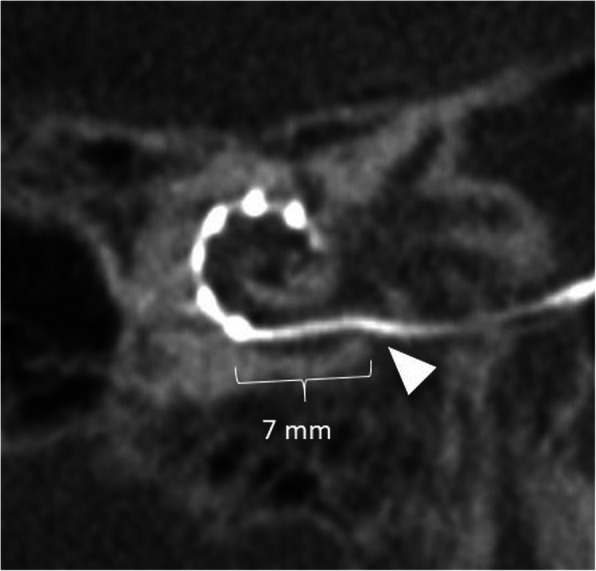
A 11-year-old male patient, with overinserted electrode. CBCT paraaxial maximum intensity projection image shows the most basal electrode contact 7 mm from the round window (arrowhead)
Fig. 27
Fig. 27
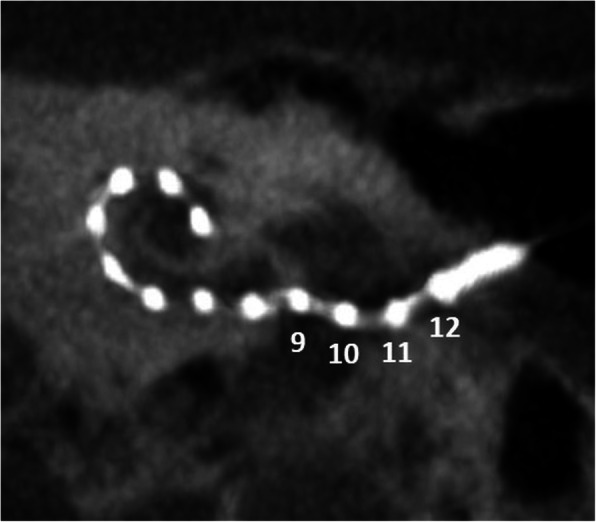
A 66-year-old female patient, with underinserted electrode. CBCT paraaxial maximum intensity projection image shows extracochlear location of electrode contacts 9 to 12
Fig. 28.
Fig. 28.
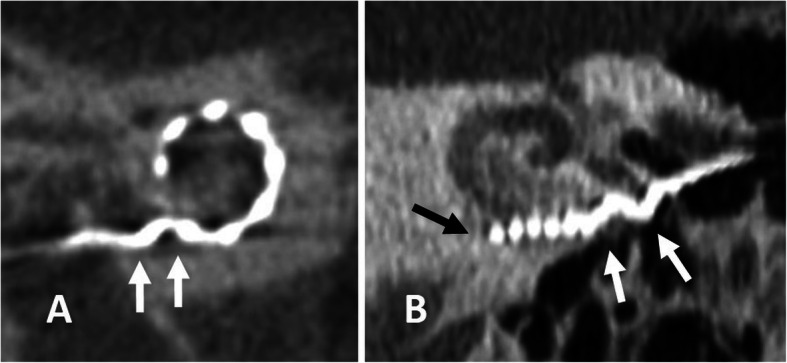
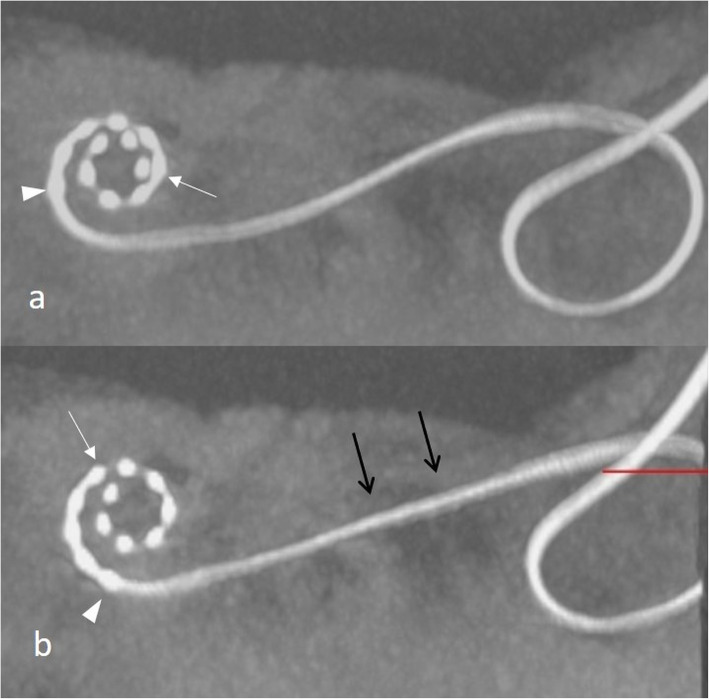
a A 75-year-old female patient, with electrode bending. CBCT paraaxial image shows electrode bending (arrows) at the basal turn. b A 70-year-old male patient with electrode pinching in far advanced otosclerosis. CBCT paraaxial image shows accordion-like pinching of the basal parts of the electrode array (white arrows). The tip of the electrode array sticks at the basal turn and does not turn around the modiolus (black arrow)
Fig. 29
Fig. 29
A 66-year-old male patient, with tip fold-over. CBCT paraaxial maximum intensity projection image shows fold-over of the tip of the electrode in the cochlea (arrow)
Fig. 30
Fig. 30
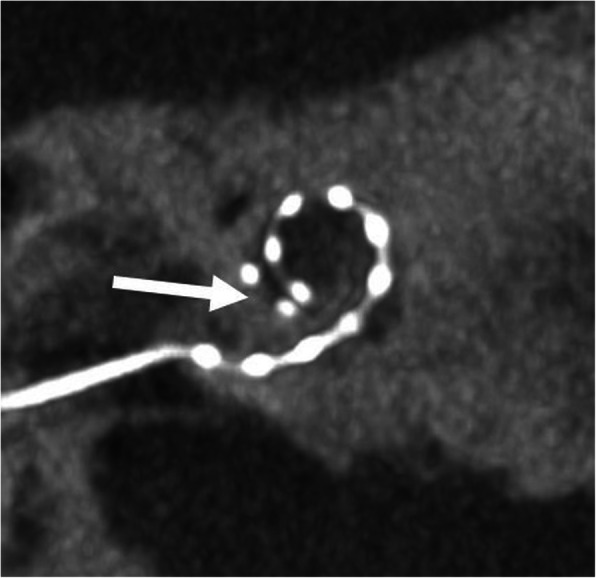
A 55-year-old female patient, with basal fold-over. CBCT paraaxial maximum intensity projection image shows fold-over of the basal part of the electrode within the cochlea (arrowhead)
Fig. 31
Fig. 31
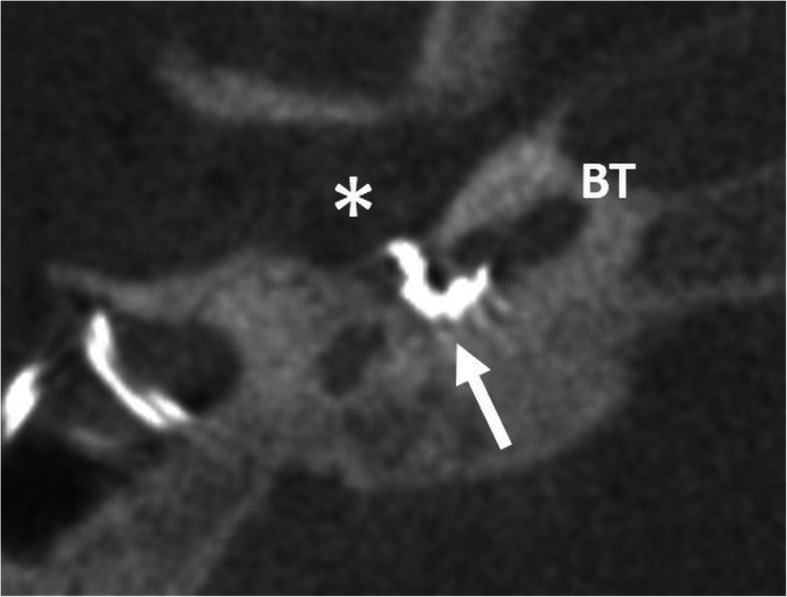
A 13-year-old female patient, with CHARGE syndrome and malposition of the electrode in the tympanic cavity (asterisk). CBCT axial image shows the apical part of the electrode array (arrow) not passing the angled entry of the round window into the basal turn (BT)
Fig. 32
Fig. 32
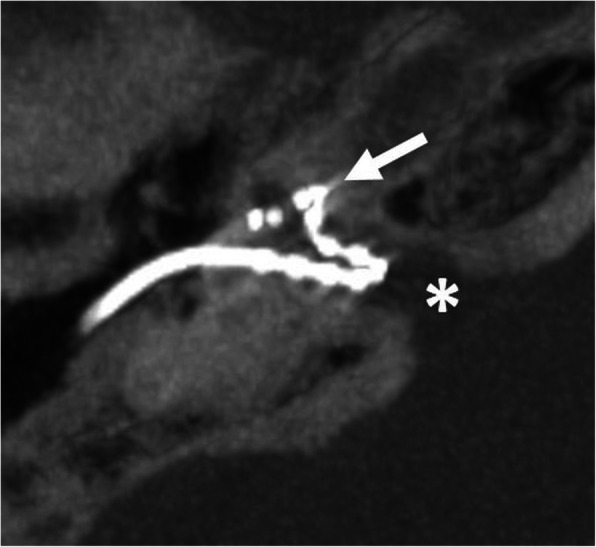
A 20-year-old male patient, with incomplete partition type III and malposition of the electrode in the internal auditory canal. CBCT paraaxial maximum intensity projection image shows part of the electrode array in the basal turn (arrow), but the rest of the electrode forming a slope within the internal auditory canal (asterisk)
Fig. 33
Fig. 33
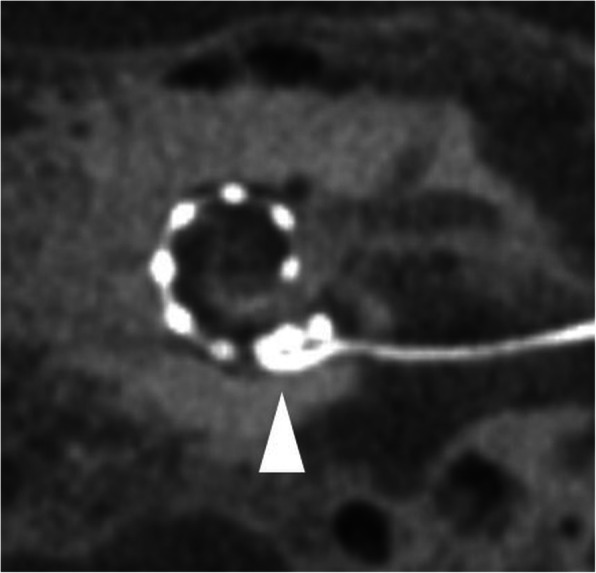
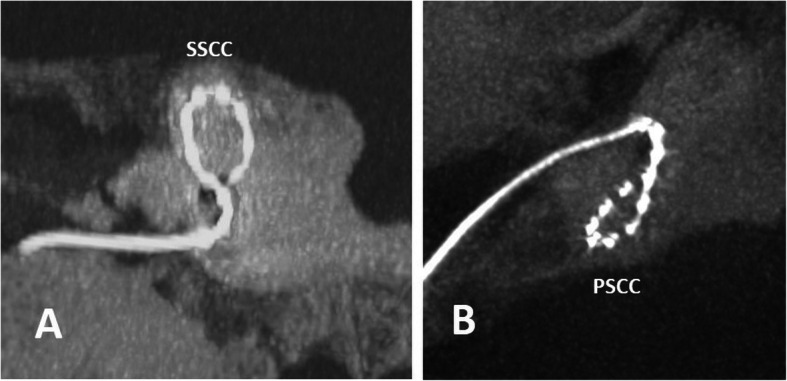
a A 86-year-old male patient, with immediate postoperative nausea. CBCT paracoronal maximum intensity projection image shows the malposition of the electrode in the superior semi-circular canal (SSCC). b A 20-year-old male patient with asymptomatic malposition of the electrode in the posterior semi-circular canal (PSCC) on CBCT paraaxial maximum intensity projection image
Fig. 34
Fig. 34
A 53-year-old male patient, with a complete malfunction of the CI and pain 3 months after CI surgery. CBCT paraaxial maximum intensity projection image shows initial overinsertion of the electrode array (a). The control scan shows back extrusion of the electrode array with migrated positions of the electrode tip (arrow) and basal electrode element (arrowhead) and straightened electrode array (black arrows) in the mastoidectomy cave (b)
Fig. 35
Fig. 35
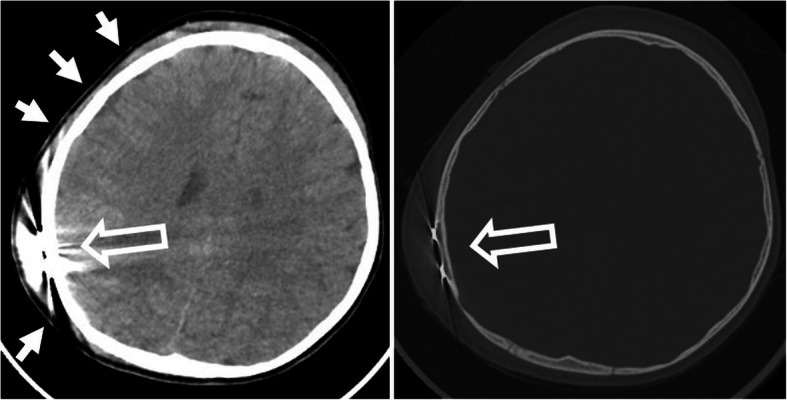
A 4-year-old male patient, with pain and insufficient hold of the speech processor after running into his brother. CT axial soft kernel image (left image) shows marked hematoma (arrows) in the skin at the frontal bone and temporal bone around the implanted magnet (hollow arrow). No intracranial bleeding. CT bone kernel axial image (right image) shows intact bone. The magnet is in the correct position

References

    1. Deep N, Dowling E, Jethanamest D, Carlson M. Cochlear implantation: an overview. J Neurol Surg Part B Skull Base. 2018;80:169–177. - PMC - PubMed
    1. Carlson ML, Sladen DP, Gurgel RK, Tombers NM, Lohse CM, Driscoll CL. Survey of the American Neurotology Society on cochlear implantation: part 1, candidacy assessment and expanding indications. Otol Neurotol. 2018;39:e12–e19. - PubMed
    1. Vesseur A, Free R, Snels C, et al. Hearing restoration in cochlear nerve deficiency: the choice between cochlear implant or auditory brainstem implant, a meta-analysis. Otol Neurotol. 2018;39:428–437. - PubMed
    1. Peng KA, Kuan EC, Hagan S, Wilkinson EP, Miller ME. Cochlear nerve aplasia and hypoplasia: predictors of cochlear implant success. Otolaryngol Head Neck Surg. 2017;157:392–400. - PubMed
    1. Birman CS, Brew JA, Gibson WPR, Elliott EJ. CHARGE syndrome and cochlear implantation: difficulties and outcomes in the paediatric population. Int J Pediatr Otorhinolaryngol. 2015;79:487–492. - PubMed

LinkOut - more resources