. 2020 Oct;594(20):3371-3383.
doi: 10.1002/1873-3468.13911. Epub 2020 Sep 4.

Immunometabolic function of the transcription cofactor VGLL3 provides an evolutionary rationale for sexual dimorphism in autoimmunity

Affiliations

Immunometabolic function of the transcription cofactor VGLL3 provides an evolutionary rationale for sexual dimorphism in autoimmunity

Adam Pagenkopf et al. FEBS Lett. 2020 Oct.

Abstract

Sexual dimorphism is exhibited remarkably in the female predominance of autoimmune diseases (e.g. systemic lupus erythematosus, female-to-male ratio 9 : 1). To understand the female bias in autoimmunity, we focused on vestigial-like family member 3 (VGLL3), a molecule with increased expression in females and known to promote autoimmunity. We report that VGLL3 mediates the cellular stress response by upregulating p53 and IL-17C. Energy stress allows VGLL3 to be induced by IFNα, which ultimately leads to p53-dependent, lupus-associated, inflammatory cell death. Our results suggest that female-biased expression of VGLL3 helps cells adapt to metabolic stress, which, intriguingly, is known as a significant challenge during the evolution of placental mammals due to the need to feed a developing embryo. The findings also uncover the importance of maintaining metabolic homeostasis in the prevention of autoimmunity.

Keywords: autoimmunity; immunometabolism; sexual dimorphism.


Conflict of interest statement

Conflict of interests

The authors declare no financial conflict of interests.

Figures
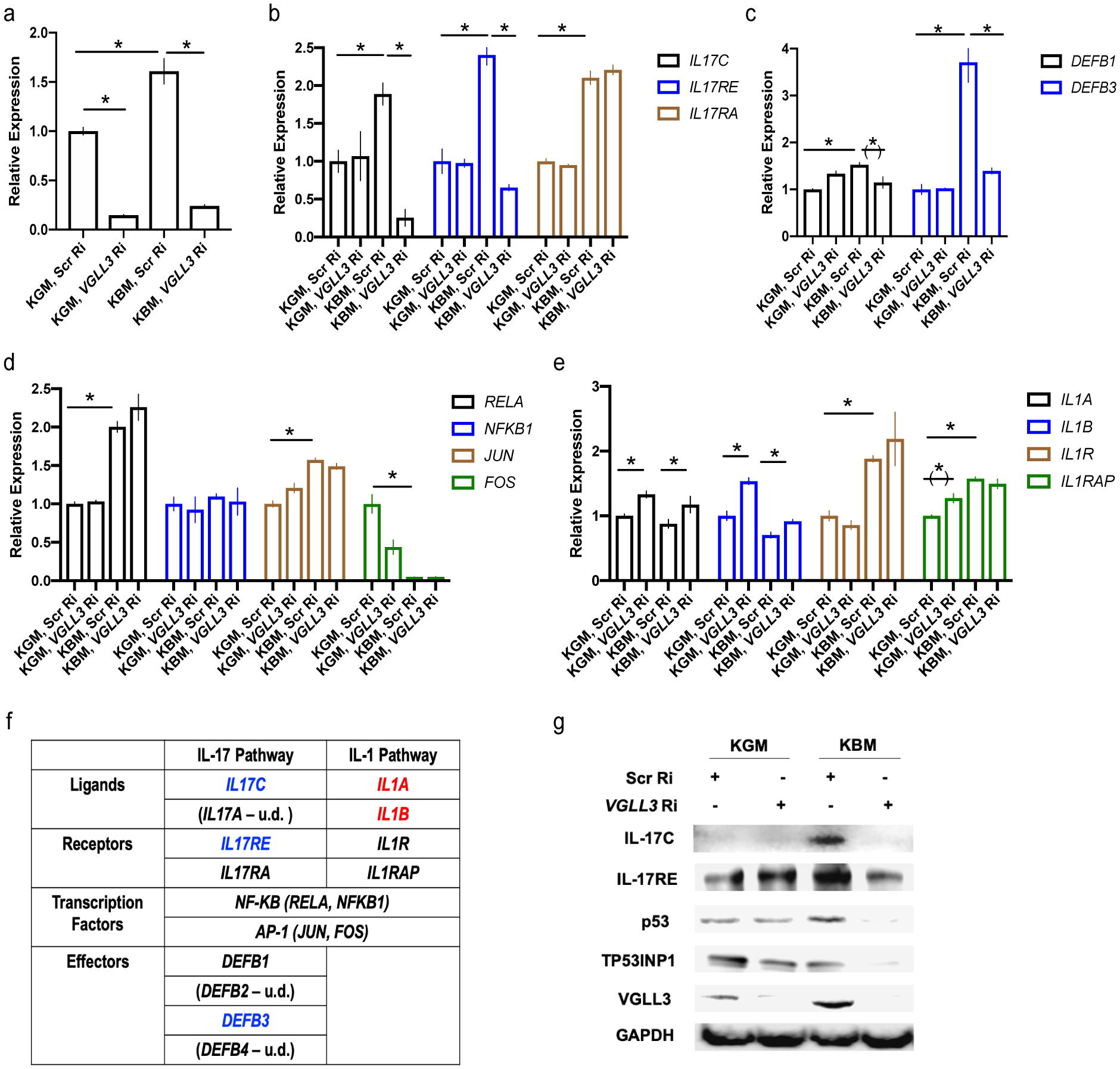
Figure 1.
Figure 1.
VGLL3 supports keratinocyte adaptation to nutrient deprivation. a-e, qRT-PCR of VGLL3 (a), IL-17 and receptor genes (b), DEFBs (c), NF-κB and AP-1 genes (d), IL-1 and receptor genes (e) under KGM (keratinocyte growth media, complete) or KBM (keratinocyte basal media, removing growth factors) culture conditions in female keratinocytes, with scrambled (Scr Ri) or VGLL3 (VGLL3 Ri) siRNA. n=3, mean ±s.e.m, * P <0 .05, (*) P < 0.1, Student’s t-test. f, summary of the effect of VGLL3 knockdown on IL-17 and IL-1 pathways. Blue, expression downregulated by VGLL3 knockdown. Red, expression upregulated by VGLL3 knockdown. u.d., expression undetermined. g, western blot of indicated proteins under KGM (keratinocyte growth media, complete) or KBM (keratinocyte basal media, removing growth factors) culture conditions, with scrambled (Scr Ri) or VGLL3 (VGLL3 Ri) siRNA in female keratinocytes.
Figure 2.
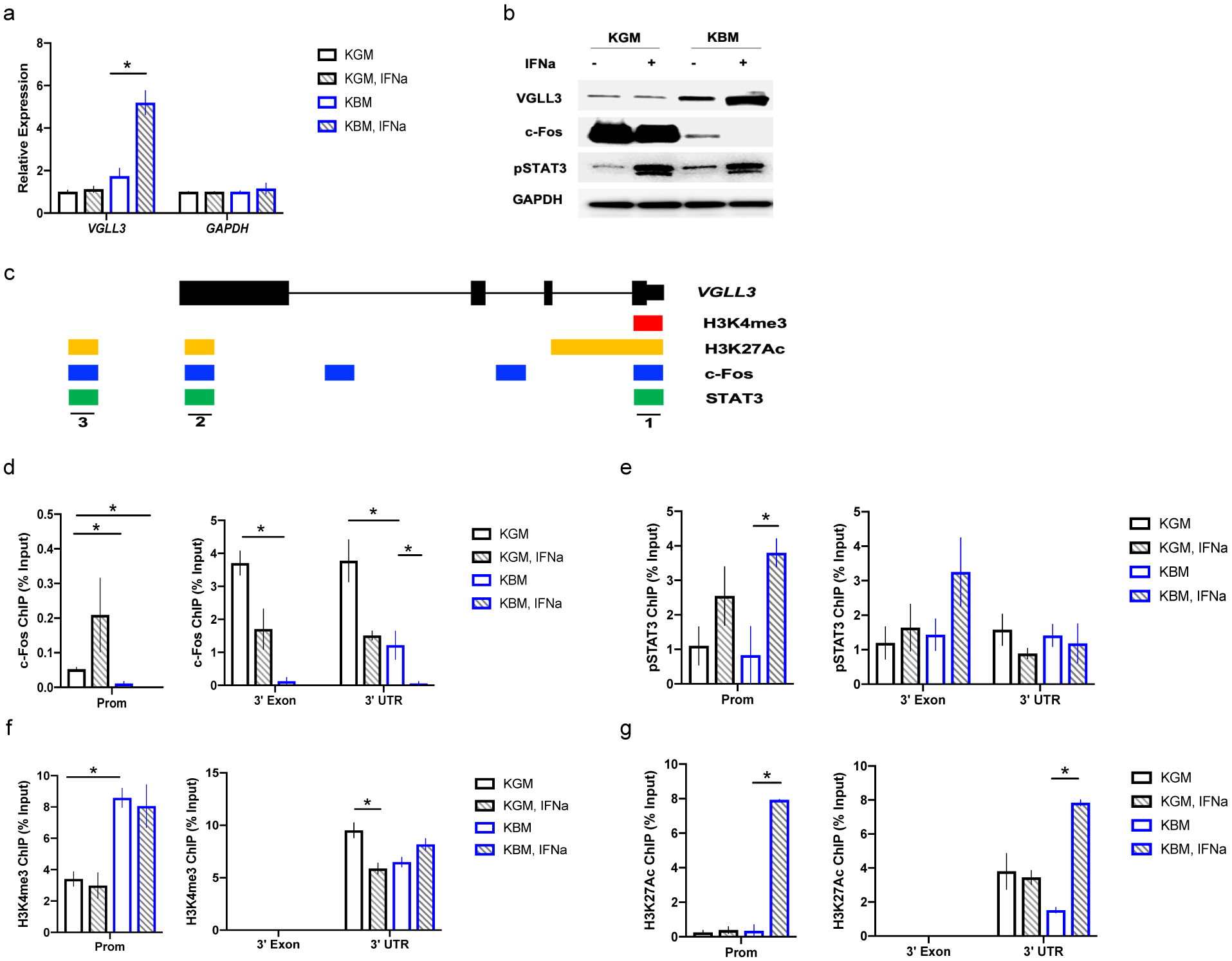
Figure 2.
Nutrient stress remodels VGLL3 chromatin, enabling VGLL3 induction by IFNα. a, qRT-PCR of VGLL3 under KGM (keratinocyte growth media, complete) or KBM (keratinocyte basal media, removing growth factors) culture conditions in female keratinocytes, with or without IFNα treatment. b, western blot of indicated proteins under KGM or KBM culture conditions, with or without IFNα treatment in female keratinocytes. c, regulatory sites along VGLL3 gene, summarized from UCSC genome browser. d-g, ChIP-qPCR of c-Fos (d), pSTAT3 (e), H3K4me3 (f), and H3K27ac (g) on the three regulatory sites of VGLL3, under KGM or KBM culture conditions, with or without IFNα treatment in female keratinocytes. n=3, mean ±s.e.m, * P <0 .05, Student’s t-test.
Figure 3.
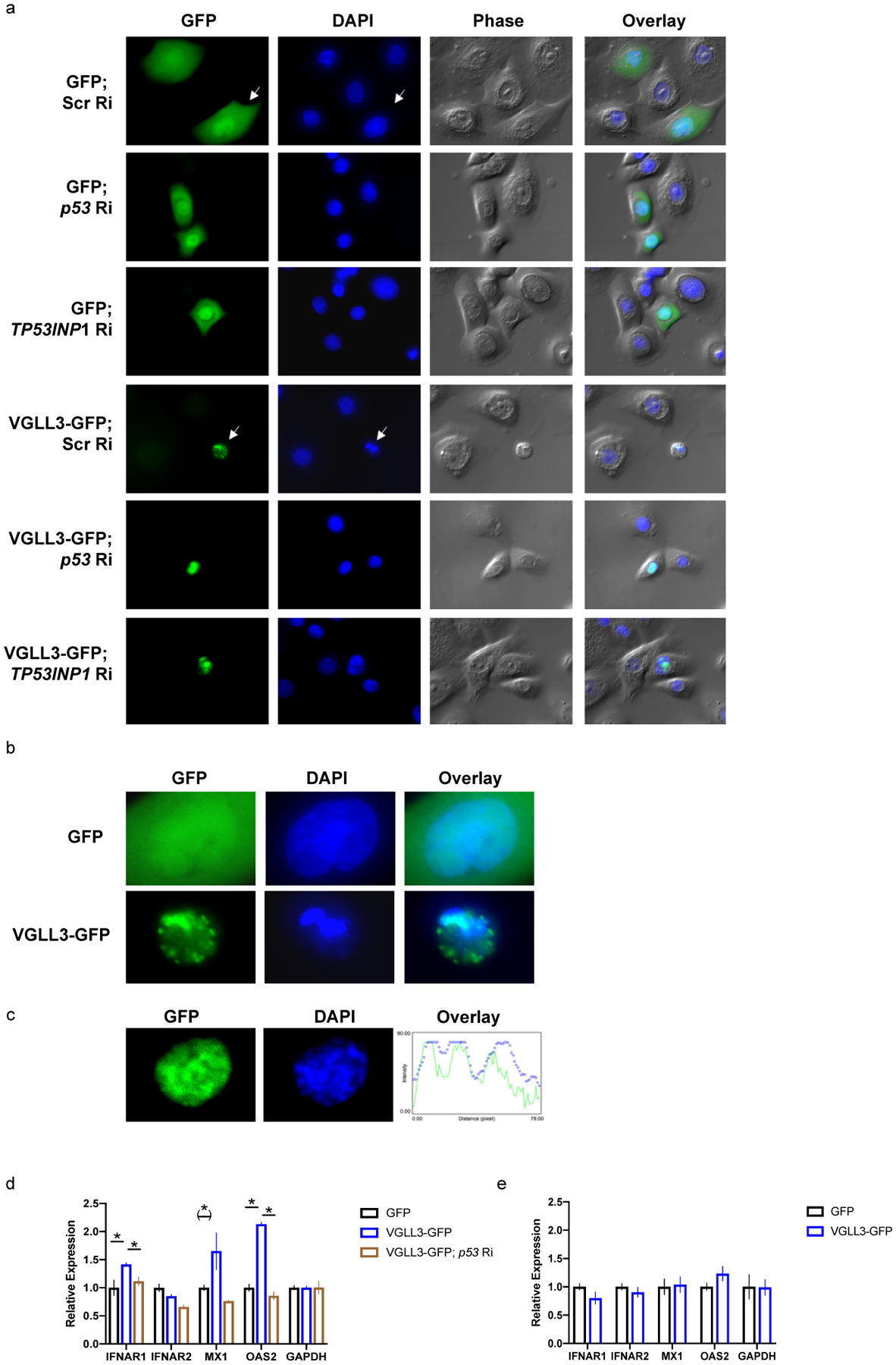
Figure 3.
VGLL3 excess causes regulated, inflammatory cell death. a, keratinocyte cell morphology (phase) and DNA status (DAPI) upon transfection with indicated constructs in female keratinocytes. Ri, RNAi. Scr, Scrambled. Zoom-in pictures of arrow-pointed cells are shown in b to demonstrate chromatin condensation. c, overlap between GFP and DAPI signals in female keratinocyte expressing VGLL3-GFP. d, qRT-PCR of indicated genes in THP-1 cells migrated to conditioned media from female keratinocytes overexpressing GFP, VGLL3-GFP, and VGLL3-GFP with siRNA against p53. n=3. e, qRT-PCR of indicated genes in female keratinocytes overexpressing GFP and VGLL3-GFP. n=3. Mean ±s.e.m, * P < 0 .05, (*) P < 0.1, Student’s t-test.
Figure 4.
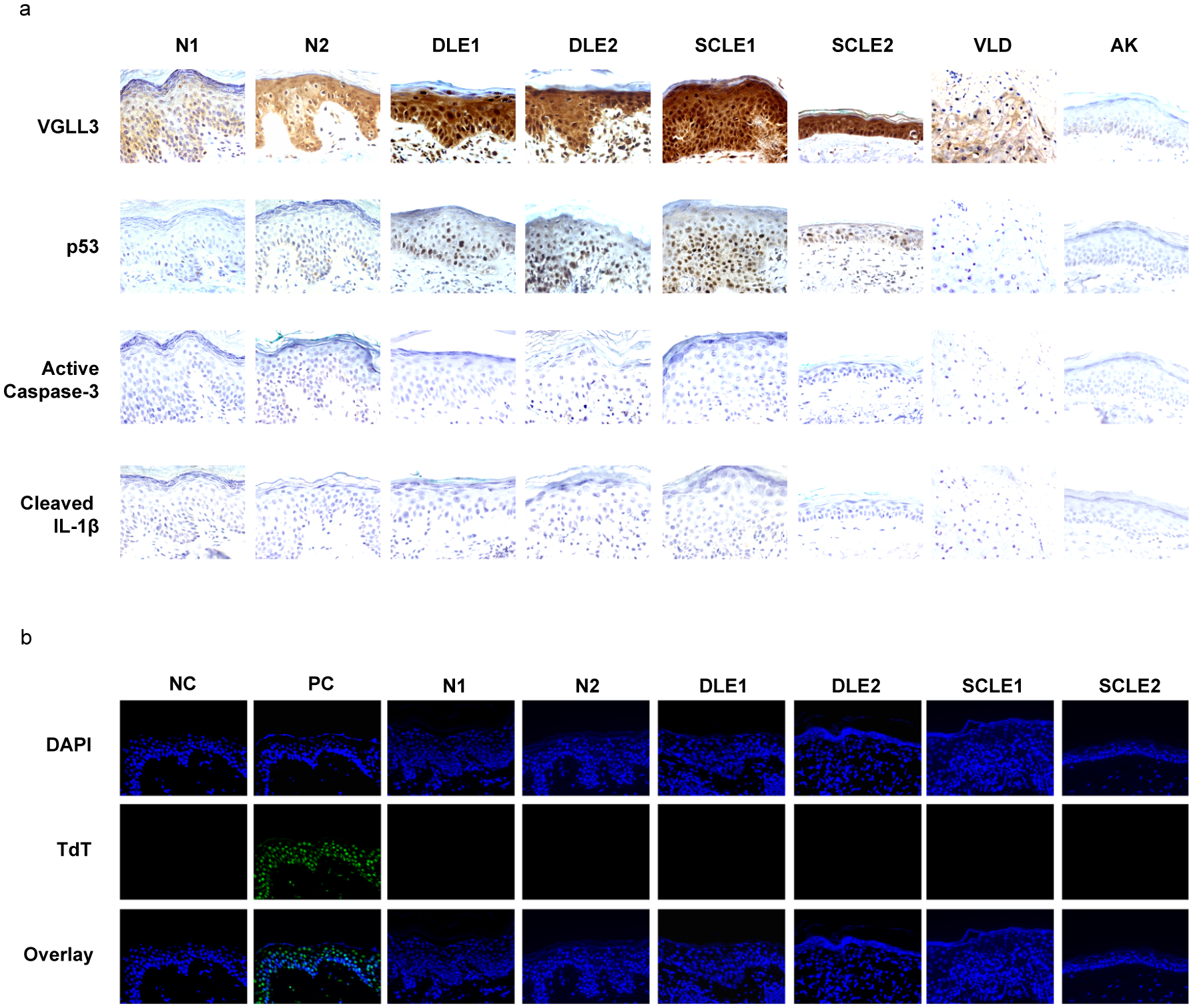
Figure 4.
VGLL3-p53 is upregulated in lupus lesional skin. a, immunohistochemistry staining of indicated proteins. b, TUNEL assay of normal and lupus skin, with negative control (NC) and positive control (PC) shown on the left. N1, normal skin, male. N2, normal skin, female. DLE1, discoid lupus erythematosus skin, male. DLE2, discoid lupus erythematosus skin, female. SCLE1, subacute cutaneous lupus erythematosus skin, male. SCLE2, subacute cutaneous lupus erythematosus skin, female. VLD, vulva lichenoid dermatitis, female. AK, actinic keratosis, male.

References

    1. Crow JF Advantages of sexual reproduction. Dev Genet 15, 205–213, doi:10.1002/dvg.1020150303 (1994). - DOI - PubMed
    1. Klein SL & Flanagan KL Sex differences in immune responses. Nat Rev Immunol 16, 626–638, doi:10.1038/nri.2016.90 (2016). - DOI - PubMed
    1. Li B et al. A Comprehensive Mouse Transcriptomic BodyMap across 17 Tissues by RNA-seq. Sci Rep 7, 4200, doi:10.1038/s41598-017-04520-z (2017). - DOI - PMC - PubMed
    1. Trabzuni D et al. Widespread sex differences in gene expression and splicing in the adult human brain. Nat Commun 4, 2771, doi:10.1038/ncomms3771 (2013). - DOI - PMC - PubMed
    1. Gershoni M & Pietrokovski S The landscape of sex-differential transcriptome and its consequent selection in human adults. BMC Biol 15, 7, doi:10.1186/s12915-017-0352-z (2017). - DOI - PMC - PubMed

Publication types

MeSH terms