


Increasing Awareness and Use of Mobile Health Technology Among Individuals With Hypertension in a Rural Community of Bangladesh: Protocol for a Randomized Controlled Trial
- PMID: 32804088
- PMCID: PMC7459433
- DOI: 10.2196/15523
Increasing Awareness and Use of Mobile Health Technology Among Individuals With Hypertension in a Rural Community of Bangladesh: Protocol for a Randomized Controlled Trial
Abstract
Background: Hypertension remains one of the foremost noncommunicable diseases that most often lead to cardiovascular diseases and its different complications. The prevalence of hypertension in Bangladesh has been increasing. However, there are very limited studies that have evaluated the impact of health education and awareness development in mitigating the burden of hypertension and its complications in Bangladesh.
Objective: This study aims to increase awareness, enhance knowledge, and change lifestyle behaviors through health education and the use of mobile health (mHealth) technology among individuals with hypertension living in a rural community of Bangladesh.
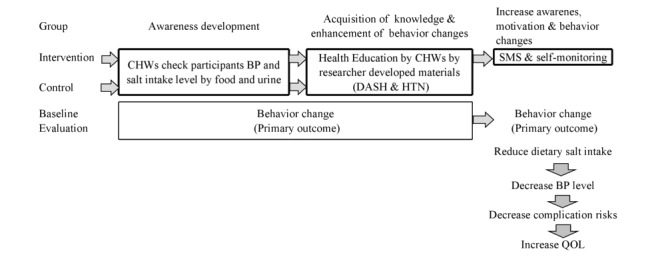
Methods: A randomized controlled trial is underway in a Mirzapur subdistrict of Bangladesh. This trial compares two groups of individuals with hypertension: The comparison arm receives health education and the intervention arm receives health education and a periodic mobile phone-based text message intervention. The trial duration is 5 months. The primary end point is participants' actual behavior changes brought about by increased awareness and knowledge.
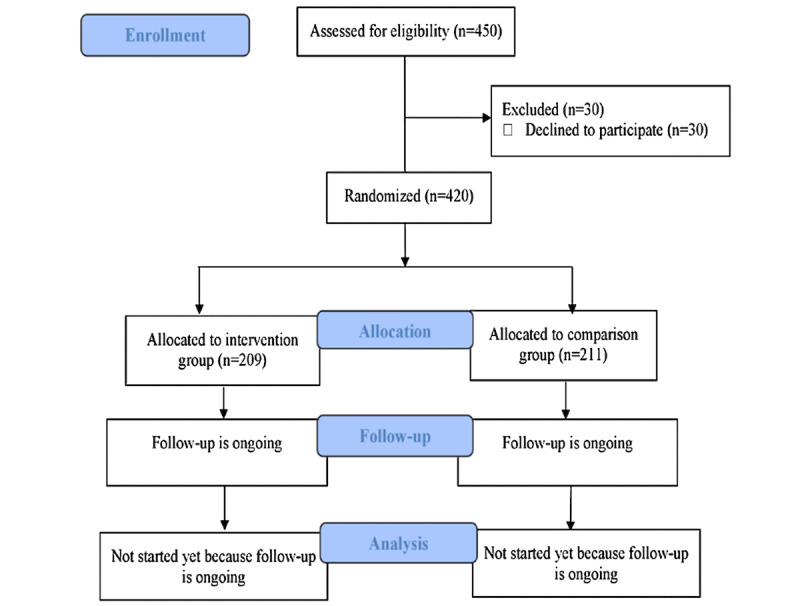
Results: Enrollment of participants started in August 2018, and collection of follow-up data was completed at the end of July 2019. A total of 420 participants volunteered to participate, and among them, 209 and 211 were randomly allocated to the intervention group and the control group, respectively. Among them, the ratio of males/females was 12.0/88.0 in the intervention group and 16.1/83.9 in the control group. Data cleaning and analyses have been completed and the results have been submitted for publication.
Conclusions: Periodic short education using mHealth technology in addition to face-to-face health education may be an effective method for increasing awareness and knowledge about behavioral changes and maintaining healthy lifestyle behaviors.
Trial registration: Bangladesh Medical Research Council (BMRC) 06025072017; ClinicalTrials.gov NCT03614104, https://clinicaltrials.gov/ct2/show/NCT03614104; University hospital Medical Information Network (UMIN) R000033736, https://upload.umin.ac.jp/cgi-open-bin/ctr_e/ctr_his_list.cgi?recptno=R000033736.
International registered report identifier (irrid): DERR1-10.2196/15523.
Keywords: Bangladesh; awareness development; behavioral changes; hypertension; knowledge; mHealth.
©Yasmin Jahan, Michiko Moriyama, Md Moshiur Rahman, Kana Kazawa, Atiqur Rahman, Abu Sadat Mohammad Sayeem Bin Shahid, Sumon Kumar Das, Abu Syed Golam Faruque, Mohammod Jobayer Chisti. Originally published in JMIR Research Protocols (http://www.researchprotocols.org), 17.08.2020.
Conflict of interest statement
Conflicts of Interest: None declared.
Figures
References
-
- World Health Organization Global Status Report on Noncommunicable Diseases 2010: Description of the Global Burden of NCDs, Their Risk Factors and Determinants. 2011. pp. 1–176. https://www.who.int/nmh/publications/ncd_report2010/en/
-
- Narayan KM, Ali MK, Koplan JP. Global noncommunicable diseases—where worlds meet. N Engl J Med. 2010;363(13):1196–1198. doi: 10.1056/NEJMp1002024. http://www.nejm.org/doi/abs/10.1056/NEJMp1002024 - DOI - DOI - PubMed
-
- World Health Organization Global Health Observatory (GHO) Data: Raised Blood Pressure. 2017. https://www.who.int/gho/ncd/risk_factors/blood_pressure_prevalence_text/en/
-
- World Health Organization A Global Brief on Hypertension: Silent Killer, Global Public Health Crisis: World Health Day. 2013. https://apps.who.int/iris/handle/10665/79059 .
-
- Shehata MF. A proposed study on how far anger contributes to initiating essential hypertension in canadian caucasian adults with a family history of hypertension. Clin Med Insights Cardiol. 2010;4(3):9–13. doi: 10.1177/117954681000400001. http://journals.sagepub.com/doi/10.1177/117954681000400001 - DOI - DOI - PMC - PubMed
Associated data
LinkOut - more resources
Full Text Sources
Medical
