Review
. 2020 Oct;47(10):1110-1118.
doi: 10.1111/1346-8138.15536. Epub 2020 Aug 17.

Skin microbiota in health and disease: From sequencing to biology

Affiliations
Review

Skin microbiota in health and disease: From sequencing to biology

Thomas H A Ederveen et al. J Dermatol. 2020 Oct.

Abstract

Microbiota live in a closely regulated interaction with their environment, and vice versa. The presence and absence of microbial entities is greatly influenced by features of the niche in which they thrive. Characteristic of this phenomenon is that different human skin sites harbor niche-specific communities of microbes. Microbial diversity is considerable, and the current challenge lies in determining which microbes and (corresponding) functionality are of importance to a given ecological niche. Furthermore, as there is increasing evidence of microbial involvement in health and disease, the need arises to fundamentally understand microbiome processes for application in health care, nutrition and personal care products (e.g. diet, cosmetics, probiotics). This review provides a current overview of state-of-the-art sequencing-based techniques and corresponding data analysis methodology for profiling of complex microbial communities. Furthermore, we also summarize the existing knowledge regarding cutaneous microbiota and their human host for a wide range of skin diseases.

Keywords: bioinformatics; cutaneous diseases; microbiomics; next-generation sequencing; skin microbiota.


Conflict of interest statement

None declared.

Figures
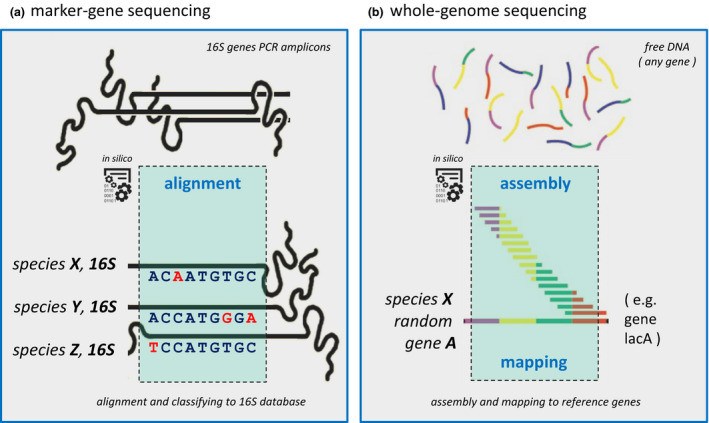
Figure 1
Figure 1
Principal microbiota sequencing approaches. We roughly distinguish two main applications for next‐generation sequencing (NGS) of microbial communities: marker‐gene sequencing (MGS) for metataxonomics and whole‐genome sequencing (WGS) for metagenomics. (a) In the MGS example, 16S is selected as marker gene, which is extracted from a mixed microbial population by polymerase chain reaction (PCR, not shown), and sequenced by NGS techniques. After MGS sequencing, reads (±500 bp) are aligned, and based on informative positional differences in the 16S gene, known reference microbiota can be assigned, or novel taxonomies can be inferred. With WGS, one can extract genomic potential and function information, in contrast with MGS, as with the latter, one can only extract taxonomic information. (b) In the WGS example, typically small sequences (100–150 bp), derived randomly from the full genomic content (i.e. all genes present, not focusing only on 16S) of a mixed microbial population, are assembled into genes of all microbiota present.
Figure 2
Figure 2
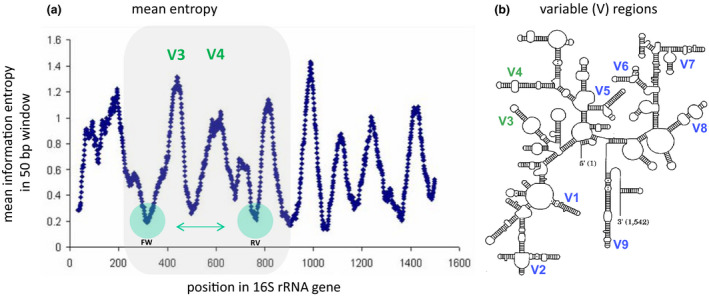
16S rRNA marker gene characteristics. The 16S rRNA gene in bacteria is widely used for metataxonomics. Between different clades of phylogenetically‐related bacteria, this gene varies strongly in terms of conservation and variation, as shown in the left panel by the consecutive peaks and valleys in that graph. (a) Visualization of the mean information entropy for each position of the 16S gene (±1.5 kbp in length), based on all known 16S genes present in the Ribosomal Database Project. One can see peaks (strong variation) and valleys (strong conservation) in different regions of the 16S gene sequence, regions which can be used for taxonomic discrimination and primer design, respectively. In this example, we observe nine peaks (variable regions), of which V3 and V6 show the largest peaks and deepest valleys. Therefore, the gene region from V3 up to V6 is very suitable for primer design and marker‐gene sequencing. Nonetheless, as most currently applied short‐read next‐generation sequencing applications are not able to sequence for more than 500 bp, like for Illumina MiSeq, one has to choose for a shorter region length, such as for V1–V2, or for V3–V4 as illustrated here. Figure adapted from Andersson et al. 81 . (b) The nine different variable regions, structurally visualized over the full length of the 16S gene. The locations of V3 and V4 are indicated in green.
Figure 3
Figure 3
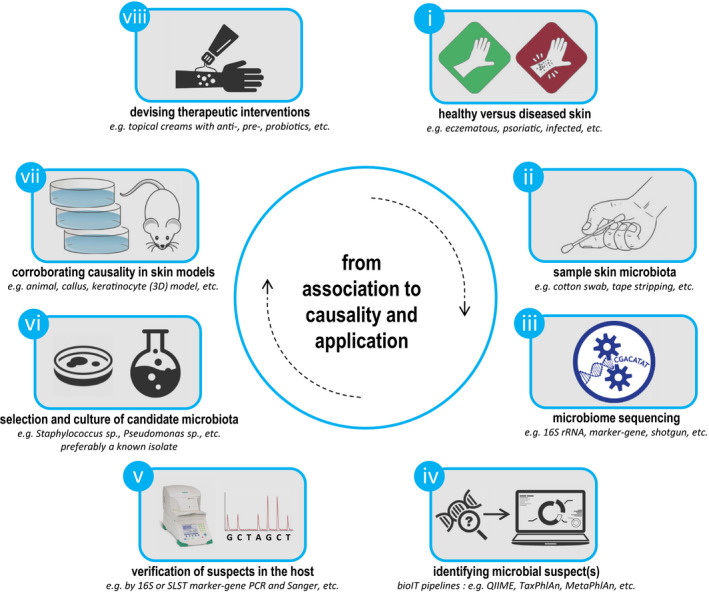
Studies do not stop at association. Schematic typical workflow/study approach in order to potentially go from association to causality, with specific focus on skin (micro)biology. (i) Healthy versus affected skin is evaluated, with suspected involvement of the microbiome as causative driver. (ii) Skin samples are collected through standard protocols, and (iii) are sequenced by a suitable platform depending on research question and study budget. (iv) Microbial suspects are identified by available data analysis pipelines, and (v) their specific presence and (differential) abundance are validated in the host by alternative (conventional) methods. Thereafter, (vi) candidates are selected and cultured for (vii) corroboration of microbiota‐associated effects of initial study findings by relevant in vitro or in vivo (disease) models. Finally, if applicable, (viii) functional applications could potentially be devised from study findings (e.g. organisms, proteins, compounds, protease inhibitors), ultimately leading to novel therapeutic interventions for treatment of skin disease. PCR, polymerase chain reaction; SLST, single‐locus sequence typing.

References

    1. Sender R, Fuchs S, Milo R. revised estimates for the number of human and bacteria cells in the body. PLOS Biology 2016; 14(8): e1002533. - PMC - PubMed
    1. Marchesi JR, Ravel J. The vocabulary of microbiome research: a proposal. Microbiome 2015; 3(1): 31. - PMC - PubMed
    1. Scholz CF, Jensen A, Lomholt HB, Brüggemann H, Kilian M. A novel high‐resolution single locus sequence typing scheme for mixed populations of Propionibacterium acnes in vivo. PLoS One 2014; 9(8): e104199. - PMC - PubMed
    1. Ederveen THA, Smits JPH, Hajo K et al A generic workflow for Single Locus Sequence Typing (SLST) design and subspecies characterization of microbiota. Sci Rep 2019; 9(1): 19834. - PMC - PubMed
    1. Cole JR, Wang Q, Fish JA et al Ribosomal Database Project: data and tools for high throughput rRNA analysis. Nucleic Acids Res 2014; 42(D1): D633–D642. - PMC - PubMed