


Regional Variation in Billed Advance Care Planning Visits
- PMID: 32805062
- PMCID: PMC8060899
- DOI: 10.1111/jgs.16730
Regional Variation in Billed Advance Care Planning Visits
Abstract
Background/objective: Advance care planning (ACP) is associated with improved patient and caregiver outcomes, but is underutilized. To encourage ACP, the Centers for Medicare & Medicaid Services implemented specific ACP visit reimbursement codes in 2016. To better understand the utilization of these ACP reimbursement codes, we explored regional variation in billed ACP visits.
Design: We performed a retrospective cross-sectional analysis using a randomly sampled 5% cohort of Medicare fee-for-service (FFS) beneficiaries' claims files from 2017. Region was defined by hospital referral region.
Setting: National Medicare FFS.
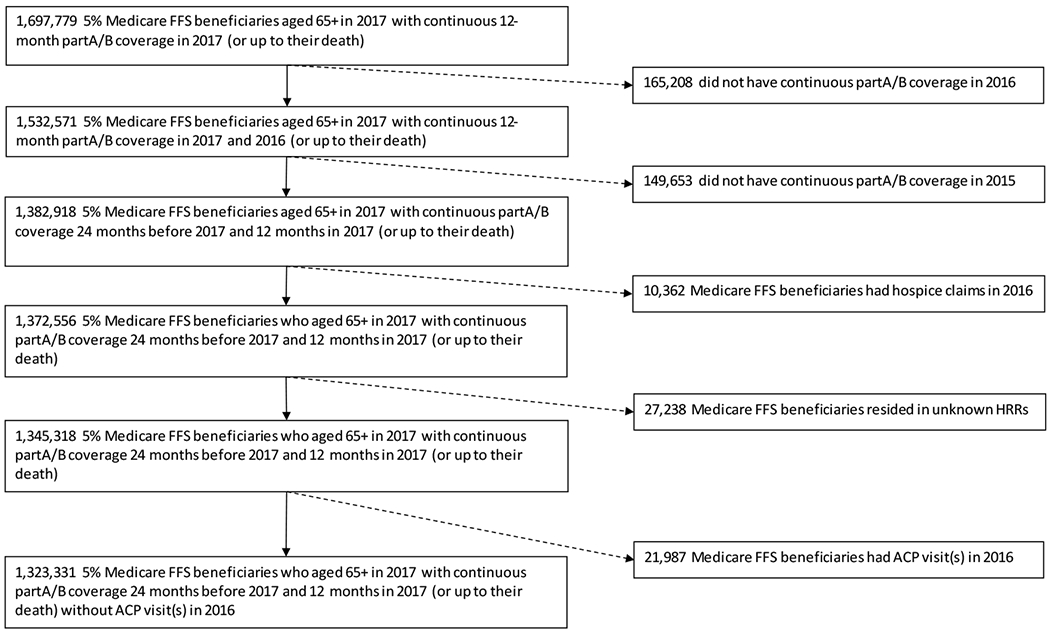
Participants: A total of 1.3 million Medicare beneficiaries aged 65 years and older.
Measurement: Receipt of billed ACP service, identified through Current Procedural Terminology code 99497 or 99498. Proportion of beneficiaries who received billed ACP service(s) by region was calculated. We fit a multilevel logistic regression model with a random regional intercept to determine the variation in billed ACP visits attributable to the region after accounting for patient (demographics, comorbidities, and medical care utilization) and regional factors (hospital size, emergency department visits, hospice utilization, and costs).
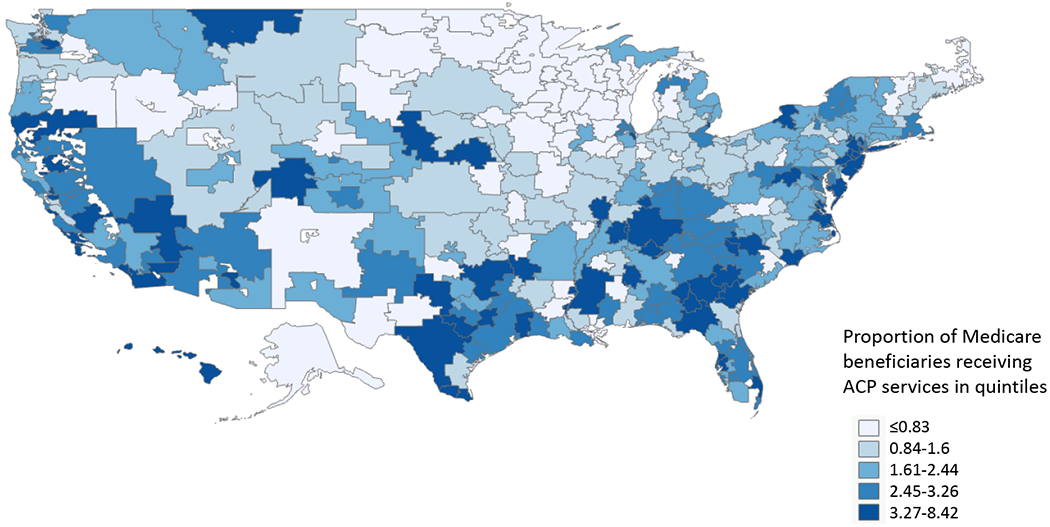
Results: The study population included about 1.3 million beneficiaries, of which 32,137 (2.4%) had at least one billed ACP visit in 2017. There was substantial regional variation in the percentage of beneficiaries with billed ACP visits: lowest quintile region, less than 0.83%; subsequent regions, less than 1.6%, less than 2.4%, less than 3.3% to less than 8.4% in the highest quintile regions. A total of 15.4% of the variance in whether an older adult had a billed ACP visit was explained by the region. Although numerous regional factors were associated with billed ACP visits, none were strong predictors.
Conclusion: In 2017, we found wide regional variation in the use of billed ACP visits, although use overall was low in all regions. Increasing the understanding of the drivers and the effects of billed ACP visits could inform strategies for increasing ACP.
Keywords: Medicare beneficiaries; advance care planning; regional variation.
© 2020 The American Geriatrics Society.
Conflict of interest statement
Conflict of interest: none
Figures
References
-
- Houben CHM, Spruit MA, Groenen MTJ, Wouters EFM, Janssen DJA. Efficacy of Advance Care Planning: A Systematic Review and Meta-Analysis. Journal of the American Medical Directors Association. 2014;15: 477–489. - PubMed
