Review
. 2020 Aug 17;21(1):103.
doi: 10.1186/s10194-020-01170-x.

Gut microbiota regulates neuropathic pain: potential mechanisms and therapeutic strategy

Affiliations
Review

Gut microbiota regulates neuropathic pain: potential mechanisms and therapeutic strategy

Binbin Lin et al. J Headache Pain. .

Abstract

Neuropathic pain (NP) is a sustained and nonreversible condition characterized by long-term devastating physical and psychological damage. Therefore, it is urgent to identify an effective treatment for NP. Unfortunately, the precise pathogenesis of NP has not been elucidated. Currently, the microbiota-gut-brain axis has drawn increasing attention, and the emerging role of gut microbiota is investigated in numerous diseases including NP. Gut microbiota is considered as a pivotal regulator in immune, neural, endocrine, and metabolic signaling pathways, which participates in forming a complex network to affect the development of NP directly or indirectly. In this review, we conclude the current understanding of preclinical and clinical findings regarding the role of gut microbiota in NP and provide a novel therapeutic method for pain relief by medication and dietary interventions.

Keywords: Gut microbiota; Neuropathic pain; Therapeutic strategy.


Conflict of interest statement

The authors declare that they have no competing interests.

Figures
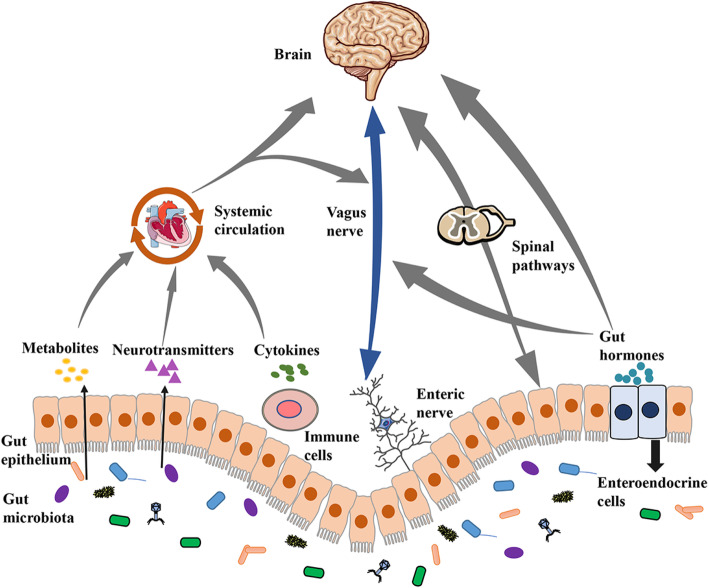
Fig. 1
Fig. 1
Communication pathways of the microbiota-gut-brain axis. This graph describes the crosstalk of the microbiota-gut-brain axis, which mainly comprise of four modules: metabolic, neural, immune, and endocrine signaling pathways
Fig. 2
Fig. 2
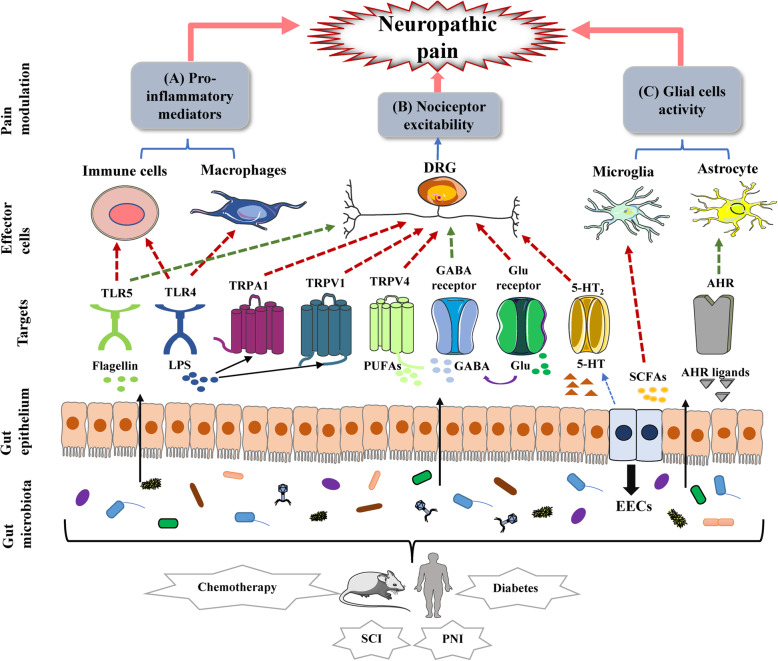
The potential role of gut microbiota in neuropathic pain. Gut microbiota-derived mediators participate in the modulation of neuropathic pain through three routes: a LPS and flagellin act on immune cells and macrophages through TLR, and lead to the release of pro-inflammatory mediators; b Different mediators alter nociceptor excitability via diverse receptors expressed on DRG neurons; c Metabolites regulate glial cells activity directly or through AHR. The red dotted line represents exacerbating pain and the green one represents alleviating pain. Abbreviations: DRG, dorsal root ganglion; TLR, Toll-like receptor; TRPA1, transient receptor potential cation channel, subfamily A, member 1; TRPV1, transient receptor potential cation channel, subfamily V, member 1; TRPV4, transient receptor potential cation channel, subfamily V, member 4; GABA, γ-aminobutyric acid; Glu, glutamate; AHR, aryl hydrocarbon receptor; LPS, lipopolysaccharide; PUFAs, polyunsaturated fatty acids; SCFAs, short-chain fatty acids; ECCs, enteroendocrine cells; SCI, spinal cord injury; PNI, peripheral nerve injury
Fig. 3
Fig. 3
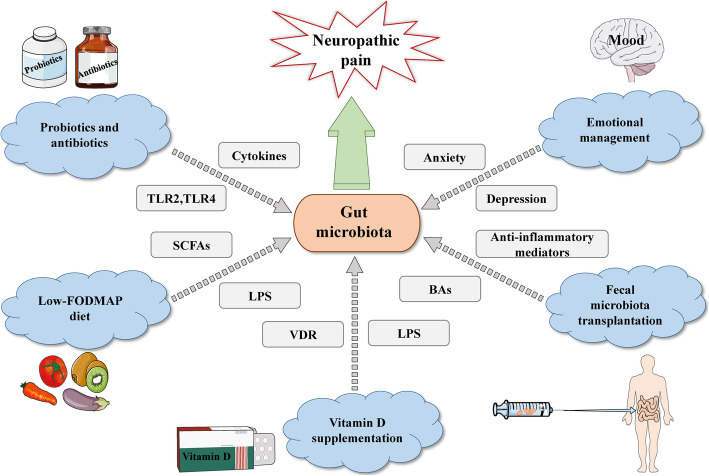
The underlying therapeutic strategy for neuropathic pain through targeting of gut microbiota. There are primarily five therapeutic regimens consisting of probiotics and antibiotics, fecal microbiota transplantation, low-FODMAP diet, vitamin D supplementation, and emotional management for effectively relieving NP. The grey dotted line symbolizes potential mediators/influence factors. Abbreviations: TLR, Toll-like receptor; BAs, bile acids; LPS, lipopolysaccharide; SCFAs, short-chain fatty acids; FODMAP, fermentable oligosaccharides, disaccharides, monosaccharides, and polyols; VDR, vitamin D receptor

References

    1. van Hecke O, Austin SK, Khan RA, Smith BH, Torrance N. Neuropathic pain in the general population: a systematic review of epidemiological studies. Pain. 2014;155(4):654–662. - PubMed
    1. Freynhagen R, Baron R, Tölle T, Stemmler E, Gockel U, Stevens M, Maier C. Screening of neuropathic pain components in patients with chronic back pain associated with nerve root compression: a prospective observational pilot study (MIPORT) Curr Med Res Opin. 2006;22(3):529–537. - PubMed
    1. von Hehn CA, Baron R, Woolf CJ. Deconstructing the neuropathic pain phenotype to reveal neural mechanisms. Neuron. 2012;73(4):638–652. - PMC - PubMed
    1. Sender R, Fuchs S, Milo R. Revised estimates for the number of human and bacteria cells in the body. PLoS Biol. 2016;14(8):e1002533. - PMC - PubMed
    1. Defaye M, Gervason S, Altier C, Berthon J-Y, Ardid D, Filaire E, Carvalho FA. Microbiota: a novel regulator of pain. J Neural Transm. 2020;127(4):445–465. - PubMed