Review
. 2020 Oct;98(10):1369-1383.
doi: 10.1007/s00109-020-01961-4. Epub 2020 Aug 18.

Immuno-epidemiology and pathophysiology of coronavirus disease 2019 (COVID-19)

Affiliations
Review

Immuno-epidemiology and pathophysiology of coronavirus disease 2019 (COVID-19)

Omalla A Olwenyi et al. J Mol Med (Berl). 2020 Oct.

Abstract

Occasional zoonotic viral attacks on immunologically naive populations result in massive death tolls that are capable of threatening human survival. Currently, severe acute respiratory syndrome coronavirus 2 (SARS-CoV-2), the infectious agent that causes coronavirus disease (COVID-19), has spread from its epicenter in Wuhan China to all parts of the globe. Real-time mapping of new infections across the globe has revealed that variable transmission patterns and pathogenicity are associated with differences in SARS-CoV-2 lineages, clades, and strains. Thus, we reviewed how changes in the SARS-CoV-2 genome and its structural architecture affect viral replication, immune evasion, and transmission within different human populations. We also looked at which immune dominant regions of SARS-CoV-2 and other coronaviruses are recognized by Major Histocompatibility Complex (MHC)/Human Leukocyte Antigens (HLA) genes and how this could impact on subsequent disease pathogenesis. Efforts were also placed on understanding immunological changes that occur when exposed individuals either remain asymptomatic or fail to control the virus and later develop systemic complications. Published autopsy studies that reveal alterations in the lung immune microenvironment, morphological, and pathological changes are also explored within the context of the review. Understanding the true correlates of protection and determining how constant virus evolution impacts on host-pathogen interactions could help identify which populations are at high risk and later inform future vaccine and therapeutic interventions.

Keywords: COVID-19; HLA; MHC; Pathogenesis; SARS-COV-2; Virus evolution.


Conflict of interest statement

The authors declare that they have no conflict of interest.

Figures
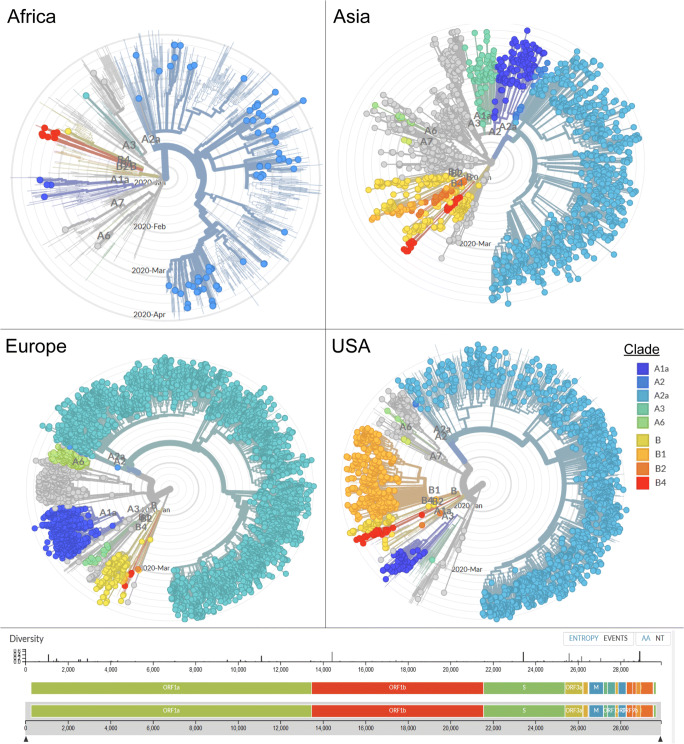
Fig. 1
Fig. 1
Phylogenetic analysis of full-length SARS-CoV-2 sequences submitted to Global Initiative on Sharing all Influenza Data (GISAID), (https://www.gisaid.org/CoV2020/). Radial phylogenetic trees were generated using Nextstrain (https://nextstrain.org/ncov) after the SARS-CoV-2 global dataset was filtered according to Africa, Asia, Europe, and the USA regions. The branch lengths are distanced by time and individual points colored by Clades (A1a, A2, A2a, A3, A6, B, B1, B2, and B4) with Wuhan-Hu-1/2019 used as a reference. Analysis was carried out on 2 May 2020
Fig. 2
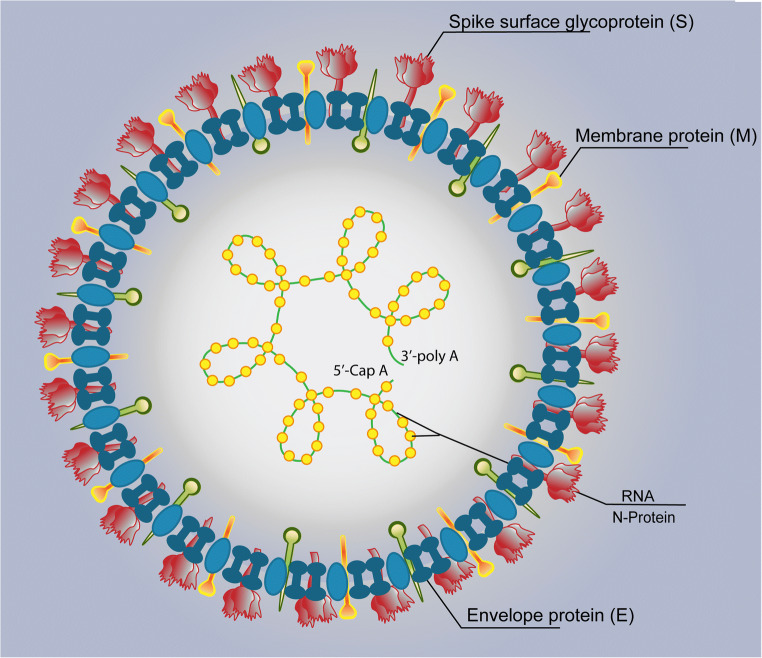
Fig. 2
Key structural proteins of severe acute respiratory syndrome coronavirus 2 (SARS-CoV-2) that include the spike surface glycoprotein (S), membrane protein (M), RNA attached to nucleocapsid protein (N) and envelope protein (E).
Fig. 3
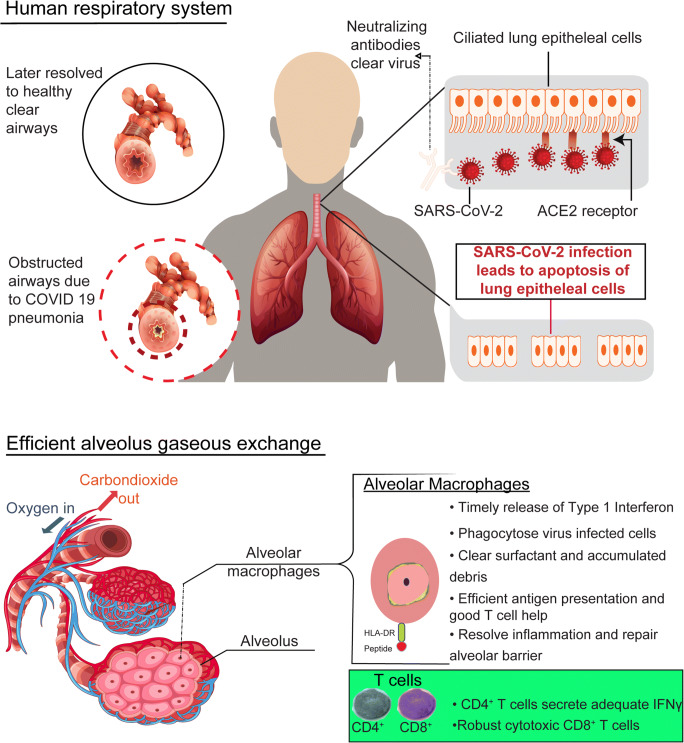
Fig. 3
Immunological events that occur in individuals who develop asymptomatic/mild to moderate symptoms of COVID-19 following exposure to SARS-CoV-2. Infection can be cleared by neutralizing antibodies (nabs). Upon recognition of foreign invaders via pattern recognition receptors (PRRs), macrophages secrete type I interferons that lead to an antiviral state. In addition, these macrophages phagocytose virus-infected cells that could have been opsonized by the nabs, carry out efficient antigen presentation to T cells, clear all the debris in the lungs, and resolve inflammation. As a result, highly functional T cells (CD4+ T cells expressing high levels of IFNγ and increased CD8+ T cell cytotoxicity) are obtained.
Fig 4
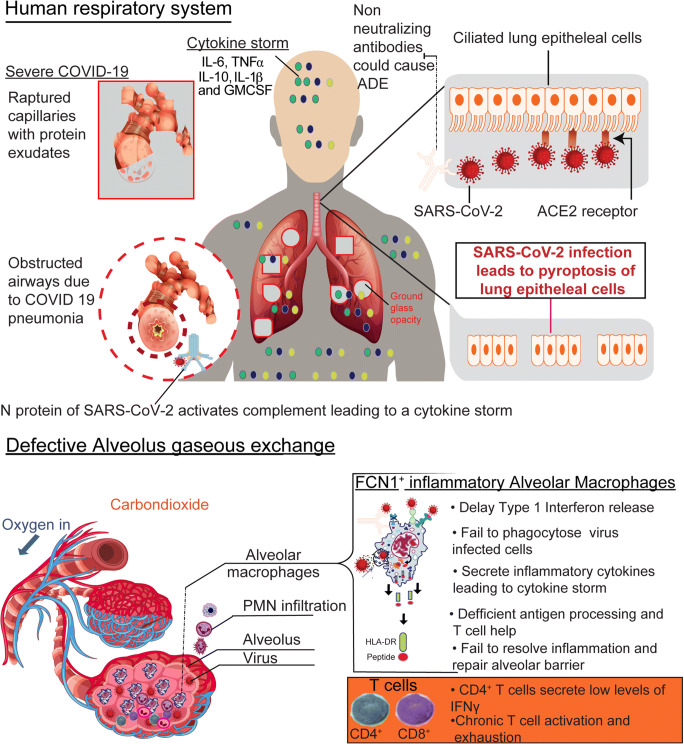
Fig 4
Immunological events that lead to severe COVID-19. SARS-CoV-2 evades detection by neutralizing antibodies (nabs). Present non-nabs could contribute to the severity of pathogenesis by causing antibody-dependent enhancement (ADE). Following macrophage detection of the virus, delays in secretion of type 1 interferons avoid antiviral state hence favoring increased viral replication. In addition, macrophage function is dysregulated as evidenced by the failure to resolve inflammation within the lungs, inadequate repairs of the alveolar barrier, damage to the alveolar capillary networks, and increased buildup of debris leads to poor oxygen saturation as demonstrated by bi-lateral ground-glass opacity. In addition, the depletion of alveolar macrophages followed by subsequent enrichment of inflammatory Ficolin-1+ (FCN1+) macrophages, infiltration of polymorphonuclear neutrophils (PMNs) followed by activation of complement pathways lead to exaggerated production of inflammatory cytokines that later sustains a cytokine storm, and fuels systemic pathology.

References

    1. Mnookin S (2011) The panic virus: a true story of medicine, science, and fear. Simon and Schuster
    1. Galloway SE, Petzing SR, Young CG (2015) Reassessing biological threats: implications for cooperative mitigation strategies. Front Public Health 3(251). 10.3389/fpubh.2015.00251 - PMC - PubMed
    1. Dawood AA. Mutated COVID-19 may foretell a great risk for mankind in the future. New Microbes New Infect. 2020;35:100673. doi: 10.1016/j.nmni.2020.100673. - DOI - PMC - PubMed
    1. Rouzine IM, Rozhnova G. Antigenic evolution of viruses in host populations. PLoS Pathog. 2018;14(9):e1007291. doi: 10.1371/journal.ppat.1007291. - DOI - PMC - PubMed
    1. Remuzzi A, Remuzzi G (2020) COVID-19 and Italy: what next? Lancet - PMC - PubMed

Publication types

MeSH terms