


An international multicenter efficacy and safety study of IqYmune in initial and maintenance treatment of patients with chronic inflammatory demyelinating polyradiculoneuropathy: PRISM study
- PMID: 32808406
- PMCID: PMC7754365
- DOI: 10.1111/jns.12408
An international multicenter efficacy and safety study of IqYmune in initial and maintenance treatment of patients with chronic inflammatory demyelinating polyradiculoneuropathy: PRISM study
Abstract
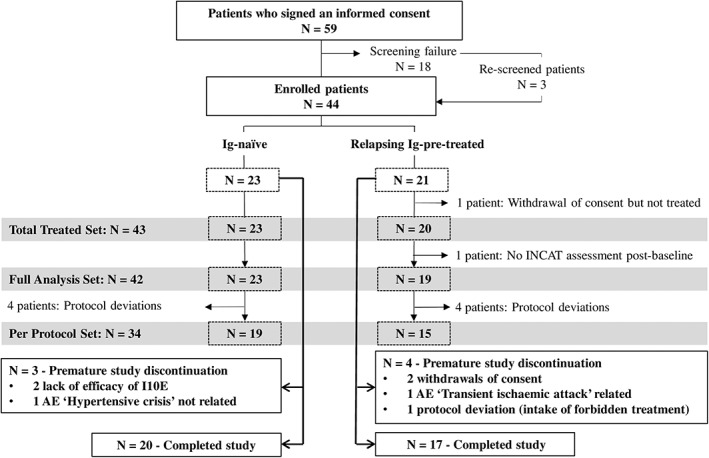
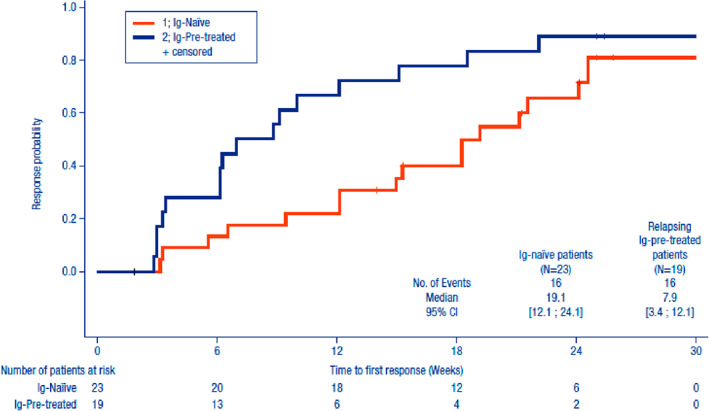
This prospective, multicenter, single-arm, open-label phase 3 study aimed to evaluate the efficacy and safety of IqYmune in patients with chronic inflammatory demyelinating polyradiculoneuropathy (CIDP). Patients received one induction dose of 2 g/kg and then seven maintenance doses of 1 g/kg at 3-week intervals. The primary endpoint was the responder rate at the end of study (EOS), defined as an improvement of ≥1 point on the adjusted inflammatory neuropathy cause and treatment (INCAT) disability scale. The responder rate was compared with the responder rate of a historical placebo group (33.3%). Secondary endpoints included changes from baseline to EOS of adjusted INCAT disability score, grip strength, Medical Research Council (MRC) sum score, Rasch-modified MRC sum score, Rasch-built overall disability scale score and the clinical global impression. Forty-two patients, including 23 Ig-naïve and 19 Ig-pre-treated, were included in the efficacy set. The overall response rate at EOS was 76.2% (95% confidence interval [60.5%-87.9%]). The superiority of IqYmune compared to the historical placebo control was demonstrated (P < .0001). The responder rate was numerically higher in Ig-pre-treated than in Ig-naïve patients but confidence intervals were overlapping (84.2% [60.4%-96.6%] vs 69.6% [47.1%-86.8%]). All secondary endpoints confirmed this conclusion. The median time to response was 15 weeks [8.9-19.1 weeks]. A total of 156 adverse events including five serious were considered related to IqYmune, 87.2% were mild. Neither hemolysis nor signs of renal or hepatic impairment were observed. These results demonstrate that IqYmune is an effective and well-tolerated treatment in patients with CIDP.
Keywords: IqYmune; PRISM; chronic inflammatory demyelinating polyradiculoneuropathy; inflammatory neuropathy cause and treatment; intravenous immunoglobulin.
© 2020 The Authors. Journal of the Peripheral Nervous System published by Wiley Periodicals LLC on behalf of Peripheral Nerve Society.
Figures
References
-
- Hughes RAC, Donofrio P, Bril V, et al. Intravenous immune globulin (10% caprylate chromatography purified) for the treatment of chronic inflammatory demyelinating polyradiculoneuropathy (ICE study): a randomised placebo‐controlled trial. Lancet Neurol. 2008;7:136‐144. 10.1016/S1474-4422(07)70329-0. - DOI - PubMed
-
- Léger JM, De Bleecker JL, Sommer C, Robberecht W, et al. Efficacy and safety of Privigen® in patients with chronic inflammatory demyelinating polyneuropathy: results of a prospective, single‐arm, open‐label phase III study (the PRIMA study). J Peripher Nerv Syst. 2013;18(2):130‐140. 10.1111/jns5.12017. - DOI - PMC - PubMed
-
- Krivan G, Chernyshova L, Kostyuchenko L, et al. A multicentre study on the efficacy, safety and pharmacokinetics of IqYmune®, a highly purified 10% liquid intravenous immunoglobulin, in patients with primary immune deficiency. J Clin Immunol. 2017;37:539‐547. 10.1007/s10875-017-0416-4. - DOI - PMC - PubMed
