Evaluating the Association of Clinical Characteristics With Neutralizing Antibody Levels in Patients Who Have Recovered From Mild COVID-19 in Shanghai, China
- PMID: 32808970
- PMCID: PMC9377417
- DOI: 10.1001/jamainternmed.2020.4616
Evaluating the Association of Clinical Characteristics With Neutralizing Antibody Levels in Patients Who Have Recovered From Mild COVID-19 in Shanghai, China
Erratum in
-
Error in Abstract Results.JAMA Intern Med. 2020 Oct 1;180(10):1405. doi: 10.1001/jamainternmed.2020.5576. JAMA Intern Med. 2020. PMID: 33017012 Free PMC article. No abstract available.
Abstract
Importance: The coronavirus disease 2019 (COVID-19) pandemic caused by severe acute respiratory syndrome coronavirus 2 (SARS-CoV-2) threatens global public health. The association between clinical characteristics of the virus and neutralizing antibodies (NAbs) against this virus have not been well studied.
Objective: To examine the association between clinical characteristics and levels of NAbs in patients who recovered from COVID-19.
Design, setting, and participants: In this cohort study, a total of 175 patients with mild symptoms of COVID-19 who were hospitalized from January 24 to February 26, 2020, were followed up until March 16, 2020, at Shanghai Public Health Clinical Center, Shanghai, China.
Exposures: SARS-CoV-2 infections were diagnosed and confirmed by reverse transcriptase-polymerase chain reaction testing of nasopharyngeal samples.
Main outcomes and measures: The primary outcome was SARS-CoV-2-specific NAb titers. Secondary outcomes included spike-binding antibodies, cross-reactivity against SARS-associated CoV, kinetics of NAb development, and clinical information, including age, sex, disease duration, length of stay, lymphocyte counts, and blood C-reactive protein level.
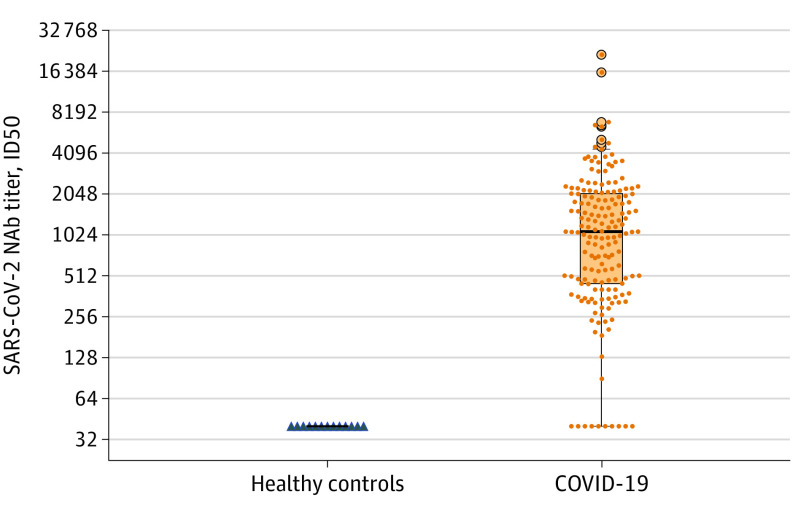
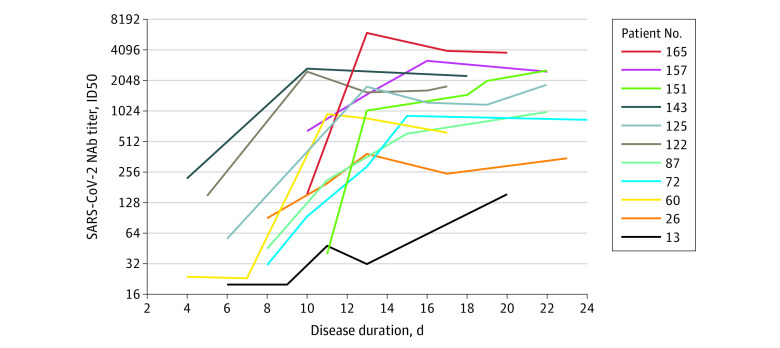
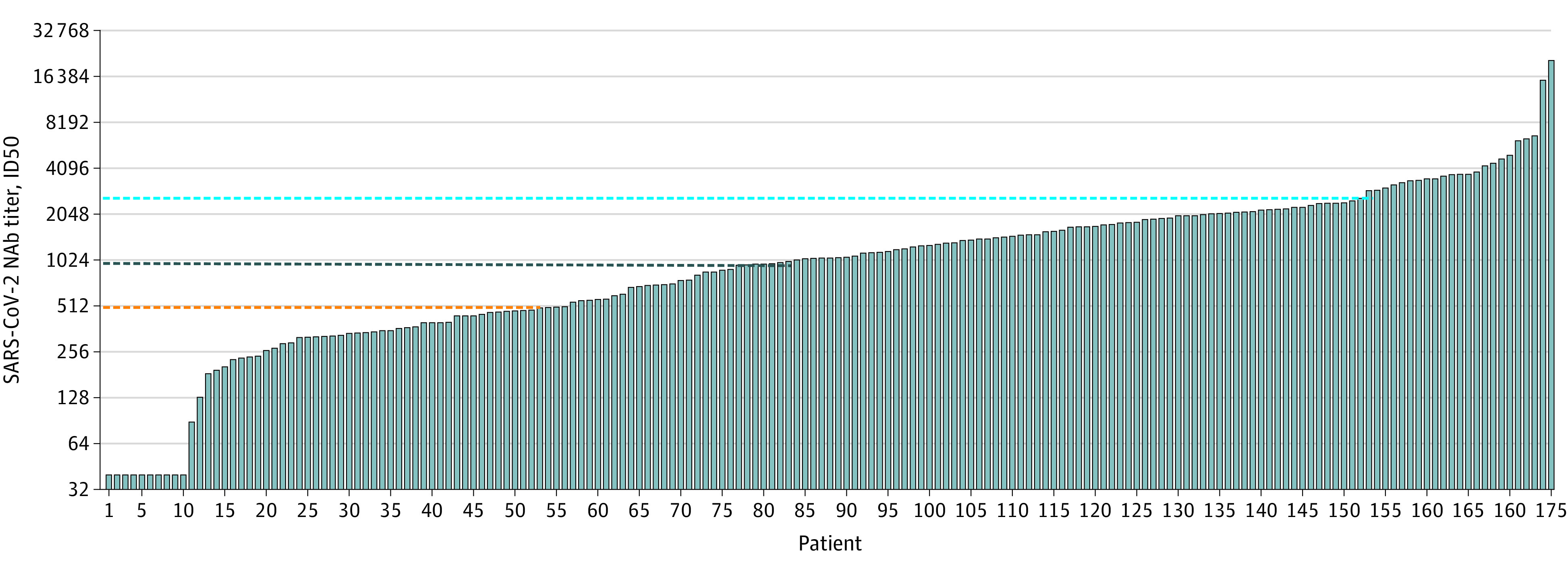
Results: Of the 175 patients with COVID-19, 93 were female (53%); the median age was 50 (interquartile range [IQR], 37-63) years. The median length of hospital stay was 16 (IQR, 13-21) days, and the median disease duration was 22 (IQR, 18-26) days. Variable levels of SARS-CoV-2-specific NAbs were observed at the time of discharge (50% inhibitory dose [ID50], 1076 [IQR, 448-2048]). There were 10 patients whose NAb titers were less than the detectable level of the assay (ID50, <40), and 2 patients who showed very high titers of NAbs, with ID50 levels of 15 989 and 21 567. NAbs were detected in patients from day 4 to 6 and reached peak levels from day 10 to 15 after disease onset. NAbs were unable to cross-react with SARS-associated CoV and NAb titers correlated with the spike-binding antibodies targeting S1 (r = 0.451; 95% CI, 0.320-0.564; P < .001), receptor binding domain (r = 0.484; 95% CI, 0.358-0.592; P < .001), and S2 regions (r = 0.346; 95% CI, 0.204-0.473; P < .001). NAb titers at the time of discharge were significantly higher in the 82 men (1417 [IQR, 541-2253]) than those in the 93 women (905 [IQR, 371-1687]) (median difference, 512; 95% CI, 82-688; P = .01) and at the time of follow-up in 56 male patients (1049 [IQR, 552-2454]) vs 61 female patients (751 [IQR, 216-1301]) (median difference, 298; 95% CI, 86-732; P = .009). Plasma NAb titers were significantly higher in 56 older (1537 [IQR, 877-2427) and 63 middle-aged (1291 [IQR, 504-2126]) patients than in 56 younger patients (459 [IQR, 225-998]) (older vs younger: median difference, 1078; 95% CI, 548-1287; P < .001; middle-aged vs younger: median difference, 832; 95% CI, 284-1013; P < .001). The NAb titers were correlated with plasma C-reactive protein levels (r = 0.508; 95% CI, 0.386-0.614; P < .001) and negatively correlated with lymphocyte counts (r = -0.427; 95% CI, -0.544 to -0.293; P < .001) at the time of admission.
Conclusions and relevance: In this cohort study, among 175 patients who recovered from mild COVID-19 in Shanghai, China, NAb titers to SARS-CoV-2 appeared to vary substantially. Further research is needed to understand the clinical implications of differing NAb titers for protection against future infection.
Conflict of interest statement
Figures
Comment in
-
Neutralizing Antibodies Against SARS-CoV-2-Important Questions, Unclear Answers.JAMA Intern Med. 2020 Oct 1;180(10):1362. doi: 10.1001/jamainternmed.2020.4624. JAMA Intern Med. 2020. PMID: 32808969 No abstract available.
References
-
- World Health Organization . Coronavirus disease 2019. (COVID-19) situation report. Accessed May 28, 2020 https://www.who.int/emergencies/diseases/novel-coronavirus-2019/situatio...
-
- Wong VW, Dai D, Wu AK, Sung JJ. Treatment of severe acute respiratory syndrome with convalescent plasma. Hong Kong Med J. 2003;9(3):199-201. - PubMed
Publication types
MeSH terms
Substances
LinkOut - more resources
Full Text Sources
Research Materials
Miscellaneous