. 2020 Aug 18;10(1):148.
doi: 10.1186/s13568-020-01074-8.

Mukonal exerts anticancer effects on the human breast cancer cells by inducing autophagy and apoptosis and inhibits the tumor growth in vivo

Affiliations

Mukonal exerts anticancer effects on the human breast cancer cells by inducing autophagy and apoptosis and inhibits the tumor growth in vivo

Wenbiao Wang et al. AMB Express. .

Abstract

Mukonal is an active member of carbazole alkaloids isolated from Murraya koenigii. It has been shown to possess remarkable biological and pharmacological activities including anticancer activity. Therefore, the aim of current investigation was to explore anti-breast cancer activity of mukonal and to explore the underlying mechanism. Results indicate that mukonal has potential to induce antiproliferative effects against MDA-MB-231 and SK-BR-3 cells with an IC50 of 7.5 µM. No significant toxicity of mukonal was observed in case of normal breast cells. The antiproliferative effects of mukonal were found to proceed via apoptosis, which was further supported by increased cleavage of PARP and caspase-3 and reduced expression of Bcl-2. Mukonal induced autophagic cells death in breast cancer cells as was evidenced by formation of autophagosomes and enhanced expressions of Beclin-1, LC3B-I and LC3B-II proteins. In vivo examination of anti-breast cancer property of mukonal indicated that it could potentially reduce tumor weight and volume in xenografted mice models. In conclusion, mukonal has a remarkable potential of inhibiting breast cancer via induction of apoptosis and autophagy. Mukonal also inhibited xenografted tumors models in a dose-dependent manner. Therefore, mukonal may prove lead molecule in breast cancer drug discovery and treatment provided further investigations are recommended.

Keywords: Alkaloids; Apoptosis; Autophagy; Breast cancer; Carbazole alkaloids; Mukonal.


Conflict of interest statement

The authors declare that they have no competing interests.

Figures
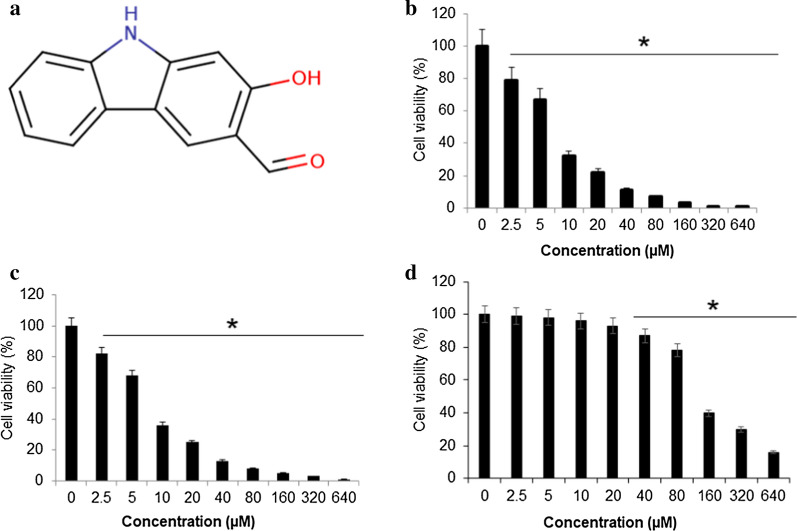
Fig. 1
Fig. 1
Mukonal inhibits the growth of breast cancer cells. a Chemical structure of mukonal molecule. b The viability of SK-BR-3 breast tumor cells after being subjected varying mukonal concentration as indicated. SK-BR-3 cells were exposed to mukonal for 48 h and then subsequently stained with MTT solution for calorimetric analysis. c The viability of MDA-MB-231 breast tumor cells after being subjected varying mukonal concentration as indicated. d The viability of normal MB-157 breast cells after being subjected varying mukonal concentration as indicated. All the experiments were executed three times and data was shown as mean ± SE (standard error). The p value of < 0.05 was taken as a statistical significant figure
Fig. 2
Fig. 2
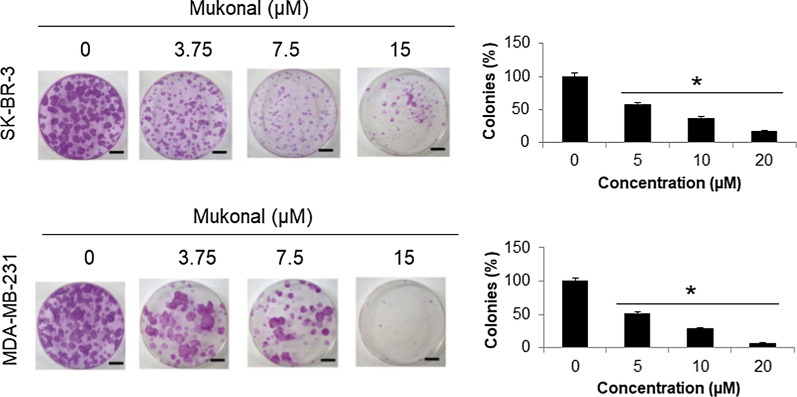
Clonogenic analysis of MDA-MB-231 and SK-BR-3 cells after being exposed to indicated mukonal doses. MDA-MB-231 and SK-BR-3 breast tumor cell lines were treated with mukonal, left untouched for 10 days and stained with crystal violet to calculate the number of colonies generated provided considering colonies with > 50 number of cells for calculation. All the experiments were executed three times and data was shown as mean ± SE (standard error). The p value of < 0.05 was taken as a statistical significant figure
Fig. 3
Fig. 3
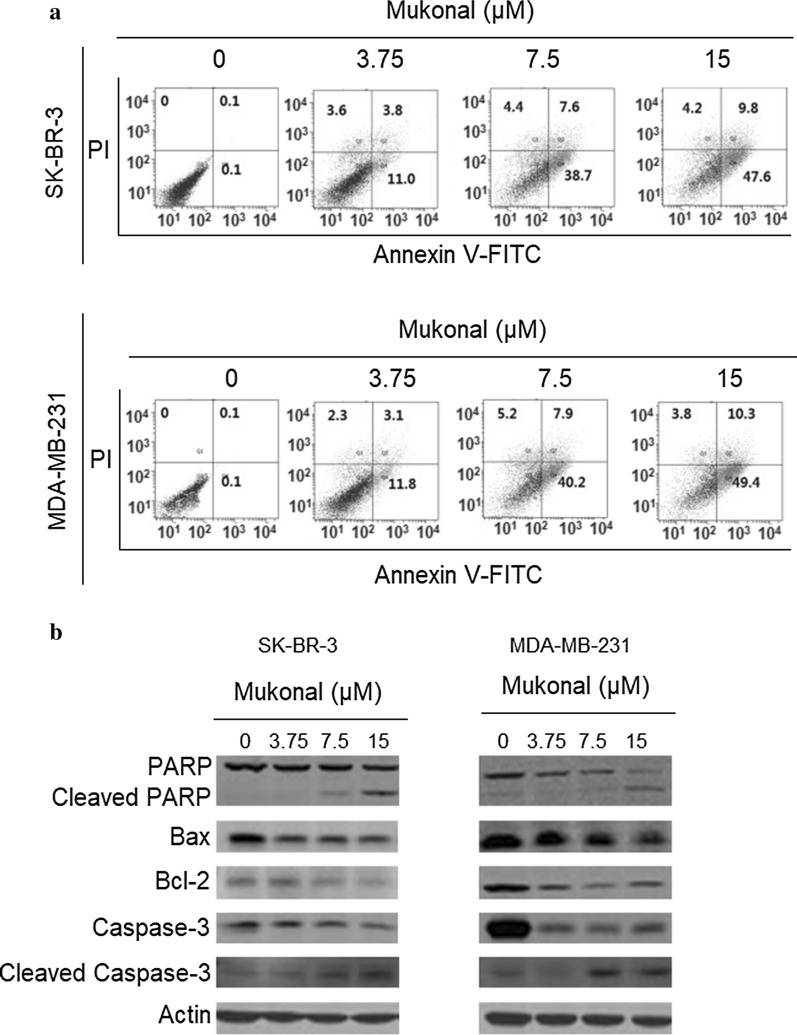
a Flow cytometric analysis of mukonal treated SK-BR-3 cells. SK-BR-3 cells were cultured in 6-well plates and then subjected to indicated mukonal doses. Afterwards, staining with annexin V/PI was performed to analyze apoptosis flow cytometrically. b Flow cytometric analysis of mukonal treated MDA-MB-231 cells. MDA-MB-231 cells were cultured in 6-well plates and then subjected to indicated mukonal doses. Afterwards, staining with annexin V/PI was performed to analyze apoptosis flow cytometrically. c Western blotting analysis was performed to assess the activity of apoptosis allied proteins in SK-BR-3 cells. Results indicated that mukonal enhanced activity of proapoptosis proteins wherein blocking of antiapoptotic protein expression. d Western blotting analysis was performed to assess the activity of apoptosis allied proteins in MDA-MB-231 cells. Results indicating that mukonal enhanced activity of proapoptosis proteins in MDA-MB-231 cells wherein blocking of antiapoptotic protein expression. All the experiments were executed three times and data was shown as mean ± SE (standard error). The p value of < 0.05 was taken as a statistical significant figure
Fig. 4
Fig. 4
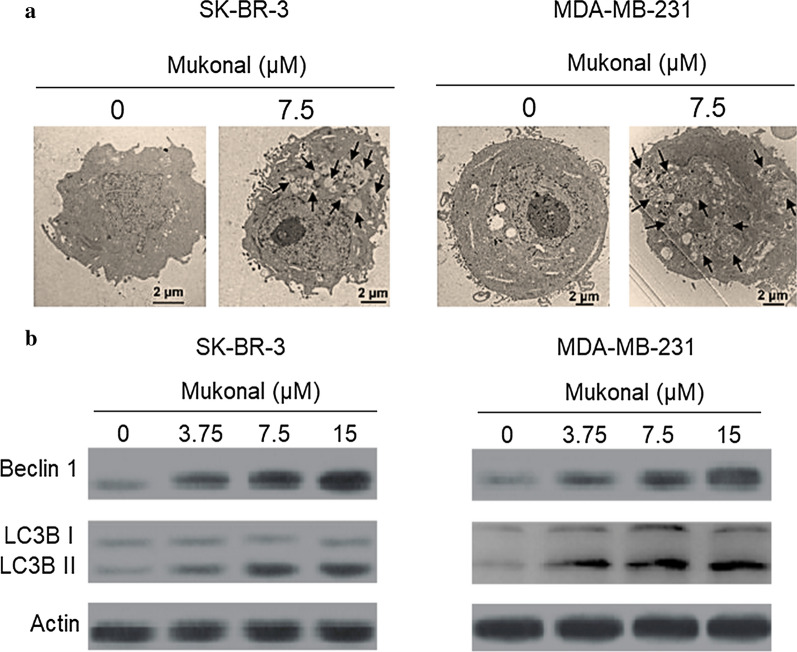
a TEM analysis of SK-BR-3 cells after being exposed to indicated doses of mukonal. Results revealed formation of autophagic vesicles/autophagosomes in treated groups as compared to control group. Autophagosomes have been shown by arrows in the picture. b TEM analysis of MDA-MB-231 cells after being exposed to indicated doses of mukonal. Results revealed formation of autophagic vesicles/autophagosomes in treated groups as compared to control group. Autophagosomes have been shown by arrows in the picture. c Western blotting results of SK-BR-3 cells after being exposed to mukonal at indicated doses. In treated groups enhanced activity of Beclin-1, LC3B-I and LC3B-II was observed with increasing concentrations of mukonal. d Western blotting results of MDA-MB-231 cells after being exposed to mukonal at indicated doses. In treated groups enhanced activity of Beclin-1, LC3B-I and LC3B-II was observed with increasing concentrations of mukonal
Fig. 5
Fig. 5
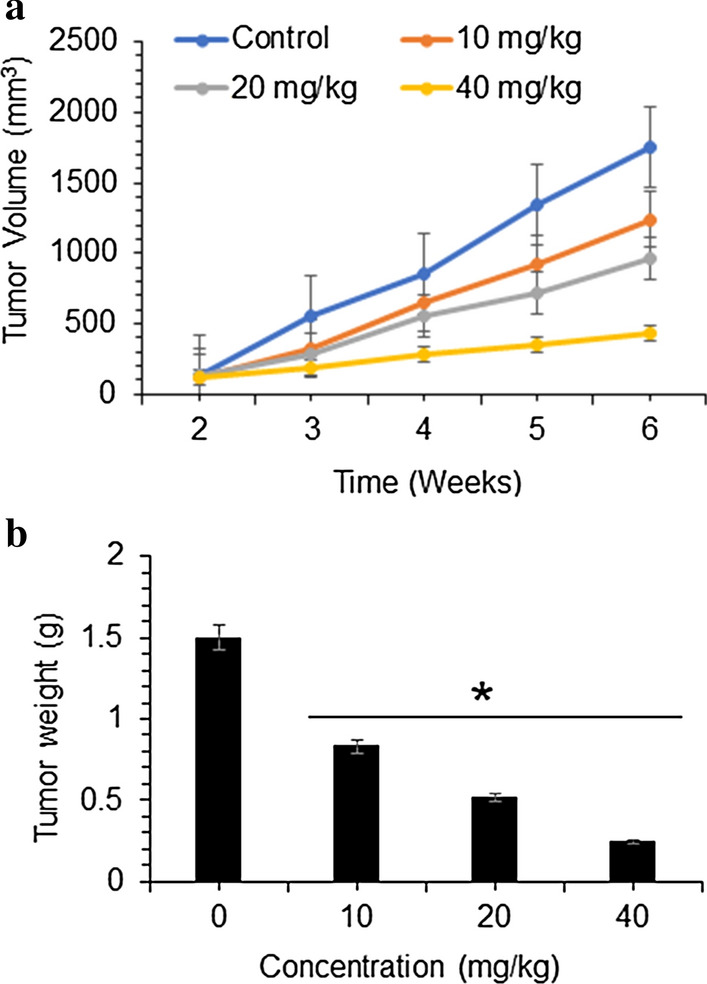
Mukonal inhibits MDA-MB-231 and SK-BR-3 tumor growth in vivo. a Tumor volume and b tumor weight were measured at indicated time intervals and doses of mukonal molecule. All the experiments for separate drug concentration were executed three times and data was shown as mean ± SE (standard error). The p value of < 0.05 was taken as a statistical significant figure

References

    1. Bhattacharyya P, Chakraborty A. Mukonal, a probable biogenetic intermediate of pyranocarbazole alkaloids from Murraya koenigii. Phytochemistry. 1984;23(2):471–472. doi: 10.1016/S0031-9422(00)80360-X. - DOI
    1. Bonofiglio D, Giordano C, De Amicis F, Lanzino M, Ando S. Natural products as promising antitumoral agents in breast cancer: mechanisms of action and molecular targets. Mini-Rev Med Chem. 2016;16(8):596–604. doi: 10.2174/1389557515666150709110959. - DOI - PubMed
    1. Collignon J, Lousberg L, Schroeder H, Jerusalem G. Triple-negative breast cancer: treatment challenges and solutions. Breast Cancer Targets Therapy. 2016;8:93. - PMC - PubMed
    1. DeSantis CE, Fedewa SA, Goding Sauer A, Kramer JL, Smith RA, Jemal A. Breast cancer statistics, 2015: convergence of incidence rates between black and white women. CA Cancer J Clin. 2016;66:31–42. doi: 10.3322/caac.21320. - DOI - PubMed
    1. García-Prat L, Martínez-Vicente M, Perdiguero E, Ortet L, Rodríguez-Ubreva J, Rebollo E, Ruiz-Bonilla V, Gutarra S, Ballestar E, Serrano AL, Sandri M. Autophagy maintains stemness by preventing senescence. Nature. 2016;529(7584):37–42. doi: 10.1038/nature16187. - DOI - PubMed