


Simulation via instant messaging-Birmingham advance (SIMBA) model helped improve clinicians' confidence to manage cases in diabetes and endocrinology
- PMID: 32811488
- PMCID: PMC7437058
- DOI: 10.1186/s12909-020-02190-6
Simulation via instant messaging-Birmingham advance (SIMBA) model helped improve clinicians' confidence to manage cases in diabetes and endocrinology
Abstract
Background: Simulation-based learning (SBL) has been increasingly used in both undergraduate and postgraduate medical training curricula. The aim of Simulation via Instant Messaging-Birmingham Advance (SIMBA) is to create a simple virtual learning environment to improve trainees' self-reported confidence in diabetes and Endocrinology.
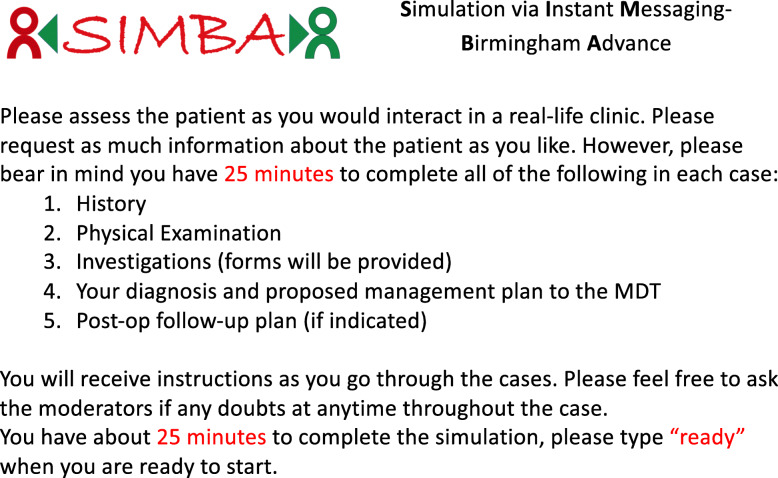
Methods: This study was done as part of the continuous professional development for Health Education England West Midlands speciality trainees in diabetes and Endocrinology. Standardized transcripts of anonymized real-life endocrinology (endocrine session) and diabetes cases (diabetes session) were used in the simulation model. Trainees interacted with moderators through WhatsApp® in this model. All cases were then discussed in detail by a consultant endocrinologist with reference to local, national and international guidelines. Trainee acceptance rate and improvement in their self-reported confidence levels post-simulation were assessed.
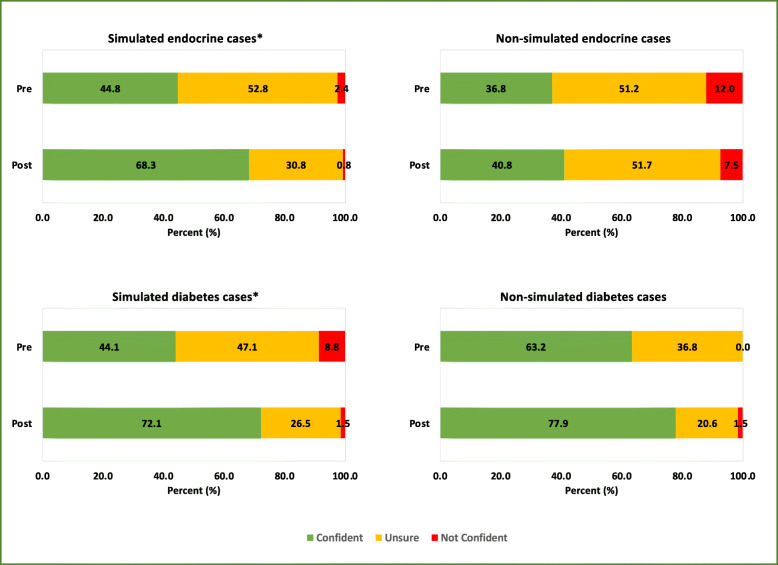
Results: 70.8% (n = 17/24) and 75% (n = 18/24) strongly agreed the simulation session accommodated their personal learning style and the session was engaging. 66.7% (n = 16/24) strongly felt that the simulation was worth their time. In the endocrine session, there was a significant improvement in trainees' confidence in the management of craniopharyngioma (p = 0.0179) and acromegaly (p = 0.0025). There was a trend towards improved confidence levels to manage Cushing's disease and macroprolactinoma. In diabetes session, there was a significant improvement in trainees' confidence to interpret continuous glucose monitor readings (p = 0.01). There was a trend towards improvement for managing monogenic diabetes, hypoglycaemic unawareness and interpreting Libre readings. Overall, there was a significant improvement in trainees' confidence in managing cases that were discussed post-simulation.
Conclusion: SIMBA is an effective learning model to improve trainees' confidence to manage various diabetes and endocrine case scenarios. More sessions with a variety of other speciality case scenarios are needed to further assess SIMBA's effectiveness and application in other areas of medical training.
Conflict of interest statement
The authors declare that they have no competing interests.
Figures



References
-
- Steadman RH, Coates WC, Huang YM, Matevosian R, Larmon BR, McCullough L, et al. Simulation-based training is superior to problem-based learning for the acquisition of critical assessment and management skills*. Crit Care Med. 2006;34(1):151–157. - PubMed
-
- Lee Chang A, Dym AA, Venegas-Borsellino C, Bangar M, Kazzi M, Lisenenkov D, et al. Comparison between simulation-based training and lecture-based education in teaching situation awareness. A randomized controlled study. Ann Am Thorac Soc. 2017;14(4):529–535. - PubMed
-
- Jayshree S. Dawane, Pandit V. a., Dhande P. P., Sahasrabudhe R.a KYS. A comparative study of different teaching methodologies used for developing understanding of cardiac pharmacology in undergraduate medical students. IOSR J Res Method Educ. 2014;4(3):34–38.
-
- Zhao B, Potter DD. Comparison of lecture-based learning vs discussion-based learning in undergraduate medical students. J Surg Educ. 2016;73(2):250–257. - PubMed
-
- Okuda Y, Bryson EO, DeMaria S, Jacobson L, Quinones J, Shen B, et al. The utility of simulation in medical education: what is the evidence? Mt Sinai J Med A J Transl Pers Med. 2009;76(4):330–343. - PubMed
MeSH terms
LinkOut - more resources
Full Text Sources
Medical
