


Does Sars-Cov-2 threaten our dreams? Effect of quarantine on sleep quality and body mass index
- PMID: 32811530
- PMCID: PMC7432549
- DOI: 10.1186/s12967-020-02465-y
Does Sars-Cov-2 threaten our dreams? Effect of quarantine on sleep quality and body mass index
Abstract
Background: COVID 19-related quarantine led to a sudden and radical lifestyle changes, in particular in eating habits. Objectives of the study were to investigate the effect of quarantine on sleep quality (SQ) and body mass index (BMI), and if change in SQ was related to working modalities.
Materials: We enrolled 121 adults (age 44.9 ± 13.3 years and 35.5% males). Anthropometric parameters, working modalities and physical activity were studied. Sleep quality was evaluated by the Pittsburgh Sleep Quality Index (PSQI) questionnaire. At baseline, the enrolled subjects were assessed in outpatient clinic and after 40 days of quarantine/lockdown by phone interview.
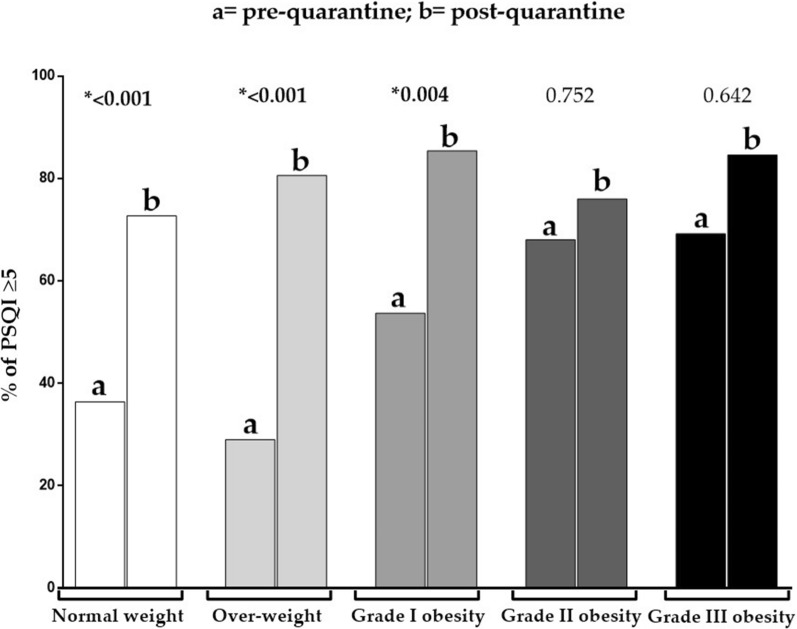
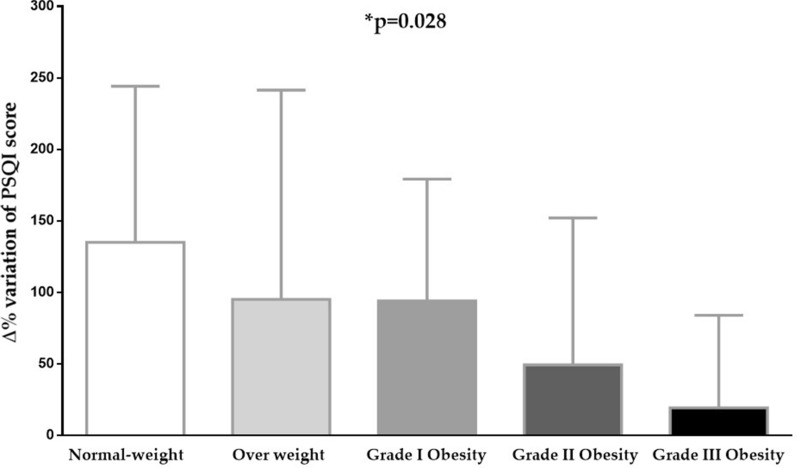
Results: Overall, 49.6% of the subjects were good sleepers (PSQI < 5) at the baseline and significantly decreased after quarantine (p < 0.001). In detail, sleep onset latency (p < 0.001), sleep efficiency (p = 0.03), sleep disturbances (p < 0.001), and daytime dysfunction (p < 0.001) significantly worsened. There was also a significant increase in BMI values in normal weight (p = 0.023), in subjects grade I (p = 0.027) and II obesity (p = 0.020). In all cohort, physical activity was significantly decreased (p = 0.004). However, analyzing the data according gender difference, males significantly decreased physical activity as well as females in which there was only a trend without reaching statistical significance (53.5% vs 25.6%; p = 0.015 and 50.0% vs 35.9%, p = 0.106; in males and females, respectively). In addition, smart working activity resulted in a significant worsening of SQ, particularly in males (p < 0.001).
Conclusions: Quarantine was associated to a worsening of SQ, particularly in males doing smart working, and to an increase in BMI values.
Keywords: CoVID-19; Nutritionist; Obesity; Quarantine; Sars-Cov-2; Sleep disturbance; Sleep quality; Smart-working.
Conflict of interest statement
None of the Authors have conflicts of interest to declare.
Figures

References
-
- Gazzetta Ufficiale della Repubblica Italiana. No Title. 9 March. 2020 (cited 2020 May 4). p. 16. https://www.gazzettaufficiale.it/eli/id/2020/03/09/20A01558/sg.
MeSH terms
LinkOut - more resources
Full Text Sources
Medical
Miscellaneous
