


What can primary care services do to help First Nations people with unhealthy alcohol use? A systematic review: Australia, New Zealand, USA and Canada
- PMID: 32811549
- PMCID: PMC7437002
- DOI: 10.1186/s13722-020-00204-8
What can primary care services do to help First Nations people with unhealthy alcohol use? A systematic review: Australia, New Zealand, USA and Canada
Abstract
Background: First Nations peoples of Australia, New Zealand, the United States of America (USA) and Canada are more likely to be non-drinkers than other people in these countries. However, those who do drink may be at greater risk of alcohol-related harms (at a population level) due to the ongoing impacts from colonisation and associated oppression. Addressing unhealthy drinking (drinking above recommended limits including alcohol use disorders) in primary care settings is one important way to increase accessibility of treatment.
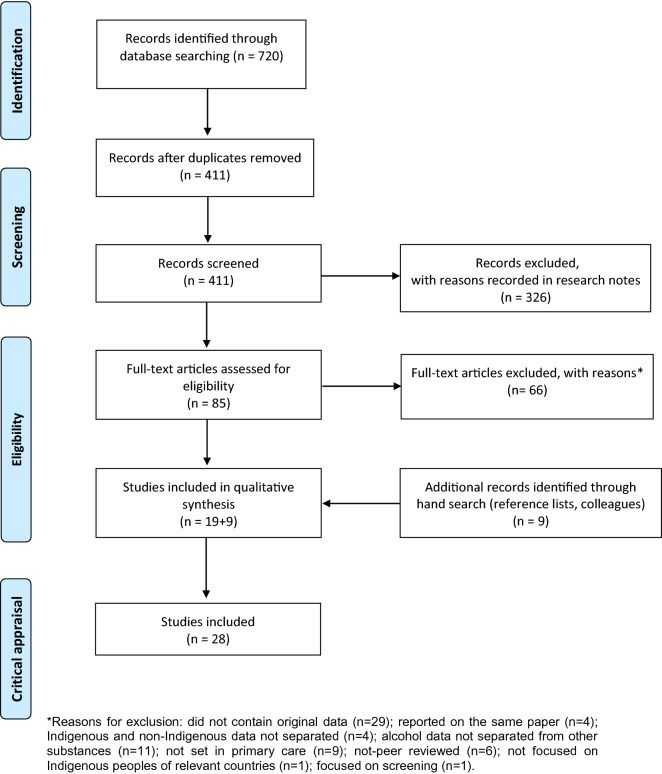
Methods: This systematic review identifies peer-reviewed studies of alcohol treatments delivered in primary care or other non-residential settings for First Nations peoples of Australia, New Zealand, USA and Canada. Literature searches were conducted in seven academic databases from their inception until March, 2020. We assessed evidence of treatment or implementation effectiveness, perceived acceptability or accessibility, and the study quality as assessed by the AXIS tool and by a measure of community participation in the research process.
Results: Twenty-eight studies were included, published between 1968 and 2018. Studies reported on a range of alcohol treatments, from brief intervention to ambulatory withdrawal management, relapse prevention medicines, and cultural therapies. Brief intervention was the most studied approach. Cultural healing practices and bicultural approaches were a key theme amongst several studies. Four studies measured treatment effectiveness, including one randomised controlled trial (naltrexone vs naltrexone plus sertraline vs placebo) and two uncontrolled trials of disulfiram. Of the six implementation studies, three were (hybrid) effectiveness-implementation designs. Most of the remaining studies (n = 21) focused on treatment accessibility or acceptability. Community participation in the research process was poorly reported in most studies.
Conclusions: Research evidence on how best to care for First Nations peoples with unhealthy alcohol use is limited. Trials of naltrexone and disulfiram presented promising results. Cultural and bicultural care were perceived as highly important to clinical staff and clients in several studies. More effectiveness studies on the full scope of alcohol treatments are needed. Greater community participation in research and more transparent reporting of this in study methods will be key to producing quality research that combines scientific rigour with cultural appropriateness.
Keywords: Alcohol; Cultural healing; Culture; Disulfiram; First Nations; Indigenous; Naltrexone; Outpatient; Primary health care; Relapse prevention medicines.
Conflict of interest statement
The authors have no competing interests to declare.
Figures
References
-
- Stephens C, Nettleton C, Porter J, Willis R, Clark S. Indigenous peoples’ health 2014; why are they behind everyone, everywhere? Lancet. 2005;366(9479):10–13. - PubMed
-
- Health promotion agency Research and data: hazardous and risky drinking—Differences among past-year drinkers. AlcoholNZ. 2017;7(1):21–23.
-
- Australian Institute of Health and Welfare. The health and welfare of Aboriginal and Torres Strait Islander peoples 2015: Determinants of Health—Alcohol. Canberra: AIHW. 2015;Cat.no.IHW147:55-57.
-
- Health Canada. A statistical profile on the health of First Nations in Canada—determinants of health, 2006-2010. Ottawa: Health Canada; 2015. Cat.no.H34-193/1-2014E-PDF.
-
- Australian Institute of Health and Welfare. Substance use among Aboriginal and Torres Strait Islander people: Alcohol use. Canberra: AIHW. 2011;Cat.no.IHW40:11-19.
Publication types
MeSH terms
LinkOut - more resources
Full Text Sources
Medical
