


Review
doi: 10.1016/j.healun.2020.07.010.
Epub 2020 Jul 23.
The International Thoracic Organ Transplant Registry of the International Society for Heart and Lung Transplantation: 37th adult heart transplantation report-2020; focus on deceased donor characteristics
Affiliations
- PMID: 32811772
- PMCID: PMC7737223
- DOI: 10.1016/j.healun.2020.07.010
Item in Clipboard
Review
The International Thoracic Organ Transplant Registry of the International Society for Heart and Lung Transplantation: 37th adult heart transplantation report-2020; focus on deceased donor characteristics
J Heart Lung Transplant.
2020 Oct.
No abstract available
Keywords: cardiac allograft vasculopathy; heart transplantation; organ donor; risk factors; survival.
Figures
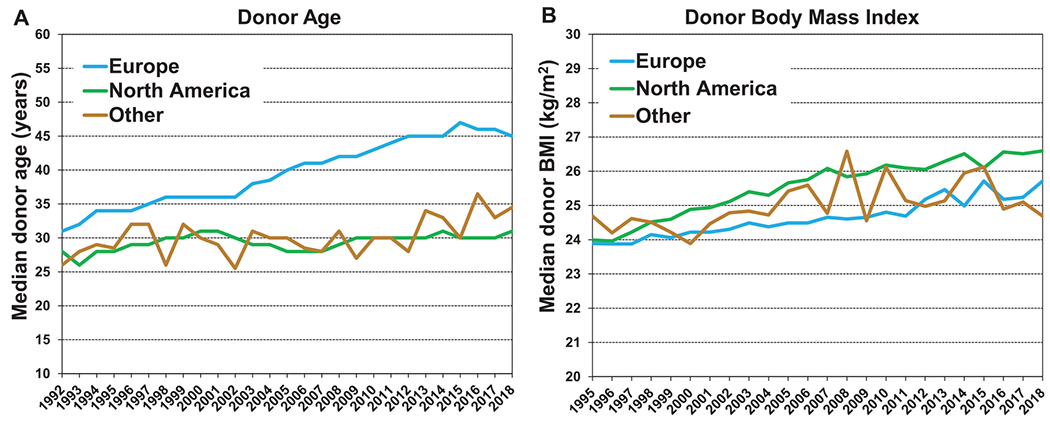
Median donor (a) age by year and geographic location (transplants: January 1992–June 2018) and (b) BMI by year and geographic location (transplants: January 1995–June 2018). BMI, body mass index.
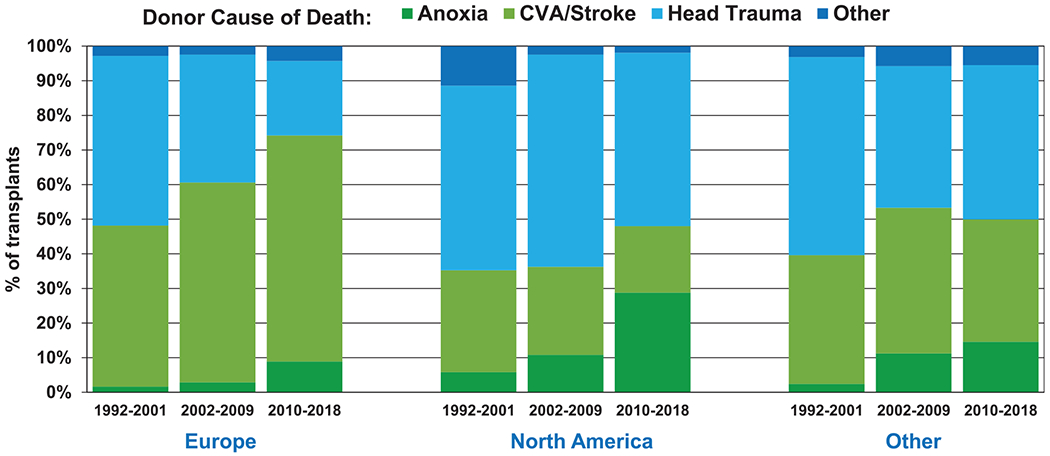
Donor cause of death by geographic location and era (transplants: January 1992–June 2018). CVA, cerebrovascular accident.

Percentage of donors with a history of (a) smoking (transplants: January 1995–June 2018) and (b) alcohol use (transplants: January 2005–June 2018).

Percentage of donors with a history of cocaine and other drug use (transplants: January 2000–June 2018).

Percentage of donors with (a) diabetes and hypertension (transplants: January 1995–June 2018) and (b) LVEF <50% (transplants: January 2005–June 2018). LVEF, left ventricular ejection fraction.

Kaplan–Meier survival within 12 months by donor and recipient age (transplants: January 2000–June 2017).

Kaplan–Meier survival within 12 months by donor (a) cause of death (transplants: January 2000–June 2017) and (b) LVEF (transplants: January 2005–June 2017). CVA, cerebrovascular accident; LVEF, left ventricular ejection fraction.

Kaplan–Meier survival within 12 months by donor history of (a) smoking (transplants: January 2000–June 2017) and (b) alcohol use (transplants: January 2005–June 2017).

Kaplan–Meier survival within 12 months by allograft ischemic time and donor age (transplants: January 2000–June 2017).

Kaplan–Meier survival within 12 months by allograft ischemic time and donor LVEF (transplants: January 2005–June 2017). LVEF, left ventricular ejection fraction.

Kaplan–Meier survival within 5 years conditional on survival to 1 year by donor history of (a) diabetes (transplants: January 2000–June 2013) and (b) hypertension (transplants: January 2000–June 2013).

Kaplan–Meier survival within 5 years conditional on survival to 1 year by donor (a) cause of death (transplants: January 2000–June 2013) and (b) LVEF (transplants: January 2005–June 2013). CVA, cerebrovascular accident; LVEF, left ventricular ejection fraction; NS, non-significant.

Kaplan–Meier survival within 5 years conditional on survival to 1 year by allograft ischemic time and donor history of hypertension (transplants: January 2000–June 2013). NS, non-significant.

Kaplan–Meier freedom from CAV conditional on survival to discharge by donor age (transplants: January 2000–June 2017). CAV, cardiac allograft vasculopathy.

Kaplan–Meier freedom from CAV conditional on survival to discharge by donor (a) cause of death (transplants: January 2000–June 2017) and (b) LVEF (transplants: January 2005–June 2017). CAV, cardiac allograft vasculopathy; CVA, cerebrovascular accident; LVEF, left ventricular ejection fraction; NS, non-significant.

Kaplan–Meier freedom from CAV conditional on survival to discharge by donor history of (a) diabetes (transplants: January 2000–June 2017) and (b) hypertension (transplants: January 2000–June 2017). CAV, cardiac allograft vasculopathy.

Kaplan–Meier freedom from CAV conditional on survival to discharge by donor history of (a) smoking (transplants: January 2000–June 2017) and (b) alcohol use (transplants: January 2005–June 2017). CAV, cardiac allograft vasculopathy.
References
-
- Khush KK, Cherikh WS, Chambers DC, et al. The International Thoracic Organ Transplant Registry of the International Society for Heart and Lung Transplantation: thirty-sixth adult heart transplantation report - 2019; focus theme: donor and recipient size match [published correction appears in J Heart Lung Transplant 2020;39:91]. J Heart Lung Transplant 2019;38:1056–66. - PMC - PubMed
-
- Khush KK, Cherikh WS, Chambers DC, et al. The International Thoracic Organ Transplant Registry of the International Society for Heart and Lung Transplantation: thirty-fifth adult heart transplantation report-2018; focus theme: multiorgan transplantation. J Heart Lung Transplant 2018;37:1155–68. - PubMed
-
- Lund LH, Khush KK, Cherikh WS, et al. The Registry of the International Society for Heart and Lung Transplantation: thirty-fourth adult heart transplantation report-2017; focus theme: allograft ischemic time. J Heart Lung Transplant 2017;36:1037–46. - PubMed
Publication types
MeSH terms
Grants and funding
LinkOut - more resources
Full Text Sources
Other Literature Sources
Medical
