Meta-Analysis
. 2020 Dec;28(2):765-777.
doi: 10.1007/s40199-020-00367-4. Epub 2020 Aug 18.

Is there any potential management against COVID-19? A systematic review and meta-analysis

Affiliations
Meta-Analysis

Is there any potential management against COVID-19? A systematic review and meta-analysis

Haleh Talaie et al. Daru. 2020 Dec.

Abstract

Purpose: A recent survey has shown that the COVID-19 pandemic has culminated in dramatical and critical treatment particularly in acute infected patients. In fact, this systematic review-meta-analysis was directly pertained to estimation at the efficient value of some clinical managements to confront the COVID-19 infection.

Methods: Pubmed, Embase, Scopus, Cochrane, and Scholar databases were searched from inception to July 1, 2020, to identify studies reporting the current treatment process and medications (e.g. hydroxychloroquine, antiviral therapy, convalescent plasma, and immunomodulatory agents) for COVID-19. A random-effects model meta-analysis was performed to calculate the relative risk (RR) with 95% confidence intervals (CI). The outcomes of this study were the frequency of negative conversion cases, clinical improvements, mechanical ventilation demand, intensive care unit (ICU) entry, and mortality. The standard treatment refers to the published guidelines and specialist experience which varies in different articles, and the proposed treatment refers to the kind of interest suggested in the included studies.

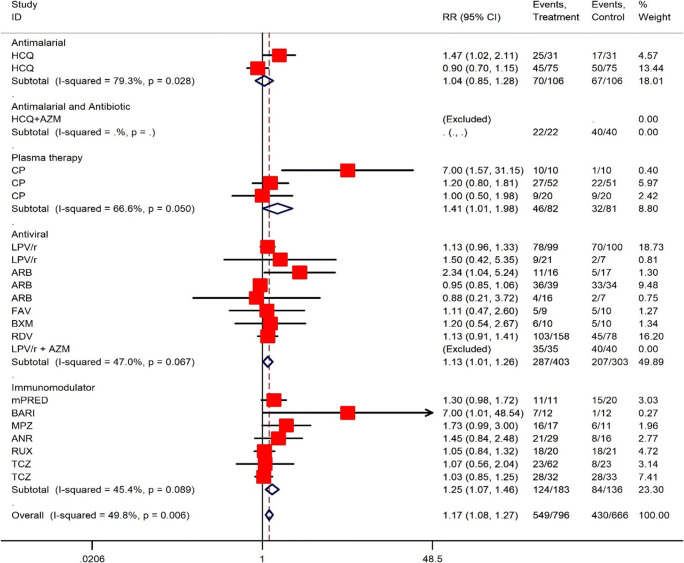
Results: A number of 45 articles met the eligibility criteria (out of 6793 articles). Among them, 26 articles involving 3263 patients were included in quantitative analysis. Anti-COVID-19 interventions could significantly increase clinical improvement (RR 1.17, 95% CI 1.08-1.27; I2 = 49.8%) and reduce the mortality rate (RR 0.58, 95% CI 0.35-0.95; I2 = 74.8%). Although in terms of negative conversion, ICU entry, and mechanical ventilation demand, clinical intervention had no beneficial effect. The clinical effect of immunomodulatory agents (especially tocilizumab and anakinra) was noticeable compared to other medications with RR of 0.22 (95% CI 0.09-0.53; I2 = 40.9%) for mortality and 1.25 (95% CI 1.07-1.46; I2 = 45.4%) for clinical improvement. Moreover, Antivirals (RR 1.13, 95% CI 1.01-1.26; I2 = 47.0%) and convalescent plasma therapy (RR 1.41, 95% CI 1.01-1.98; I2 = 66.6%) had significant beneficial effects on clinical improvement.

Conclusion: Based on our findings, all the included interventions significantly declined the mortality and enhanced clinical improvements with no effect on negative conversion and mechanical ventilation demand. Especially, immunomodulators and plasma therapy showed favorable outcomes. An evaluation on the efficacy of proposed treatment against COVID-19.

Keywords: COVID-19; Meta-analysis; Outcome; SARS-CoV-2; Treatment.


Figures

None
An evaluation on the efficacy of proposed treatment against COVID-19.
Fig. 1
Fig. 1
Flow diagram of the study selection process
Fig. 2
Fig. 2
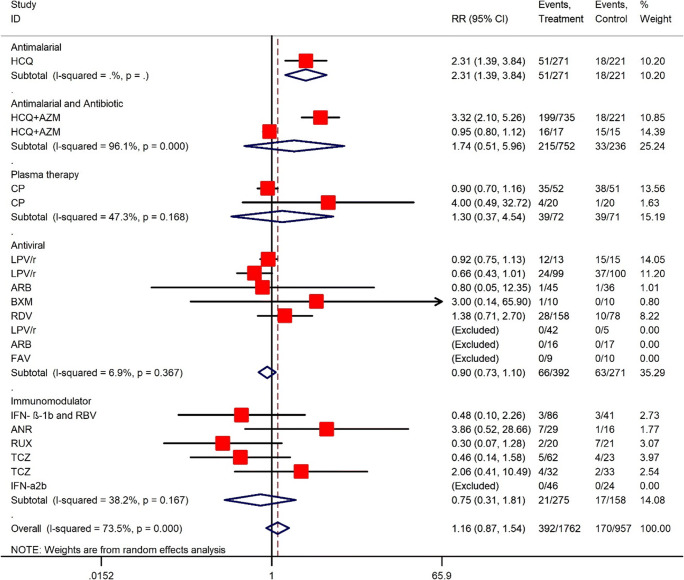
Random-effects meta-analysis of the proposed treatment efficacy on the frequency of negative conversion cases relative risk in controlled retrospective and clinical trial studies. RR: relative risk, Event Treatment: Proposed treatment, Event Control: Standard treatment, HCQ: Hydroxychloroquine, AZM: Azithromycin, CP: Convalescent plasma, LPV/r: Lopinavir and Ritonavir, ARB: Arbidol, FAV: Favipiravir, BXM: Baloxavir marboxil, IFN: Interferon, MPZ: Meplazumab, RUX: Ruxolitinib
Fig. 3
Fig. 3
Random-effects meta-analysis of the proposed treatment efficacy on the clinical improvement relative risk in controlled retrospective and clinical trial studies. RR: relative risk, Event Treatment: Proposed treatment, Event Control: Standard treatment, HCQ: Hydroxychloroquine, AZM: Azithromycin, CP: Convalescent plasma, LPV/r: Lopinavir and Ritonavir, ARB: Arbidol, FAV: Favipiravir, BXM: Baloxavir marboxil, RDV: Remdesivir, mPRED: Methylprednisolone, IFN: Interferon, BARI: Baricitinib, MPZ: Meplazumab, RUX: Ruxolitinib, ANR: Anakinra, TCZ: Tocilizumab
Fig. 4
Fig. 4
Random-effects meta-analysis of the proposed treatment efficacy on the mechanical ventilation demand relative risk in controlled retrospective and clinical trial studies. RR: relative risk, Event Treatment: Proposed treatment, Event Control: Standard treatment, HCQ: Hydroxychloroquine, AZM: Azithromycin, CP: Convalescent plasma, LPV/r: Lopinavir and Ritonavir, ARB: Arbidol, FAV: Favipiravir, RDV: Remdesivir, BXM: Baloxavir marboxil, IFN: Interferon, RUX: Ruxolitinib, ANR: Anakinra, TCZ: Tocilizumab
Fig. 5
Fig. 5
Random-effects meta-analysis of the proposed treatment efficacy on the ICU entry relative risk in controlled retrospective and clinical trial studies. RR: relative risk, Event Treatment: Proposed treatment, Event Control: Standard treatment, HCQ: Hydroxychloroquine, AZM: Azithromycin, CP: Convalescent plasma, LPV/r: Lopinavir and Ritonavir, ARB: Arbidol, FAV: Favipiravir, BXM: Baloxavir marboxil, IFN: Interferon, RUX: Ruxolitinib, BARI: Baricitinib, ANR: Anakinra, TCZ: Tocilizumab
Fig. 6
Fig. 6
Random-effects meta-analysis of the proposed treatment efficacy on the mortality relative risk in controlled retrospective and clinical trial studies. RR: relative risk, Event Treatment: Proposed treatment, Event Control: Standard treatment, HCQ: Hydroxychloroquine, AZM: Azithromycin, CP: Convalescent plasma, LPV/r: Lopinavir and Ritonavir, RDV: Remdesivir, ARB: Arbidol, FAV: Favipiravir, BXM: Baloxavir marboxil, IFN: Interferon, MPZ: Meplazumab, RUX: Ruxolitinib, mPRED: Methylprednisolone, ANR: Anakinra, TCZ: Tocilizumab

References

    1. Li R, Pei S, Chen B, Song Y, Zhang T, Yang W, Shaman J. Substantial undocumented infection facilitates the rapid dissemination of novel coronavirus (SARS-CoV-2) Science. 2020;368(6490):489–493. - PMC - PubMed
    1. Shereen MA, Khan S, Kazmi A, Bashir N, Siddique R. COVID-19 infection: origin, transmission, and characteristics of human coronaviruses. J Adv Res. 2020;24:91–98. - PMC - PubMed
    1. Shah SGS, Farrow A. A commentary on World Health Organization declares global emergency: A review of the 2019 novel Coronavirus (COVID-19) Int J Surg (London, England) 2020;76:128–129. - PMC - PubMed
    1. Lum LHW, Tambyah PA. Outbreak of COVID-19–an urgent need for good science to silence our fears? Singap Med J. 2020;61(2):55–57. - PMC - PubMed
    1. WHO. Coronavirus disease (COVID-19) outbreak situation. [cited 2020 May, 19]; Available from: https://www.who.int/emergencies/diseases/novel-coronavirus-2019.