


[Health reporting as part of public health surveillance: the example of diabetes]
- PMID: 32813075
- PMCID: PMC7437109
- DOI: 10.1007/s00103-020-03201-z
[Health reporting as part of public health surveillance: the example of diabetes]
Abstract
The continuous collection and analysis of health data on relevant diseases (surveillance) is at the core of public health. The surveillance enables the implementation of measures to protect the populations' health. Therefore, relevant information needs to be provided in a timely and target-group-specific manner to the respective stakeholders.A dissemination strategy supports the effective communication of results and considers three key questions: (1) "What content is relevant to the surveillance?", (2) "Who requires which information?" and (3) "How are the results disseminated to the target audience?" In this context, digitalisation allows for novel possibilities in the design of publication formats.Since 2015, diabetes surveillance has been established at the Robert Koch Institute. Within a structured process of consensus, we defined four fields of action relevant for health policy including 40 indicators. Thereafter, we developed the first publication formats in collaboration with the scientific advisory board of the project that reflected novel possibilities offered by digitalisation. In addition to articles in scientific journals, the essential formats of the first project phase comprise the report "Diabetes in Germany" and a website including interactive visualisations of results. Additional posts on Twitter and YouTube are used to increase coverage.In addition to the further development of the indicator set, the focus of the next project phase is the advancement of the dissemination towards user- and action-oriented reporting. In close exchange with the scientific advisory board, we aim to explore the requirements of the target audience and reflect them in the design of further publication formats.
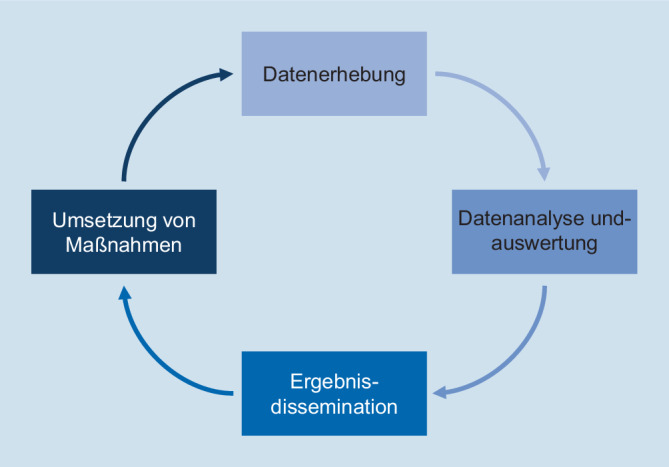
Eine Kernaufgabe von Public Health ist die kontinuierliche Erfassung und Analyse von gesundheitsbezogenen Daten zu relevanten Krankheiten (Surveillance). Sie dient der zeitnahen Umsetzung von Maßnahmen zum Schutz der Gesundheit in der Bevölkerung. Dafür müssen relevante Informationen zur richtigen Zeit und in geeigneter Weise für die entscheidenden Zielgruppen bereitgestellt werden (Dissemination).
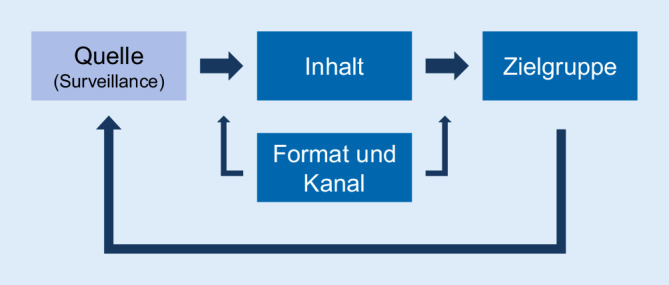
Eine Disseminationsstrategie unterstützt die effektive Ergebniskommunikation und berücksichtigt 3 Kernfragen: (1) „Was sind die relevanten Inhalte der Surveillance?“, (2) „Wer benötigt welche Informationen?“ und (3) „Wie werden die Ergebnisse den Zielgruppen bereitgestellt?“ Die Digitalisierung eröffnet hierbei neue Möglichkeiten für die Gestaltung der Formate.
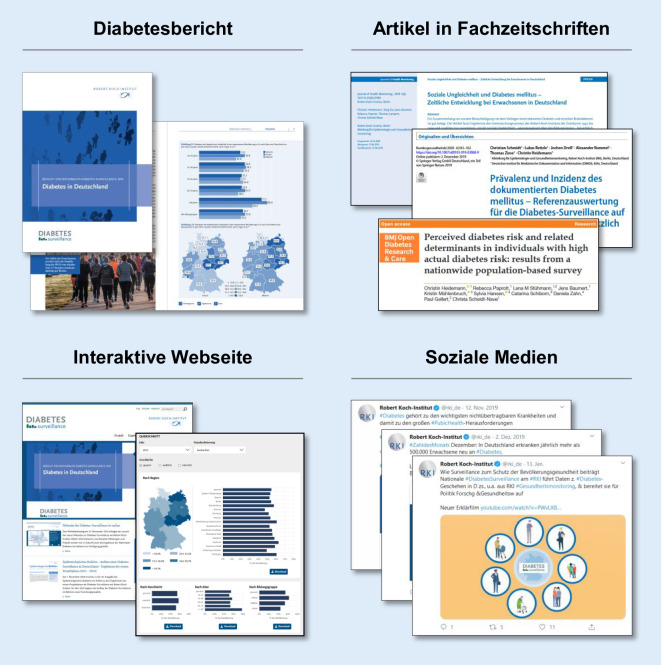
Seit 2015 wird am Robert Koch-Institut die Diabetes-Surveillance aufgebaut. In einem strukturierten Konsensprozess wurden 4 gesundheitspolitisch relevante Handlungsfelder mit 40 Kennzahlen (Indikatoren) definiert. Anschließend wurden gemeinsam mit dem wissenschaftlichen Projektbeirat unter Berücksichtigung neuer Möglichkeiten durch die Digitalisierung erste Publikationsformate erarbeitet. Neben Artikeln in Fachzeitschriften stellen der Bericht „Diabetes in Deutschland“ und eine Webseite mit interaktiver Visualisierung der Ergebnisse die wichtigsten Formate der ersten Projektphase dar. Begleitend werden Twitter und Youtube für die Erhöhung der Reichweite genutzt.
In der nächsten Projektphase steht neben der Weiterentwicklung des Indikatorensets der Ausbau der Dissemination hin zu einer nutzer- und handlungsorientierten Berichterstattung im Mittelpunkt. In engem Austausch mit dem wissenschaftlichen Beirat sollen Anforderungen der Zielgruppen erfasst und in der Entwicklung weiterer Formate berücksichtigt werden.
Keywords: Diabetes mellitus; Dissemination; Health reporting; Surveillance; Translation.

References
-
- World Health Organization (2018) Public health surveillance. https://www.who.int/topics/public_health_surveillance/en/. Zugegriffen: 4. Dez. 2018
-
- Remington PL, Nelson DE. Communicating public health surveillance information for action. In: Lee LM, Teutsch SM, Thacker SB, Louis SME, editors. Principles & practice of public health surveillance. Oxford: Oxford University Press; 2010.
Publication types
MeSH terms
LinkOut - more resources
Full Text Sources
Medical
