Fast and Automated Hyperreflective Foci Segmentation Based on Image Enhancement and Improved 3D U-Net in SD-OCT Volumes with Diabetic Retinopathy
- PMID: 32818082
- PMCID: PMC7396192
- DOI: 10.1167/tvst.9.2.21
Fast and Automated Hyperreflective Foci Segmentation Based on Image Enhancement and Improved 3D U-Net in SD-OCT Volumes with Diabetic Retinopathy
Abstract
Purpose: To design a robust and automated hyperreflective foci (HRF) segmentation framework for spectral-domain optical coherence tomography (SD-OCT) volumes, especially volumes with low HRF-background contrast.
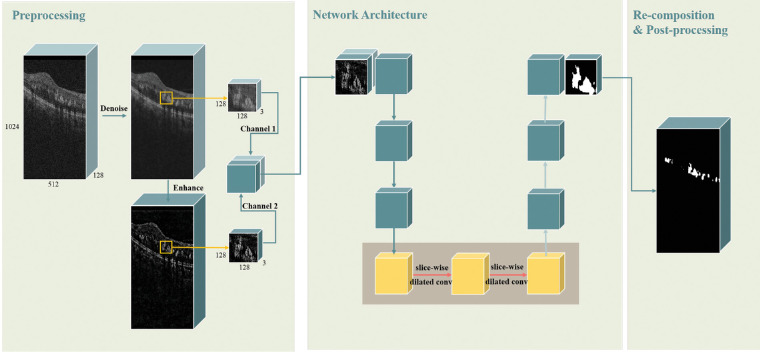
Methods: HRF in retinal SD-OCT volumes appear with low-contrast characteristics that results in the difficulty of HRF segmentation. Therefore to effectively segment the HRF we proposed a fully automated method for HRF segmentation in SD-OCT volumes with diabetic retinopathy (DR). First, we generated the enhanced SD-OCT images from the denoised SD-OCT images with an enhancement method. Then the enhanced images were cascaded with the denoised images as the two-channel input to the network against the low-contrast HRF. Finally, we replaced the standard convolution with slice-wise dilated convolution in the last layer of the encoder path of 3D U-Net to obtain long-range information.
Results: We evaluated our method using two-fold cross-validation on 33 SD-OCT volumes from 27 patients. The average dice similarity coefficient was 70.73%, which was higher than that of the existing methods with significant difference (P < 0.01).
Conclusions: Experimental results demonstrated that the proposed method is faster and achieves more reliable segmentation results than the current HRF segmentation algorithms. We expect that this method will contribute to clinical diagnosis and disease surveillance.
Translational relevance: Our framework for the automated HRF segmentation of SD-OCT volumes may improve the clinical diagnosis of DR.
Keywords: 3D U-Net; SD-OCT; hyperreflective foci segmentation; image enhancement; slice-wise dilated convolution.
Copyright 2020 The Authors.
Conflict of interest statement
Disclosure: S. Xie, None; I.P. Okuwobi, None; M. Li, None; Y. Zhang, None; S. Yuan, None; Q. Chen, None
Figures




References
-
- Bolz M, Schmidt-Erfurth U, Deak G, Mylonas G, Kriechbaum K, Scholda C. Optical coherence tomographic hyperreflective foci: a morphologic sign of lipid extravasation in diabetic macular edema. Ophthalmology. 2009; 116: 914–920. - PubMed
-
- De BU, Sacconi R, Pierro L, Lattanzio R, Bandello F. Optical coherence tomographic hyperreflective foci in early stages of diabetic retinopathy. Retina. 2014; 35: 449–453. - PubMed
-
- Cusick M, Chew EY, Chan CC,Kruth HS, Murphy RP, Ferris FL. Histopathology and regression of retinal hard exudates in diabetic retinopathy after reduction of elevated serum lipid levels. Ophthalmology. 2003; 110: 2126–2133. - PubMed
-
- Framme C, Schweizer P, Imesch M, Wolf S, Wolf-Schnurrbusch U. Behavior of SD-OCT-detected hyperreflective foci in the retina of anti-VEGF-treated patients with diabetic macular edema. Invest Ophthalmol Vis Sci. 2012; 53: 5814–5818. - PubMed
-
- Uji A, Tomoaki T, Kazuaki N, et al.. Association between hyperreflective foci in the outer retina, status of photoreceptor layer, and visual acuity in diabetic macular edema. Am J Ophthalmol. 2012; 153: 710–717. - PubMed
Publication types
MeSH terms
LinkOut - more resources
Full Text Sources
Medical