Review
. 2020 Oct:94:102905.
doi: 10.1016/j.dnarep.2020.102905. Epub 2020 Jul 6.

Molecular origins of APOBEC-associated mutations in cancer

Affiliations
Review

Molecular origins of APOBEC-associated mutations in cancer

Mia Petljak et al. DNA Repair (Amst). 2020 Oct.

Abstract

The APOBEC family of cytidine deaminases has been proposed to represent a major enzymatic source of mutations in cancer. Here, we summarize available evidence that links APOBEC deaminases to cancer mutagenesis. We also highlight newly identified human cell models of APOBEC mutagenesis, including cancer cell lines with suspected endogenous APOBEC activity and a cell system of telomere crisis-associated mutations. Finally, we draw on recent data to propose potential causes of APOBEC misregulation in cancer, including the instigating factors, the relevant mutator(s), and the mechanisms underlying generation of the genome-dispersed and clustered APOBEC-induced mutations.

Keywords: APOBEC mutations; Cancer cell lines; Cancer mutagenesis; Chromothripsis; Kataegis; Mutational signature.


Conflict of interest statement

Conflict of interest

The authors have no conflict of interest to declare.

Figures

Figure 1.
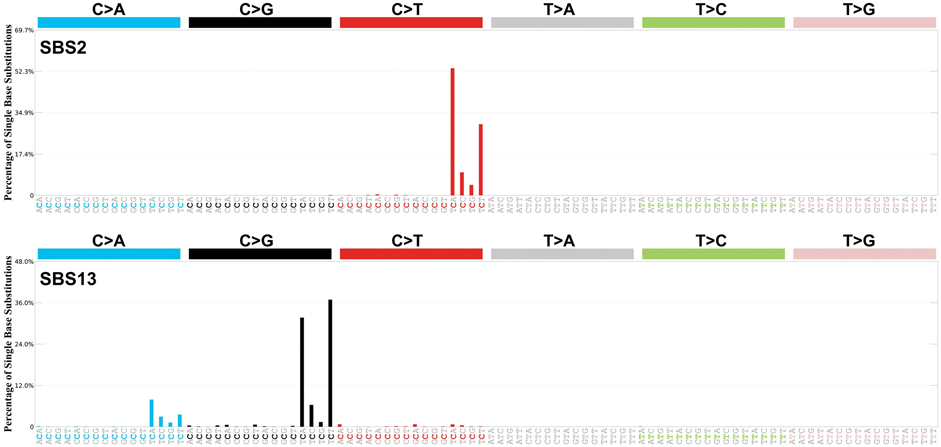
Figure 1.. APOBEC-associated genome wide signatures SBS2 and SBS13.
SBS2 and SBS13 identified from whole-genome sequences of 2,780 primary cancer from various types, as part of the Pan Cancer Analysis of Whole Genomes (PCAWG) effort [9]. Each signature is displayed according to the alphabetical 96-substitution classification on horizontal axes, defined by the six color-coded substitution types (C>A, C>G, C>T, T>A, T>C, and T>G; whereby all substitutions are referred to by the pyrimidine of the mutated Watson—Crick base pair) and sequence context immediately 5' and 3' to each mutated base. Vertical axes indicate the percentage of mutations attributed to specific mutation types, adjusted to the actual frequencies of each trinucleotide in the reference human genome version GRCh37. Images acquired from COSMIC (Mutational Signatures v3, May 2019).
Figure 2.
Figure 2.. Cell models of APOBEC mutagenesis.
A. Human cancer cell lines which generate APOBEC-associated mutations episodically in vitro represent genetically amenable models to experimentally explore origins of such mutations in cancer cells. CRISPR-Cas9 modifications of the candidate genes, such as individual APOBEC enzymes or other putative modulators of mutagenesis, can be generated in such cell lines to examine changes in mutation acquisition on various genetic backgrounds and during the defined in vitro timeframes (t). Genetically modified single-cell derived clones (‘parent clones’) are cultured for specified periods of time, e.g. depending on the mutation rates previously determined in cell lines [58]. Multiple ‘daughter clones’ are derived subsequently from single cells of individual parent clones. DNA isolated from parent clones and their corresponding daughters are subjected to WGS. Clonal mutations in daughter clones absent from their respective parent clones represent de novo mutations acquired during the specified in vitro timeframes spanning the two single cell bottlenecks. APOBEC-associated mutational burdens can be examined among de novo mutations acquired in different genetic backgrounds. B. Dicentric chromosomes formed by telomere fusion persist through mitosis intact and develop into cell-connecting DNA bridges [33]. Nuclear membrane rupture at DNA bridges enables the cytoplasmic exonuclease TREX1 to access and resect DNA. The resulting single-stranded DNA is targeted by APOBEC3B when broken DNA bridges are re-integrated into the nucleus. Repair of the fragmented DNA generates chromothripsis chromosomes frequently associated with kataegis. Uracil excision by UNG2 and abasic site cleavage by APE1 at single-stranded DNA may further enhance chromothriptic fragmentation, but APOBEC3B is not required for chromosome fragmentation.

References

    1. Navaratnam N, Morrison JR, Bhattacharya S, Patel D, Funahashi T, Giannoni F, Teng BB, Davidson NO, Scott J, The p27 catalytic subunit of the apolipoprotein B mRNA editing enzyme is a cytidine deaminase, J. Biol. Chem 268 (1993) 20709–20712. - PubMed
    1. Teng B, Burant C, Davidson N, Molecular cloning of an apolipoprotein B messenger RNA editing protein, Science. 260 (1993) 1816–1819. 10.1126/science.8511591. - DOI - PubMed
    1. Harris RS, Petersen-Mahrt SK, Neuberger MS, RNA editing enzyme APOBEC1 and some of its homologs can act as DNA mutators, Mol. Cell 10 (2002) 1247–1253. 10.1016/S1097-2765(02)00742-6. - DOI - PubMed
    1. Petersen-Mahrt SK, Neuberger MS, In vitro deamination of cytosine to uracil in single-stranded DNA by apolipoprotein B editing complex catalytic subunit 1 (APOBEC1), J. Biol. Chem 278 (2003) 19583–19586. 10.1074/jbc.C300114200. - DOI - PubMed
    1. Sowden M, Hamm JK, Smith HC, Overexpression of APOBEC-1 results in mooring sequence-dependent promiscuous RNA editing, J. Biol. Chem 271 (1996) 3011–3017. 10.1074/jbc.271.6.3011. - DOI - PubMed

Publication types

Substances