


Risk factors for malaria infection prevalence and household vector density between mass distribution campaigns of long-lasting insecticidal nets in North-western Tanzania
- PMID: 32819368
- PMCID: PMC7441624
- DOI: 10.1186/s12936-020-03369-4
Risk factors for malaria infection prevalence and household vector density between mass distribution campaigns of long-lasting insecticidal nets in North-western Tanzania
Abstract
Background: Long-lasting insecticidal nets (LLINs) are the most widely deployed vector control intervention in sub-Saharan Africa to prevent malaria. Recent reports indicate selection of pyrethroid insecticide resistance is widespread in mosquito vectors. This paper explores risk factors associated with malaria infection prevalence and vector density between mass distribution campaigns, changes in net coverage, and loss of protection in an area of high pyrethroid resistance in Northwest Tanzania.
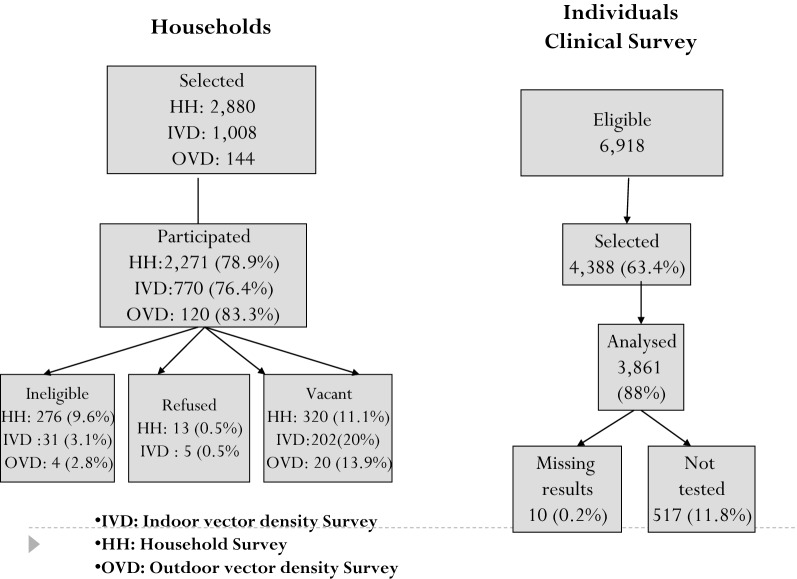
Methods: A cross sectional malaria survey of 3456 children was undertaken in 2014 in Muleba district, Kagera region west of Lake Victoria. Vector density was assessed using indoor light traps and outdoor tent traps. Anophelines were identified to species using PCR and tested for Plasmodium falciparum circumsporozoite protein. Logistic regression was used to identify household and environmental factors associated with malaria infection and regression binomial negative for vector density.
Results: LLIN use was 27.7%. Only 16.9% of households had sufficient nets to cover all sleeping places. Malaria infection was independently associated with access to LLINs (OR: 0.57; 95% CI 0.34-0.98). LLINs less than 2 years old were slightly more protective than older LLINs (53 vs 65% prevalence of infection); however, there was no evidence that LLINs in good condition (hole index < 65) were more protective than LLINs, which were more holed. Other risk factors for malaria infection were age, group, altitude and house construction quality. Independent risk factors for vector density were consistent with malaria outcomes and included altitude, wind, livestock, house quality, open eaves and LLIN usage. Indoor collections comprised 4.6% Anopheles funestus and 95.4% Anopheles gambiae of which 4.5% were Anopheles arabiensis and 93.5% were Anopheles gambiae sensu stricto.
Conclusion: Three years after the mass distribution campaign and despite top-ups, LLIN usage had declined considerably. While children living in households with access to LLINs were at lower risk of malaria, infection prevalence remained high even among users of LLINs in good condition. While effort should be made to maintain high coverage between campaigns, distribution of standard pyrethroid-only LLINs appears insufficient to prevent malaria transmission in this area of intense pyrethroid resistance.
Keywords: Effectiveness; Llins; Malaria; Tanzania; Vectors.
Conflict of interest statement
The authors declare that they have no competing interests.
Figures
References
-
- WHO . World Malaria Report 2018. Geneva: World Health Organization; 2018.
-
- National Bureau of Statistics . Demographic and health survey and malaria indicator survey 2015–2016. Tanzania: Dar Es Salaam; 2016.
-
- Renggli S, Mandike R, Kramer K, Patrick F, Brown NJ, McElroy PD, et al. Design, implementation and evaluation of a national campaign to deliver 18 million free long-lasting insecticidal nets to uncovered sleeping spaces in Tanzania. Malar J. 2013;12:85. doi: 10.1186/1475-2875-12-85. - DOI - PMC - PubMed
MeSH terms
Grants and funding
LinkOut - more resources
Full Text Sources
