


Nutritional knowledge of youth academy athletes
- PMID: 32821418
- PMCID: PMC7433089
- DOI: 10.1186/s40795-020-00360-9
Nutritional knowledge of youth academy athletes
Abstract
Background: Youth athletes are under increasing pressures to excel in their chosen sport and many turn to nutritional supplements in order to enhance sports performance. However, athletes may obtain their nutritional information via illegitimate sources such as the internet, media, and other athletes, representing miscommunication between sound scientific information and anecdotal experiences. The objective of this investigation was to examine nutrition knowledge of elite youth athletes from a non-residential regional academy of sport.
Methods: A previously validated two-part nutrition knowledge questionnaire (NKQ) was administered to 101 (37 male and 64 female) non-residential regional Academy of Sport elite youth athletes at an annual training camp. Part 1 of the NKQ presented demographic questions. Part 2 presented 90 sports nutrition knowledge questions in seven knowledge subcategories (1) Nutrients; (2) Dietary reference intakes (DRI); (3) Fluids/Hydration; (4) Recovery; (5) Weight gain; (6) Weight loss; and (7) Supplements.
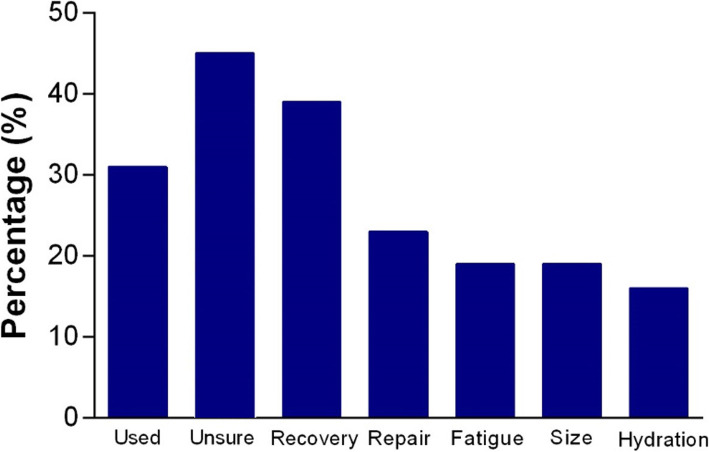
Results: The mean NKQ score of all athletes was 43.8% (± 11.4). No gender differences observed between nutritional knowledge total scores, however female athletes recorded more 'correct' responses than males (p = 0.02) in the Nutrients subcategory. Majority of athletes had difficulty identifying correct DRI with this subcategory featuring the lowest percentage of 'correct' to 'incorrect' responses (27.1% ± 2.3; p = 0.02). Supplements subcategory displayed much uncertainty with significantly more 'unsure' than 'incorrect' responses (42.4% ± 20.3; p < 0.05).
Conclusions: In agreement with previous research, results of the current study indicate that elite youth athletes lack fundamental nutritional knowledge, specifically related to DRI and supplementation. These data provide further support of current recommendations that Academy of Sport youth athletes may benefit from integrated nutrition education conducted by qualified nutrition professionals.
Keywords: Nutrition knowledge; Supplements; Youth athletes.
© The Author(s) 2020.
Conflict of interest statement
Competing interestsThe authors declare that they have no competing interests.
Figures



References
-
- WHO . Child and adolescent health and development. Progress report 2006-2007. Geneva: World Health Organization; 2008.
LinkOut - more resources
Full Text Sources