


Experiences of an Emergency Department Visit Among Older Adults and Their Families: Qualitative Findings From a Mixed-Methods Study
- PMID: 32821794
- PMCID: PMC7410141
- DOI: 10.1177/2374373519837238
Experiences of an Emergency Department Visit Among Older Adults and Their Families: Qualitative Findings From a Mixed-Methods Study
Abstract
Background: Emergency department (ED) visits are critical events for older adults, but little is known regarding their experiences, particularly about their physical needs, the involvement of accompanying family members, and the transition back to the community.
Objective: To explore experiences of an ED visit among patients aged 75 and older.
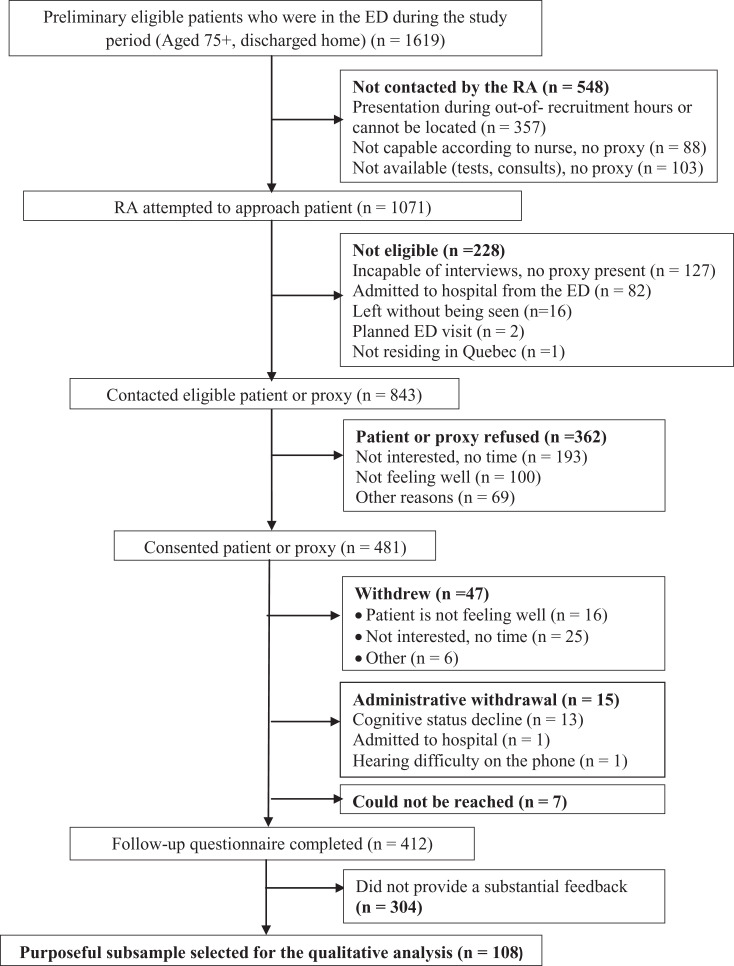
Methods: In a mixed-methods study, a cohort of patients aged 75 and older (or a family member) discharged from the ED back to the community was recruited from 4 urban EDs. A week following discharge, structured telephone interviews supplemented with open-ended questions were conducted. A subsample (76 patients, 32 family members) was purposefully selected. Verbatim transcripts of responses to the open-ended questions were thematically analyzed.
Results: Experiences related to physical needs included comfort, equipment supporting mobility and autonomy, help when needed, and access to drink and food. Family members required opportunities to provide patient support and greater involvement in their care. At discharge, patients/families required adequate discharge education, resolution of their health problem, information on medications, and greater certainty about planned follow-up medical and home care services.
Conclusions: Our findings suggest several areas that could be targeted to improve patient and family perceptions of the care at an ED visit.
Keywords: emergency medicine; family; older adults; patient experiences; transitional care.
© The Author(s) 2019.
Conflict of interest statement
Declaration of Conflicting Interests: The author(s) declared no potential conflicts of interest with respect to the research, authorship, and/or publication of this article.
Figures
References
-
- Hustey FM, Meldon SW. The prevalence and documentation of impaired mental status in elderly emergency department patients. Ann Emerg Med. 2002;39:248–53. - PubMed
-
- Hart B, Frank C, Hoffman J, Dickey D, Kristjansson J. Senior friendly health services. Perspectives. 2006;30:18–21. - PubMed
-
- Carpenter CR, Bromley M, Caterino JM, Chun A, Gerson LW, Greenspan J, et al. Optimal older adult emergency care: introducing multidisciplinary geriatric emergency department guidelines from the American College of Emergency Physicians, American Geriatrics Society, Emergency Nurses Association, and Society for Academic Emergency Medicine. Ann Emerg Med. 2014;63:e1–3. - PubMed
-
- Nikki L, Lepisto S, Paavilainen E. Experiences of family members of elderly patients in the emergency department: a qualitative study. Int Emerg Nurs. 2012;20:193–200. - PubMed
LinkOut - more resources
Full Text Sources
