. 2020 Nov 11;108(3):469-485.e8.
doi: 10.1016/j.neuron.2020.07.032. Epub 2020 Aug 20.

Two Brain Pathways Initiate Distinct Forward Walking Programs in Drosophila

Affiliations

Two Brain Pathways Initiate Distinct Forward Walking Programs in Drosophila

Salil S Bidaye et al. Neuron. .

Abstract

An animal at rest or engaged in stationary behaviors can instantaneously initiate goal-directed walking. How descending brain inputs trigger rapid transitions from a non-walking state to an appropriate walking state is unclear. Here, we identify two neuronal types, P9 and BPN, in the Drosophila brain that, upon activation, initiate and maintain two distinct coordinated walking patterns. P9 drives forward walking with ipsilateral turning, receives inputs from central courtship-promoting neurons and visual projection neurons, and is necessary for a male to pursue a female during courtship. In contrast, BPN drives straight, forward walking and is not required during courtship. BPN is instead recruited during and required for fast, straight, forward walking bouts. Thus, this study reveals separate brain pathways for object-directed walking and fast, straight, forward walking, providing insight into how the brain initiates context-appropriate walking programs.

Keywords: Drosophila; behavior; courtship; descending neurons; locomotion; neural circuits; walking.


Conflict of interest statement

Declaration of Interests The authors declare no competing interests.

Figures
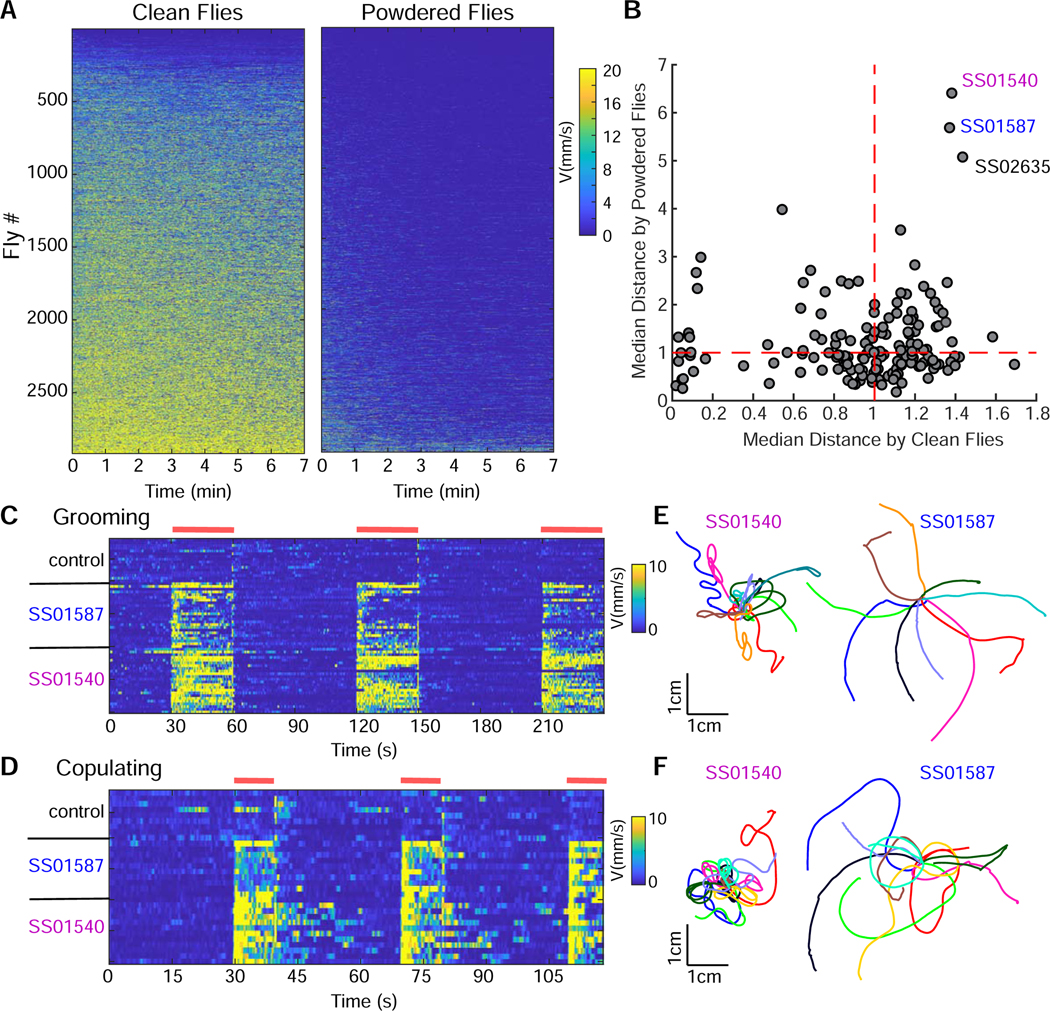
Figure 1:
Figure 1:. Optogenetic screen identifies candidate walking initiation lines
(A) Translational velocity of non-powdered, “clean” flies (left) and “powdered”, grooming flies (right) upon continuous optogenetic activation with CsChrimson throughout the 7 minute assay, shown as velocity heatmaps for individual flies arranged from lowest to highest mean velocity. (B) Normalized median distance traveled by clean versus powdered flies for each genotype. n=12–16 per genotype per condition. (C) Walking initiation upon transient activation in grooming flies for control, SS01540 and SS01587, shown as velocity heatmaps for individual flies (red bars indicate light ON). n=16–24 flies/genotype. (D) Walking initiation of females upon transient activation in copulating flies, shown as velocity heatmaps for individual flies (red bars indicate light ON). n=9–11 flies/genotype. (E) Example walking trajectories, 4 seconds light ON, for SS01540 and SS01587 in the grooming assay, 10 flies/genotype. (F) Example walking trajectories, 4 seconds light ON, for SS01540 and SS01587 in the copulation assay, 10 flies/genotype. See Figure S1 for statistical analysis of candidate lines and Video S1, S2 for activation phenotypes.
Figure 2:
Figure 2:. P9 activation triggers forward walking with ipsilateral turning
(A) DenMark (magenta) and synaptotagmin-GFP (green) in P9 neurites in the central brain (left) and VNC (right) of SS01540>DenMark,Syt-GFP flies. nc82 stains neuropil (blue). Scale 100 μm. (B) P9 segmented image, mapped onto a fly brain template. (C) CsChrimson-mVenus (green) and neuropil (magenta) (left), angular velocity with positive velocity for right turns, negative velocity for left turns (middle) and translational velocity (right) for mosaic animals with CsChrimson-mVenus in P9 neurons bilaterally (3 flies, 9 trials). (D) CsChrimson-mVenus expression (left), angular velocity (middle) and translational velocity (right) for mosaic animals with CsChrimson-mVenus in right P9 neurons (10 flies, 30 trials). (E) CsChrimson-mVenus expression (left), angular velocity (middle) and translational velocity (right) for mosaic animals with CsChrimson-mVenus in left P9 neurons (9 flies, 27 trials). Individual trials (grey), mean (magenta), light ON (red bar). See Figure S2 for characterization of an independent P9 split-Gal4 line. See Video S3 for activation phenotypes.
Figure 3:
Figure 3:. P9 neurons are activated by courtship promoting neurons and visual projection neurons.
(A) P9, pC1 and LC9 segmented neurons registered onto a template brain. See Figure S3 for anatomical overlap in single brains. (B) GCaMP6s responses (AF/F) in P9 soma (using P9-LexA, lexAop-GCaMP6s) upon stimulation of pC1 (left) or LC9 (right), using UAS-Chrimson88-tdTomato and R71G01-Gal4 for pC1 or LC9 split-Gal4. Trial averaged traces (grey), mean (magenta), optical stimulation (pink background). n=5–8 flies/genotype. (C) P9 responses (area under average trial AF/F0 curve during light ON period) upon optical stimulation of candidate upstream neurons. n=3–8 per genotype, non-parametric Mann-Whitney test compared to no Chrimson control, *p<0.05, **p<0.01, ***p<0.001. (D)EM reconstruction of the monosynaptically connected P9, pC1d and one LC9 cell (E) Schematic summarizing EM connectivity analysis showing direct and indirect inputs on P9 by LC9 cluster (64 cells), pC1d (single cell) and LC11 cluster (58 cells), see Figure S3 for anatomy of intermediate neurons. (F) P9 receives inputs from LC9 and pC1 and potentially from other VPNs like LC10, LC11, suggesting that it participates in object-directed tracking during courtship.
Figure 4:
Figure 4:. P9 is required for males to track females during courtship
(A) Fraction of males copulating with Canton S virgins over 10 minutes. Gal4 controls (dotted lines; open circles for other panels), Gal4, UAS-TeTx flies (solid lines; filled circles for other panels), n=20–28 flies/genotype, Fisher’s Exact Test, t = 10 min, ***p<0.001. Genotypes for all panels are color coded as B. (B) Copulation latency. Lines indicate median and interquartile range. n=20–28 flies/genotype, Kruskal-Wallis test and Dunn’s multiple comparison, *p<0.05, ***p<0.001. (C) Probability density showing distance (left) or angle (right) between male and female, mean ± SEM. (D) Following Index per courting pair. Lines indicate median and interquartile range. n=20–28 flies/genotype, ANOVA and Sidak’s tests, *p<0.05, ***p<0.001. (E) Probability density showing distance (left) or angle (right, 0° indicates female in front of male) between male and P9>CsChrimson “remote-controlled” female, mean ± SEM. (F) Following Index per courting male and P9>CsChrimson female. n=17–23 flies/genotype, ANOVA and Sidak’s tests, ***p<0.001. (G) Translational velocity of P9>TeTx males and P9>CsChrimson females, or control males and P9>CsChrimson females, showing mean (dark) and SEM (shading), n = 17–23 pairs, red bar indicates light ON. (H) Correlation between male and female velocities per courting pair, for males courting P9>CsChrimson females. n = 17–23 pairs, t-test with Sidak’s multiple comparison corrections, **p<0.01, ***p<0.001. See Figure S3 for additional characterization of P9 courtship phenotypes. See Figure S4 for gait analysis of P9>TeTx flies and Video S4 for courtship phenotype.
Figure 5:
Figure 5:. BPNs trigger forward walking with no turning bias
(A) BPN-S1 split-Gal4 line, showing specific BPN expression (green), nc82 stains neuropil (magenta). Scale 100 μm (B) Translational velocity of BPNS1 split-Gal4 (blue) or control (black) on activation with CsChrimson in grooming flies. n=8 flies, 24 trials, mean ± SEM. (C) DenMark (magenta) and synaptotagmin (green) labeling in BPN-S1 line. nc82 stains neuropil (blue). Scale 100 μm. (D) CsChrimson-mVenus (green) expression (left), angular velocity (middle) and translational velocity (right) for mosaic animals with CsChrimson-mVenus in BPNs bilaterally (4 flies, 12 trials). (E) CsChrimson-mVenus expression (left), angular velocity (middle) and translational velocity (right) for mosaic animals with CsChrimson-mVenus in right BPNs (8 flies, 24 trials). (F) CsChrimson-mVenus expression (left), angular velocity (middle) and translational velocity (right) for mosaic animals with CsChrimson-mVenus in left BPNs (8 flies, 24 trials). Graphs in D-F show individual activation trials (grey), mean (blue), light ON (red bar). See Figure S5 for additional characterization of 2 BPN split-Gal4 lines.
Figure 6:
Figure 6:. BPNs activity correlates with long, straight forward walks
(A) in-vivo imaging schematic of a fly walking on a ball. (B) top: translational velocity of one fly during an imaging session, bottom: time-locked imaging readout of 5 BPN soma in the same fly, shown as z-scored GCaMP fluorescence. (C-E) Trajectory of the fly in B color coded for mean BPN activity (z-score color-scale as B for the entire session (C), or first (D) or second half (E). Velocity versus mean BPN activity correlation plots for the first (D graph) and second half (E graph) of the imaging session. (F-H) Trajectory of fly in B color coded with straightness index (F), translational velocity (G) and angular velocity (H). (I) 3D subspace (velocity, angular velocity and walking duration.) representation of unbiased k-means clustering of 589 walking bouts across 3 flies and 5 imaging sessions. (J) BPN activity (mean ± SEM) for each cluster aligned to walking bout start (dotted line). Cluster colors as in I. See Figure S6 for additional analysis of BPN activity.
Figure 7:
Figure 7:. BPN activity levels reciprocally regulate straight, forward walking
(A) Walk duration (fraction of total activation time spent walking) (left), translational velocity (middle) and angular velocity (right) as a function of optogenetic activation (LED frequency) for BPN>CsChrimson flies. n=20 flies, mean ± 95%CI, linear regression line (dotted line) for r2 values shown. (B) Walk duration (left), translational velocity (middle) and angular velocity (right) of controls (black) and BPN>TeTx flies (blue). n= 16–28, Mann-Whitney, *p<0.05, ***p<0.001. (C) Trial averaged translational velocity during green light stimulation for controls (black) and BPN>TeTx flies (blue). n=16–28, mean ± SEM, green bar indicates light ON. (D) Middle leg step period (left), swing duration (middle) and stance duration (right) as a function of translational velocity of controls (red) and BPN>TeTx (blue), n=283–314 steps from 4–5 flies, t test. See Figure S7 for additional analysis of BPN silenced flies.

References

    1. Ache JM, Haupt SS, and Dürr V.(2015). A direct descending pathway informing locomotor networks about tactile sensor movement. J. Neurosci 35, 4081–4091. - PMC - PubMed
    1. Ache JM, Namiki S, Lee A, Branson K, and Card GM (2019). State-dependent decoupling of sensory and motor circuits underlies behavioral flexibility in Drosophila. Nat. Neurosci 22, 1132–1139. - PMC - PubMed
    1. Agrawal S, and Dickinson MH (2019). The effects of target contrast on Drosophila courtship. The Journal of Experimental Biology 222, jeb203414. - PubMed
    1. Agrawal S, Safarik S, and Dickinson M.(2014). The relative roles of vision and chemosensation in mate recognition of Drosophila melanogaster. J. Exp. Biol 217, 2796–2805. - PubMed
    1. Ampatzis K, Song J, Ausborn J, and El Manira A.(2014). Separate microcircuit modules of distinct v2a interneurons and motoneurons control the speed of locomotion. Neuron 83, 934–943. - PubMed

Publication types
