Review
. 2020 Aug 13;21(16):5820.
doi: 10.3390/ijms21165820.

Gut-Pancreas-Liver Axis as a Target for Treatment of NAFLD/NASH

Affiliations
Review

Gut-Pancreas-Liver Axis as a Target for Treatment of NAFLD/NASH

Gianluca Svegliati-Baroni et al. Int J Mol Sci. .

Abstract

Non-alcoholic fatty liver disease (NAFLD) represents the most common form of chronic liver disease worldwide. Due to its association with obesity and diabetes and the fall in hepatitis C virus morbidity, cirrhosis in NAFLD is becoming the most frequent indication to liver transplantation, but the pathogenetic mechanisms are still not completely understood. The so-called gut-liver axis has gained enormous interest when data showed that its alteration can lead to NAFLD development and might favor the occurrence of non-alcoholic steatohepatitis (NASH). Moreover, several therapeutic approaches targeting the gut-pancreas-liver axis, e.g., incretins, showed promising results in NASH treatment. In this review, we describe the role of incretin hormones in NAFLD/NASH pathogenesis and treatment and how metagenomic/metabolomic alterations in the gut microbiota can lead to NASH in the presence of gut barrier modifications favoring the passage of bacteria or bacterial products in the portal circulation, i.e., bacterial translocation.

Keywords: glucose metabolism; gut-pancreas-liver axis; incretins; lipid metabolism; non-alcoholic fatty liver disease; non-alcoholic steatohepatitis; type-2 diabetes.


Conflict of interest statement

The authors have no potential conflict of interest relevant to this article.

Figures
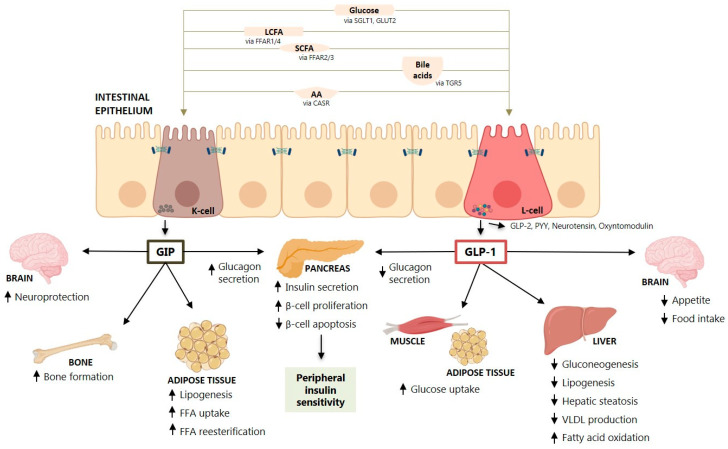
Figure 1
Figure 1
Secretion and physiological effects of incretin hormones GIP and GLP-1 in different organs and tissues. The intestinal epithelium is composed of several cell types, including enteroendocrine cells such as K-cells and L-cells, responsible for the secretion of GIP and GLP-1, respectively. The secretion of these hormones is triggered upon nutrient stimulation of G protein-coupled receptors (GPCRs) present in the cell membrane. Some of the nutrients responsible for GIP and GLP-1 secretion are glucose (and other carbohydrates), lipids, some amino acids and proteins. Bile acids can also stimulate incretin secretion. After secretion, GIP and GLP-1 exert their functions in the pancreas and extra-pancreatic tissues, such as the liver, adipose tissue, muscle, bone, and the central nervous system. Abbreviations: AA, Amino acids; CASR, Calcium-sensing receptor; FFAR, Free fatty acid receptor; GIP, Glucose-dependent insulinotropic peptide; GLP-1, Glucagon-like peptide-1; GLP-2, Glucagon-like peptide-2; GLUT, Glucose transporter; LCFA, Long-chain fatty acids; PYY, Peptide YY; SCFA, Short-chain fatty acids; SGLT, Sodium-dependent glucose cotransporter; TGR5, Takeda G protein-coupled receptor 5; VLDL, Very-low-density lipoprotein.
Figure 2
Figure 2
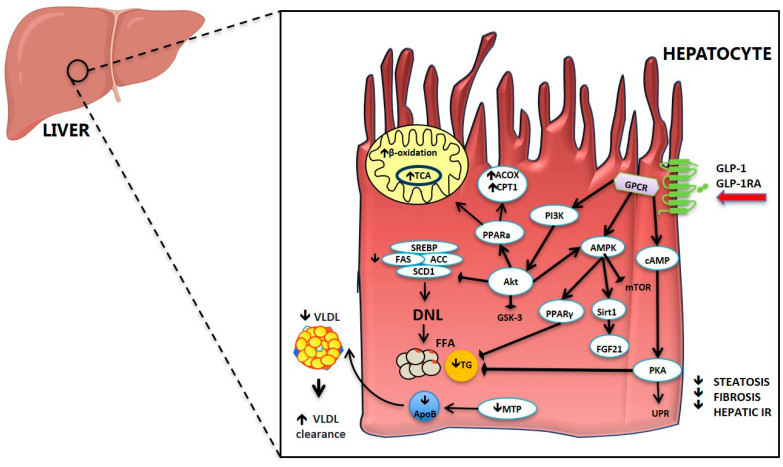
Mechanistic effects of GLP-1 and GLP-1 receptor agonists in hepatic lipid metabolism. GLP-1 and GLP-1 receptor agonists act via G protein-coupled receptors (GPCRs) in hepatocytes to target several signaling pathways, resulting in increased β-oxidation in mitochondria, decreased hepatic mRNA expression of several lipogenic genes (SREBP1, FAS, ACC and SCD1), reduced de novo lipogenesis (DNL) and reduced steatosis. Abbreviations: ACC, Acetyl-CoA carboxylase α; ACOX, Peroxisomal acyl-coenzyme A oxidase; Akt, Serine/threonine protein kinase B/Akt; AMPK, 5′ AMP-activated protein kinase; ApoB, Apolipoprotein B 100; cAMP, Cyclic adenosine monophosphate; CPT1, Carnitine palmitoyltransferase 1; DNL, de novo lipogenesis; FAS, Fatty acid synthase; FFA, Free fatty acids; FGF21, Fibroblast growth factor 21; GLP-1, Glucagon-like peptide-1; GLP-1RA, Glucagon-like peptide-1 receptor agonists; GPCR, G-protein-coupled receptors; GSK-3, Glycogen synthase kinase 3; MTP, Microsomal triglyceride transfer protein; mTOR, mammalian target of rapamycin; PI3K, Phosphoinositide 3-kinase; PKA, Protein kinase A; PPAR, Peroxisome proliferator-activated receptor; SCD1, Stearoyl-CoA desaturase 1; Sirt1, Sirtuin 1; SREBP, Sterol regulatory element-binding protein; TCA, Tricarboxylic acid cycle; TG, Triglyceride; UPR, Unfolded protein response; VLDL, Very-low-density lipoprotein.
Figure 3
Figure 3
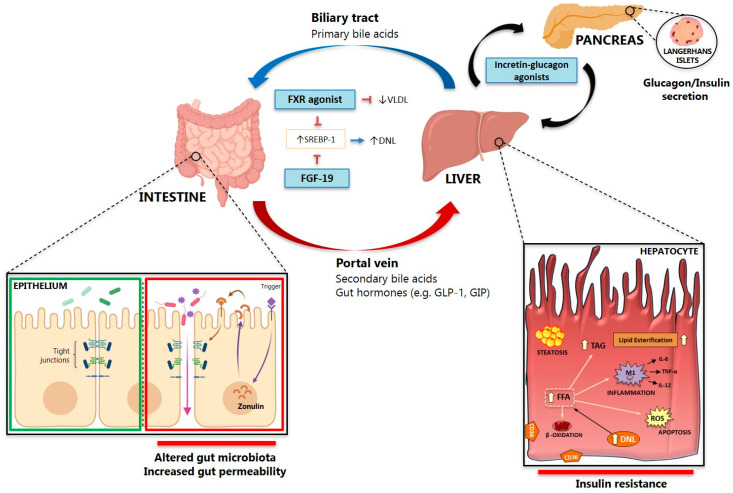
The gut-pancreas-liver axis in the context of non-alcoholic fatty liver disease (NAFLD). The intestine and the liver are in constant communication through the portal vein and the biliary tract. In the intestine, the maintenance of the intestinal endothelial cell barrier achieved through tight junctions is crucial. In pathological conditions, an alteration in the diversity and composition of gut microbiota could lead to the secretion of harmful bacterial products, which consequently damages the intestinal epithelium by disrupting tight junctions. Another mechanism that has been indicated to explain increased intestinal permeability is zonulin, a protein secreted within intestinal cells upon a trigger (e.g., gluten), which is thought to be responsible for tight junction disassembling. In such conditions, harmful bacteria/bacterial products cross the intestinal wall and reach the liver via portal circulation, where they activate toll-like receptors (TLRs) on hepatocyte cell surface, promoting steatosis, inflammation, apoptosis, and insulin resistance. The intestine is also responsible for the secretion of the incretin hormones GLP-1 and GIP upon nutrient stimulation, which go through the liver, reach circulation, and target the pancreas to regulate insulin and glucagon secretion. On the other hand, the liver secretes primary bile acids into the intestine to aid digestion, which are converted into secondary bile acids by gut microbiota, and the majority are reabsorbed back to the liver. A rearrangement in the gut-pancreas-liver axis has been hypothesized to play a role in the pathogenesis and development of NAFLD. Abbreviations: CD36, Cluster of differentiation 36; DNL, de novo lipogenesis; FFA, Free fatty acids; GIP, Glucose-dependent insulinotropic peptide; GLP-1, Glucagon-like peptide-1; IL, Interleukin; ROS, Reactive oxygen species; TAG, Triglycerides; TNF-α, Tumor necrosis factor α.

References

    1. Younossi Z., Tacke F., Arrese M., Chander Sharma B., Mostafa I., Bugianesi E., Wai-Sun Wong V., Yilmaz Y., George J., Fan J., et al. Global Perspectives on Nonalcoholic Fatty Liver Disease and Nonalcoholic Steatohepatitis. Hepatology. 2019;69:2672–2682. doi: 10.1002/hep.30251. - DOI - PubMed
    1. Bedossa P., Tordjman J., Aron-Wisnewsky J., Poitou C., Oppert J.M., Torcivia A., Bouillot J.L., Paradis V., Ratziu V., Clement K. Systematic review of bariatric surgery liver biopsies clarifies the natural history of liver disease in patients with severe obesity. Gut. 2017;66:1688–1696. doi: 10.1136/gutjnl-2016-312238. - DOI - PubMed
    1. Souto K.P., Meinhardt N.G., Ramos M.J., Ulbrich-Kulkzynski J.M., Stein A.T., Damin D.C. Nonalcoholic fatty liver disease in patients with different baseline glucose status undergoing bariatric surgery: Analysis of intraoperative liver biopsies and literature review. Surg. Obes. Relat. Dis. 2018;14:66–73. doi: 10.1016/j.soard.2017.09.527. - DOI - PubMed
    1. Day C.P., James O.F. Steatohepatitis: A tale of two “hits”? Gastroenterology. 1998;114:842–845. doi: 10.1016/S0016-5085(98)70599-2. - DOI - PubMed
    1. Tilg H., Moschen A.R. Evolution of inflammation in nonalcoholic fatty liver disease: The multiple parallel hits hypothesis. Hepatology. 2010;52:1836–1846. doi: 10.1002/hep.24001. - DOI - PubMed

MeSH terms