Review
. 2020 Aug 14;12(8):2275.
doi: 10.3390/cancers12082275.

Emerging Cancer Epigenetic Mechanisms Regulated by All-Trans Retinoic Acid

Affiliations
Review

Emerging Cancer Epigenetic Mechanisms Regulated by All-Trans Retinoic Acid

Stefano Rossetti et al. Cancers (Basel). .

Abstract

All-trans retinoic acid (RA), which is the dietary bioactive derivative obtained from animal (retinol) and plant sources (beta-carotene), is a physiological lipid signal of both embryonic and postembryonic development. During pregnancy, either RA deficiency or an excessive RA intake is teratogenic. Too low or too high RA affects not only prenatal, but also postnatal, developmental processes such as myelopoiesis and mammary gland morphogenesis. In this review, we mostly focus on emerging RA-regulated epigenetic mechanisms involving RA receptor alpha (RARA) and Annexin A8 (ANXA8), which is a member of the Annexin family, as well as ANXA8 regulatory microRNAs (miRNAs). The first cancer showing ANXA8 upregulation was reported in acute promyelocytic leukemia (APL), which induces the differentiation arrest of promyelocytes due to defective RA signaling caused by RARA fusion genes as the PML-RARA gene. Over the years, ANXA8 has also been found to be upregulated in other cancers, even in the absence of RARA fusion genes. Mechanistic studies on human mammary cells and mammary glands of mice showed that ANXA8 upregulation is caused by genetic mutations affecting RARA functions. Although not all of the underlying mechanisms of ANXA8 upregulation have been elucidated, the interdependence of RA-RARA and ANXA8 seems to play a relevant role in some normal and tumorigenic settings.

Keywords: RA receptor α (RARA); all-trans retinoic acid (RA); annexins; cancer; microRNAs.


Conflict of interest statement

The authors declare no conflict of interest.

Figures
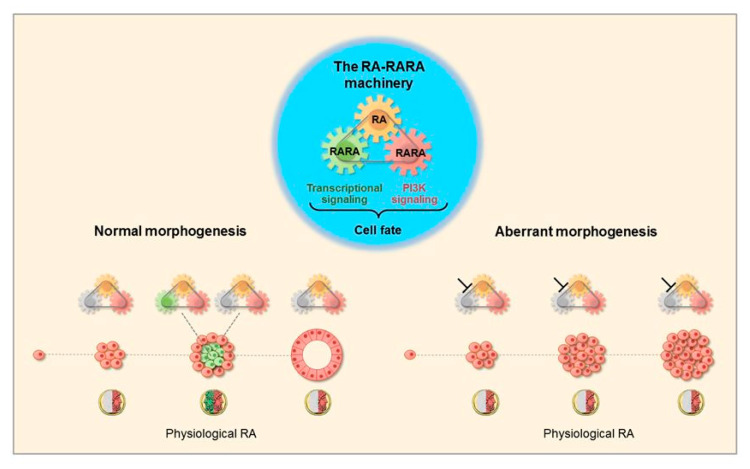
Figure 1
Figure 1
Physiological all-trans retinoic acid (RA) determines different cell fate decisions in normal and aberrant mammary epithelial cells. Blueprint of the three-module mechanism that integrates physiological RA and two RA receptor alpha (RARA) functions (center). In the course of normal human mammary epithelial cell morphogenesis (left scheme), physiological RA acts as the ancient two-faced Janus Bifrons god that regulates—in a spatiotemporal fashion—cell life (red) and cell death (green). Genetic factors affecting the RA-RARA mechanism induce 3D aberrant mammary morphogenesis (right scheme) [88].
Figure 2
Figure 2
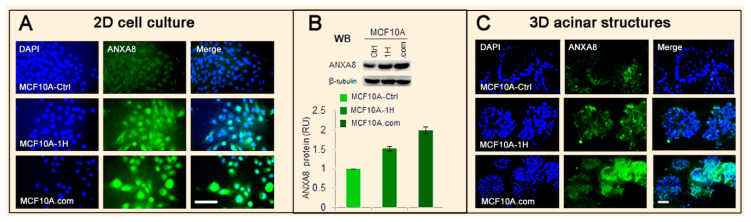
Evidence of increasing Annexin A8 (ANXA8) upregulation in isogenic MCF10A cell lines. (A) Immunofluorescence of MCF10A-Ctrl, MCF10A-1H, and MCF10A.com cell lines grown in two-dimensional (2D) culture stained with both 4′,6-diamidino-2-phenylindole (DAPI) (blue) and ANXA8 antibody (green) (scale bar 30 µm). (B) Western blotting (WB, top) and ANXA8 quantitative protein expression (bottom) in the three cell lines show an increasing ANXA8 level. (C) MCF10A-Ctrl, MCF10A-1H, and MCF10A.com cells grown in three-dimensional (3D) basement membrane culture (Matrigel) for 12 days were fixed and stained for DAPI and ANXA8 and imaged by confocal microscopy. MCF10A-Ctrl cells formed 3D acinar structures with a lumen lined by ANXA8-positive cells, while MCF10A-1H cells stably expressing the RAS oncogene developed morphologically aberrant acinar structures with ANXA8-positive cells in the luminal space. Comedocarcinoma MCF10A.com cells formed 3D ANXA8-positive “grape-like” morphologically aberrant structures (scale bar 30 µm).
Figure 3
Figure 3
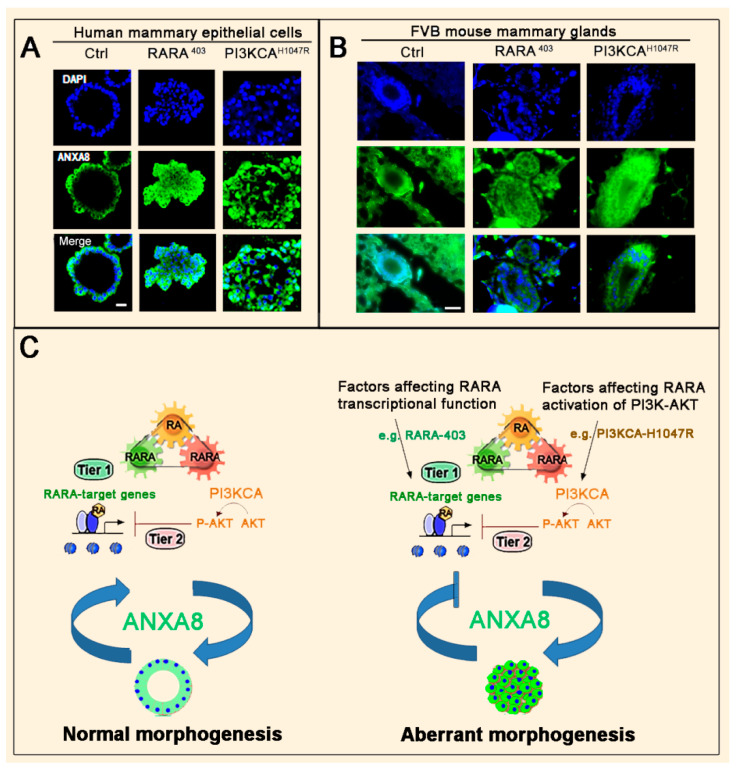
The RA-RARA-ANXA8 mechanism in normal and aberrant mammary morphogenesis. (A) Confocal microscopy images (scale bar: 10 µm) showing that normal human mammary epithelial (HME1) cells with normal RARA functions develop 3D acinar structures with a lumen lined by ANXA8-positive cells (left column). HME1 cells with RARA403 or PI3KCAH1047R mutations develop ANXA8-positive, morphologically aberrant 3D acinar structures (middle and right columns) [110]. (B) Microscopy images of the fourth mammary gland section of a 12-week-old FVB female mouse with wild type RARA and wild type PI3KCA showing a duct lined by ANXA8-positive cells (left column). In contrast, the fourth mammary gland of 12-week-old FVB female mice expressing either MMTV-RARA403 or MMTV-PI3KCAH1047R mutations showed ductal hyperplasia (DH) with ANXA8-positive cells in the luminal space (middle and right columns) (scale bar: 30 µm) (our unpublished images). (C) The interdependence of a functional RA-RARA mechanism and baseline ANXA8 expression generates normal morphogenesis (left scheme). In contrast, a defective RA-RARA mechanism upregulating endogenous ANXA8 generates aberrant morphogenesis (right scheme).
Figure 4
Figure 4
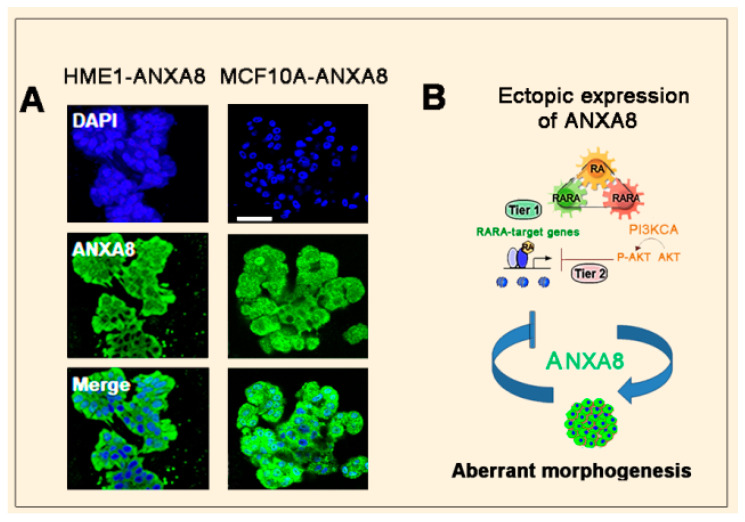
Ectopic ANXA8 generates aberrant mammary morphogenesis. (A) Confocal images of 3D morphologically aberrant structures generated by HME1 and MCF10A cells expressing stable ectopic ANXA8 (scale bar: 50 µm) (B) Scheme showing that ectopic ANXA8 is sufficient to induce aberrant morphogenesis.
Figure 5
Figure 5
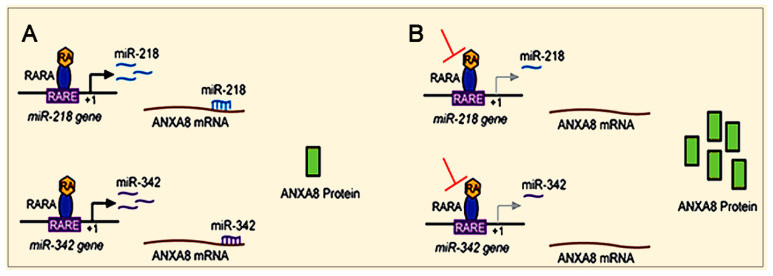
ANXA8 overexpression due to RA-RARA downregulation of ANXA8-regulatory miRNAs. (A) RA via RARA regulates ANXA8 regulatory miRNAs targeting the 3′untranslated region (3′UTR) of ANXA8 mRNA. (B) Factors inhibiting the RA-RARA regulation of ANXA8-regulatory miRNAs induce ANXA8 protein upregulation.
Figure 6
Figure 6
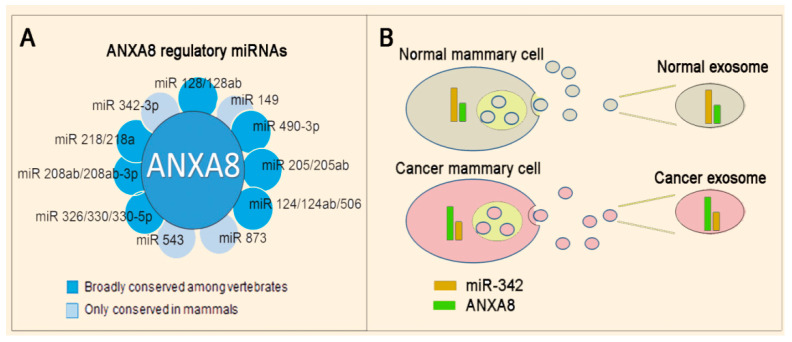
ANXA8-miRNA biomarkers. (A) Scheme showing a panel of eleven ANXA8 regulatory miRNAs detected by bioinformatics analysis [106]. (B) An inverse relationship of the ANXA8 protein and an ANXA8 regulatory miRNA (e.g., miR-342) in either normal or cancer mammary epithelial cells can also be detected in corresponding exosomes.

References

    1. Bushue N., Wan Y.J. Retinoid pathway and cancer therapeutics. Adv. Drug Deliv. Rev. 2010;62:1285–1298. doi: 10.1016/j.addr.2010.07.003. - DOI - PMC - PubMed
    1. Johnson E.J., Russell R.M. Beta-carotene. In: Coates P.M., Betz J.M., Blackman M.R., Cragg G.M., Levine M., Moss J., White J.D., editors. Encyclopedia of Dietary Supplements. 2nd ed. Informa Healthcare; London, UK: New York, NY, USA: 2010. pp. 115–120.
    1. Ross A., Vitamin A. Carotenoids. In: Shils M.S.M., Ross A., Caballero B., Cousins R., editors. Modern Nutrition in Health and Disease. 10th ed. Lippincott Williams & Wilkins; Baltimore, MD, USA: 2006. pp. 351–375.
    1. Ross C.A., Vitamin A. In: Encyclopedia of Dietary Supplements. 2nd ed. Coates P.M., Betz J.M., Blackman M.R., Cragg G.M., Levine M., Moss J., White J.D., editors. Informa Healthcare; London, UK: New York, NY, USA: 2010. pp. 778–791.
    1. Solomons N.W., Vitamin A. In: Present Knowledge in Nutrition. 9th ed. Bowman B., Russell R., editors. International Life Sciences Institute; Washington, DC, USA: 2006. pp. 157–183.

LinkOut - more resources