Review
. 2020 Aug 14;10(8):1419.
doi: 10.3390/ani10081419.

Metabolic Stress in the Transition Period of Dairy Cows: Focusing on the Prepartum Period

Affiliations
Review

Metabolic Stress in the Transition Period of Dairy Cows: Focusing on the Prepartum Period

Osvaldo Bogado Pascottini et al. Animals (Basel). .

Abstract

All modern, high-yielding dairy cows experience a certain degree of reduced insulin sensitivity, negative energy balance, and systemic inflammation during the transition period. Maladaptation to these changes may result in excessive fat mobilization, dysregulation of inflammation, immunosuppression, and, ultimately, metabolic or infectious disease in the postpartum period. Up to half of the clinical diseases in the lifespan of high-yielding dairy cows occur within 3 weeks of calving. Thus, the vast majority of prospective studies on transition dairy cows are focused on the postpartum period. However, predisposition to clinical disease and key (patho)physiological events such as a spontaneous reduction in feed intake, insulin resistance, fat mobilization, and systemic inflammation already occur in the prepartum period. This review focuses on metabolic, adaptive events occurring from drying off until calving in high-yielding cows and discusses determinants that may trigger (mal)adaptation to these events in the late prepartum period.

Keywords: dry period; energy balance; insulin resistance; metabolic status; systemic inflammation; transition disease.


Conflict of interest statement

The authors declare no conflict of interest. The funders had no role in the design of the study; in the collection, analyses, or interpretation of data; in the writing of the manuscript; or in the decision to publish the results.

Figures
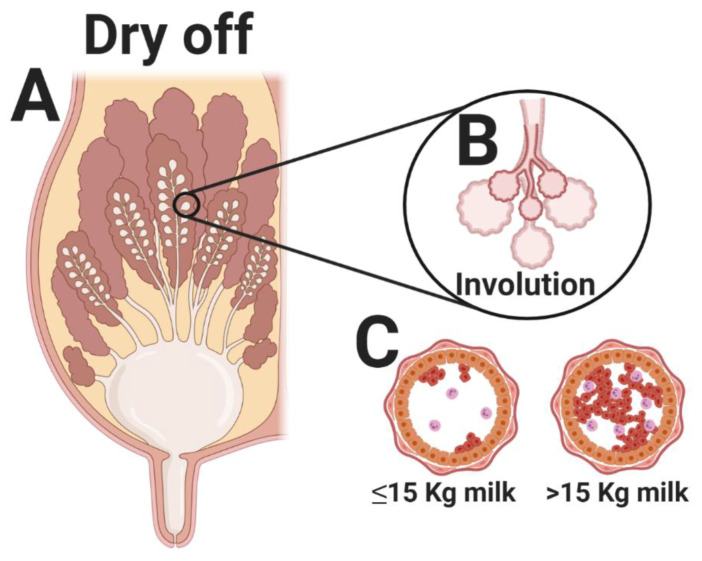
Figure 1
Figure 1
Schematic illustration of the local (and systemic) changes at the dry-off in dairy cows. (A) Milk cessation occurs abruptly 40 to 60 days before expected calving. (B) When milking is ceased abruptly, the cisternal ducts and alveoli of the udder become engorged, raising the intramammary pressure; these events induce the mammary gland involution process. (C) Mammary glands with lesser engorgement do exhibit an inflammatory response; however, the types and numbers of cells involved in the inflammatory response might be different when milk production at the dry-off is high. Mezzetti et al. [19] dichotomized the milk production at the dry-off as high (≥15 kg milk day) or low (<15 kg milk). Cows producing ≥15 kg of milk per day at the dry-off presented a greater inflammatory response than those producing <15 kg milk.
Figure 2
Figure 2
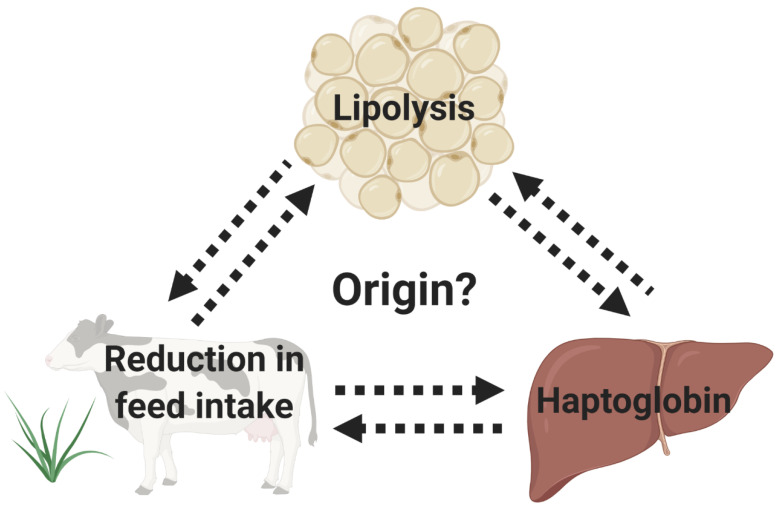
This schematic figure questions the origin of the systemic inflammation, lipolysis, and spontaneous reduction in feed intake in the prepartum period. It is largely discussed whether cows stop eating because they suffer from systemic inflammation or whether the reduction in the feed intake is responsible for the decreased energy balance and concomitant systemic inflammation in the prepartum period.
Figure 3
Figure 3
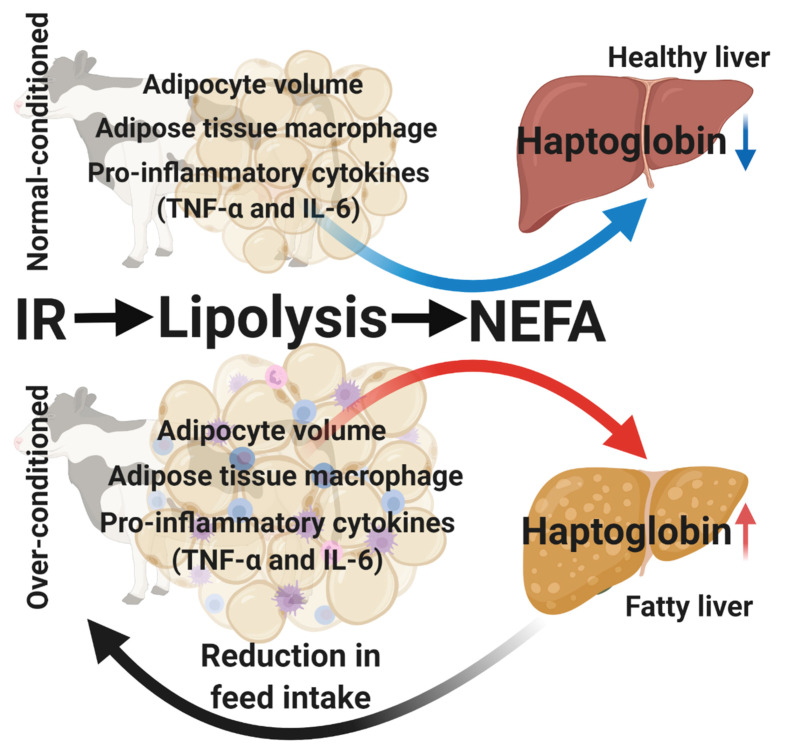
Schematic illustration of the potential origin of the spontaneous reduction in feed intake in the prepartum period in dairy cows. Based on the studies from our research group [68,69,70,71,72,73], it was demonstrated that over-conditioned cows before calving have a greater adipocyte volume, greater numbers of infiltrated macrophages, and upregulation of the tumor necrosis factor (TNF)-α and interleukin (IL)-6 genes in comparison to normal-conditioned cows. Moreover, it was also demonstrated that the insulin resistance (IR), basal lipolysis, and non-esterified fatty acid (NEFA) concentrations were greater in over- than in normal-conditioned cows. This was often associated with higher lipid accumulation in the livers of over-conditioned cows, with upregulation of the haptoglobin gene. Although we did not measure the feed intake of these cows, we hypothesize that over-conditioning cows is associated with the spontaneous reduction in feed intake in the prepartum period, triggered by their “fat cow syndrome’ in the 1 to 2 weeks before calving.

References

    1. Grummer R.R. Impact of changes in organic nutrient metabolism on feeding the transition dairy cow. J. Anim. Sci. 1995;3:2820–2833. doi: 10.2527/1995.7392820x. - DOI - PubMed
    1. Drackley J.K. Biology of dairy cows during the transition period: The final frontier. J. Dairy Sci. 1999;82:2259–2273. doi: 10.3168/jds.S0022-0302(99)75474-3. - DOI - PubMed
    1. Pascottini O.B., Probo M., LeBlanc S.J., Opsomer G., Hostens M. Assessment of associations between transition diseases and reproductive performance of dairy cows using survival analysis and decision tree algorithms. Prev. Vet. Med. 2020;176:104908. doi: 10.1016/j.prevetmed.2020.104908. - DOI - PubMed
    1. Pascottini O.B., Carvalho M.R., Van Schyndel S.J., Ticiani E., Spricigo J.W., Mamedova L.K., Ribeiro E.S., LeBlanc S.J. Feed restriction to induce and meloxicam to mitigate potential systemic inflammation in dairy cows before calving. J. Dairy Sci. 2019;102:9285–9297. doi: 10.3168/jds.2019-16558. - DOI - PubMed
    1. LeBlanc S. Monitoring metabolic health of dairy cattle in the transition period. J. Reprod. Dev. 2010;56:29–35. doi: 10.1262/jrd.1056S29. - DOI - PubMed