


Genome-Wide SNP Analysis Reveals the Population Structure and the Conservation Status of 23 Italian Chicken Breeds
- PMID: 32824706
- PMCID: PMC7460279
- DOI: 10.3390/ani10081441
Genome-Wide SNP Analysis Reveals the Population Structure and the Conservation Status of 23 Italian Chicken Breeds
Abstract
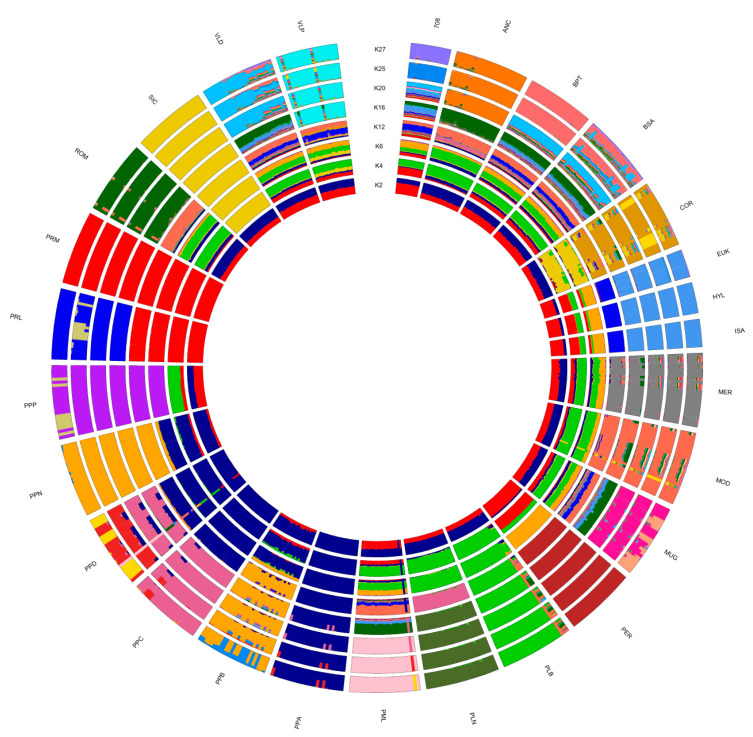
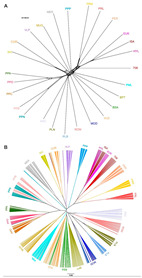
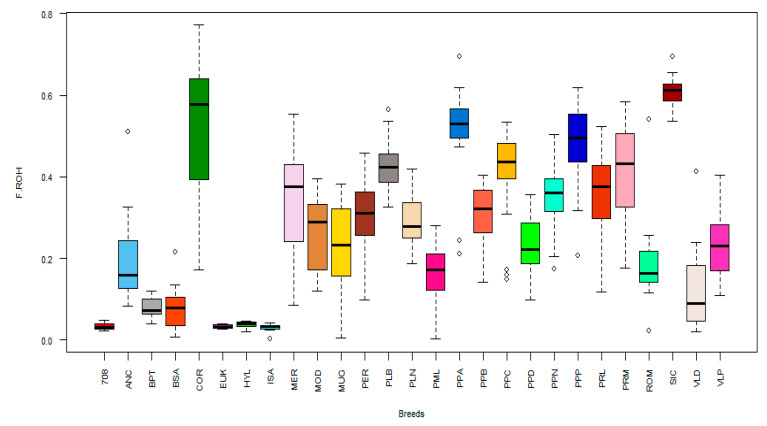
The genomic variability of local Italian chicken breeds, which were monitored under a conservation plan, was studied using single nucleotide polymorphisms (SNPs) to understand their genetic diversity and population structure. A total of 582 samples from 23 local breeds and four commercial stocks were genotyped using the Affymetrix 600 K Chicken SNP Array. In general, the levels of genetic diversity, investigated through different approaches, were lowest in the local chicken breeds compared to those in the commercial stocks. The level of genomic inbreeding, based on runs of homozygosity (FROH), was markedly different among the breeds and ranged from 0.121 (Valdarnese) to 0.607 (Siciliana). In all breeds, short runs of homozygosity (ROH) (<4 Mb in length) were more frequent than long segments. The patterns of genetic differentiation, model-based clustering, and neighbor networks showed that most breeds formed non-overlapping clusters and were clearly separate populations, which indicated the presence of gene flow, especially among breeds that originated from the same geographical area. Four genomic regions were identified as hotspots of autozygosity (islands) among the breeds, where the candidate genes are involved in morphological traits, such as body weight and feed conversion ratio. We conclude that the investigated breeds have conserved authentic genetic patterns, and these results can improve conservation strategies; moreover, the conservation of local breeds may play an important role in the local economy as a source of high-quality products for consumers.
Keywords: biodiversity; genetic diversity; local breeds; poultry; safeguard.
Conflict of interest statement
The authors declare no conflict of interest.
Figures


References
-
- Rischkowsky B., Pilling D. Food & Agriculture Org. FAO Document; Rome, Italy: 2007. The State of the World’s Animal Genetic Resources for Food and Agriculture.
-
- Hoffmann I. The global plan of action for animal genetic resources and the conservation of poultry genetic resources. Worlds. Poult. Sci. J. 2009;65:286–297. doi: 10.1017/S0043933909000245. - DOI
-
- Strillacci M.G., Marelli S.P., Cozzi M.C., Colombo E., Polli M., Gualtieri M., Cristalli A., Pignattelli P., Longeri M., Cavalchini L.G. Italian autochthonous chicken breeds conservation: Evaluation of biodiversity in Valdarnese Bianca breed (Gallus gallus domesticus) Avian Biol. Res. 2009;2:229–233. doi: 10.3184/175815509X12574095832760. - DOI
Grants and funding
LinkOut - more resources
Full Text Sources
Miscellaneous
