Resolving the Connectome, Spectrally-Specific Functional Connectivity Networks and Their Distinct Contributions to Behavior
- PMID: 32826259
- PMCID: PMC7484267
- DOI: 10.1523/ENEURO.0101-20.2020
Resolving the Connectome, Spectrally-Specific Functional Connectivity Networks and Their Distinct Contributions to Behavior
Abstract
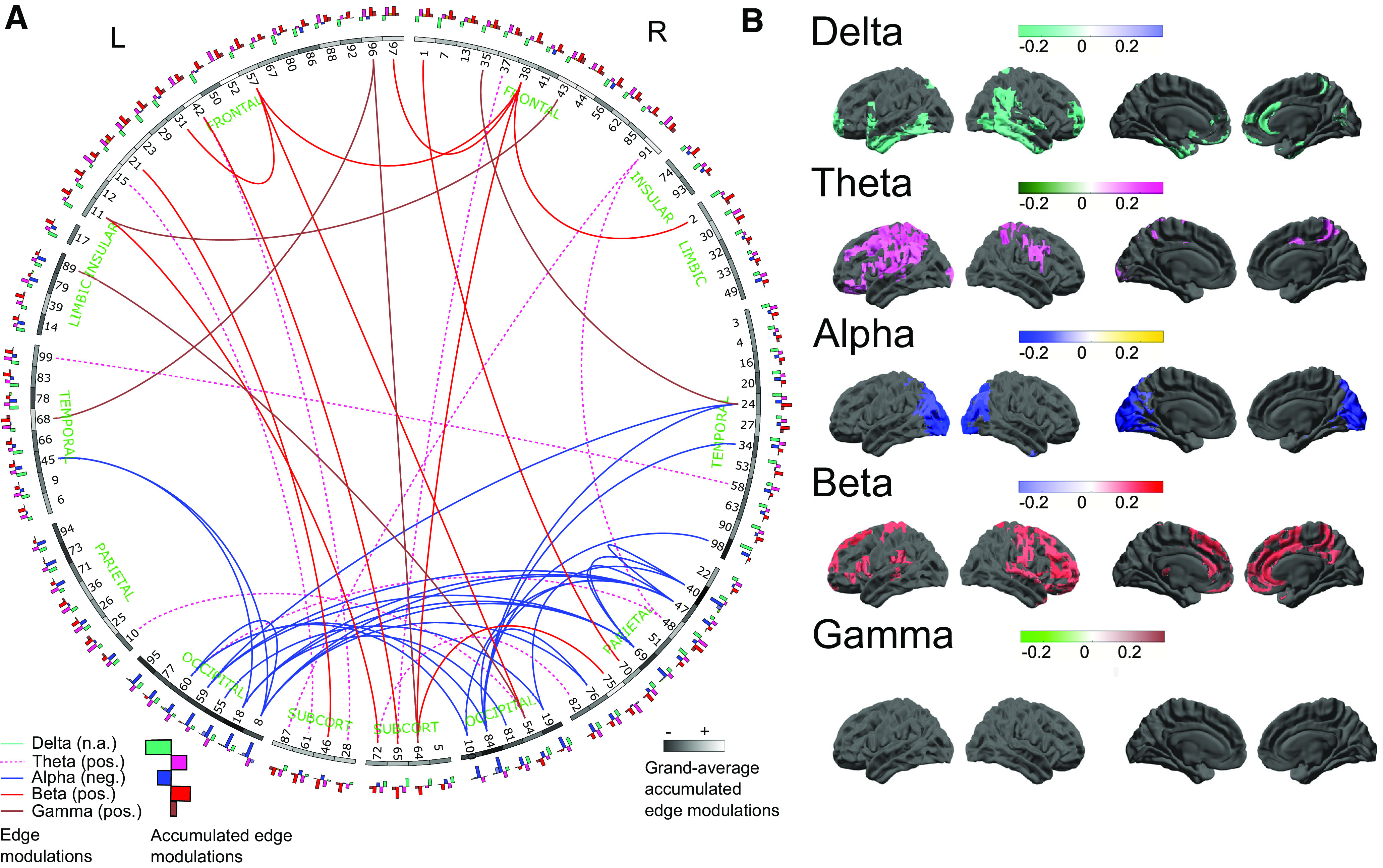
The resting human brain exhibits spontaneous patterns of activity that reflect features of the underlying neural substrate. Examination of interareal coupling of resting-state oscillatory activity has revealed that the brain's resting activity is composed of functional networks, whose topographies differ depending on oscillatory frequency, suggesting a role for carrier frequency as a means of creating multiplexed, or functionally segregated, communication channels between brain areas. Using canonical correlation analysis (CCA), we examined spectrally resolved resting-state connectivity patterns derived from magnetoencephalography (MEG) recordings to determine the relationship between connectivity intrinsic to different frequency channels and a battery of over a hundred behavioral and demographic indicators, in a group of 89 young healthy participants. We demonstrate that each of the classical frequency bands in the range 1-40 Hz (δ, θ, α, β, and γ) delineates a subnetwork that is behaviorally relevant, spatially distinct, and whose expression is either negatively or positively predictive of individual traits, with the strongest link in the α-band being negative and networks oscillating at different frequencies, such as θ, β, and γ carrying positive function.
Keywords: canonical correlation analysis; connectome; networks; oscillations; resting state; variability.
Copyright © 2020 Becker and Hervais-Adelman.
Figures


References
-
- Altenmueller EO, Muente TF, Gerloff C (2005) Neurocognitive functions and the EEG In: Electroencephalography: basic principles, clinical applications, and related fields (Niedermeyer E, Lopes da Silva FH, eds). Philadelphia: Lippincott Williams & Wilkins Company.
MeSH terms
LinkOut - more resources
Full Text Sources