. 2020 Aug 21;11(1):4185.
doi: 10.1038/s41467-020-18038-y.

Ecological uncertainty favours the diversification of host use in avian brood parasites

Affiliations

Ecological uncertainty favours the diversification of host use in avian brood parasites

Nicholas D Antonson et al. Nat Commun. .

Abstract

Adaptive responses to ecological uncertainty may affect the dynamics of interspecific interactions and shape the course of evolution within symbioses. Obligate avian brood parasites provide a particularly tractable system for understanding how uncertainty, driven by environmental variability and symbiont phenology, influences the evolution of species interactions. Here, we use phylogenetically-informed analyses and a comprehensive dataset on the behaviour and geographic distribution of obligate avian brood parasites and their hosts to demonstrate that increasing uncertainty in thermoregulation and parental investment of parasitic young are positively associated with host richness and diversity. Our findings are consistent with the theoretical expectation that ecological risks and environmental unpredictability should favour the evolution of bet-hedging. Additionally, these highly consistent patterns highlight the important role that ecological uncertainty is likely to play in shaping the evolution of specialisation and generalism in complex interspecific relationships.


Conflict of interest statement

The authors declare no competing interests.

Figures

Fig. 1
Fig. 1. Stochastic character mapping of obligate brood parasitism (red lineages) in birds.
Representative clades for each of the six known altricial and one precocial independent evolutionary origins of obligate brood parasitism in birds include a Indicatoridae, b Anatidae (arrow to character mapping), c Cuculinae, d Neomorphinae, and e Phaenicophaeinae, all within Cuculidae, f Viduidae, and g Icteridae. Silhouettes from N.D. Antonson (a, d) and phylopic.org with credit to Sharon Wegner-Larsen (b), Ferran Sayol (c), Lip Kee Yap (e), Maija Karala (f), and Matt Wilkins (g). The CC BY-SA 3.0 license can be found at https://creativecommons.org/licenses/by-sa/3.0/ and the CC BY 3.0 license at https://creativecommons.org/licenses/by/3.0/. Information on CC0 1.0 (no copyright) can be found at https://creativecommons.org/publicdomain/zero/1.0/.
Fig. 2
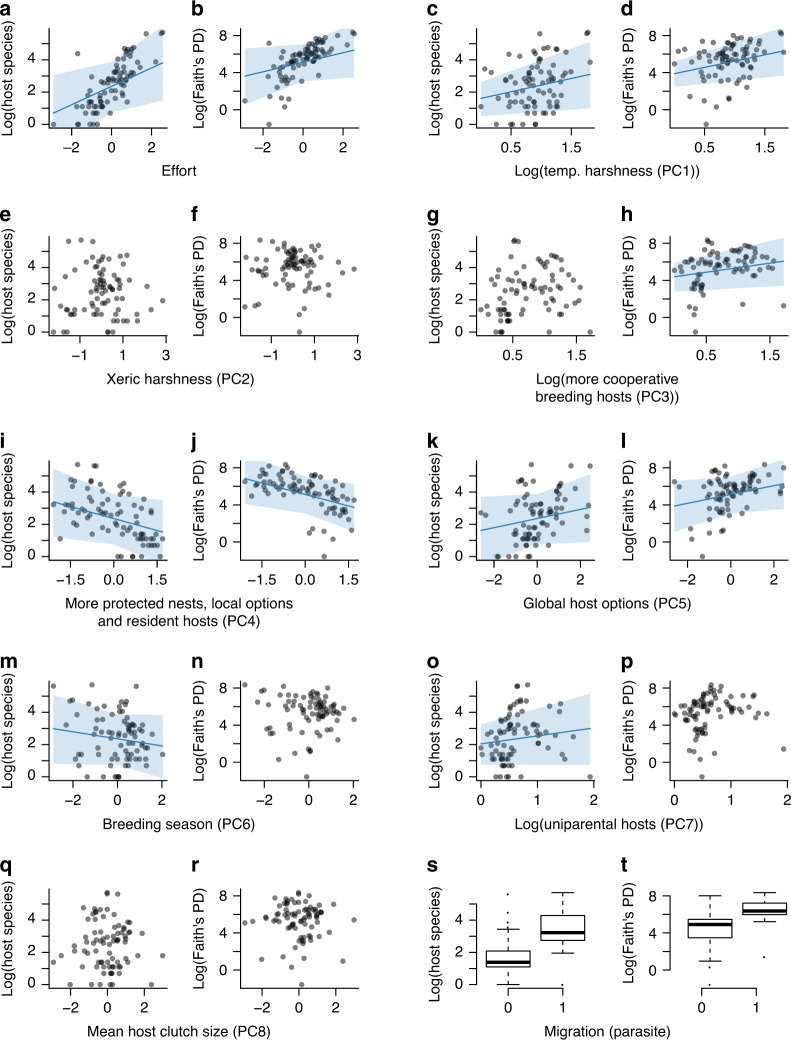
Fig. 2. Graphical summary of the effects of ecological and climatic risk factors on avian brood parasitic host choices.
Effects of research effort (a, b), temperature harshness (c, d), xeric harshness (e, f), increased reliance on cooperative breeding hosts (g, h), more protected (enclosed) nests, number of local host options, and year-round resident hosts (i, j), global number of host options (k, l), breeding season duration (m, n), increased reliance on uniparental hosts (o, p), mean host clutch size (q, r), and migratory status of the parasitic species (s, t) on the number and phylogenetic diversity of hosts of obligate avian brood parasites (N = 81 parasitic species). Quantitative descriptions for these correlates are presented in Table 1. Each data point represents one brood parasitic species. In the subplots of all continuous predictors for which credible intervals did not overlap zero (ad, hm, o), blue lines depict the values fitted by our Bayesian models and shaded areas depict corresponding 95% credible intervals of these relationships. In the parasite migration subplots (st), boxes represent the first and third quartiles, horizontal lines depict the medians, lower and upper whiskers represent 1.5 * the interquartile ranges, and dots depict outliers (differences between migration categories were not significant either for host numbers or Faith’s PD). Source data are provided as a Source Data file.

References

    1. Levins, R. Evolution in Changing Environments: Some Theoretical Explorations. (Princeton University Press, 1968).
    1. Clavel J, Julliard R, Devictor V. Worldwide decline of specialist species: toward a global functional homogenization? Front. Ecol. Environ. 2011;9:222–228.
    1. Ducatez S. Brood parasitism: a good strategy in our changing world? Proc. R. Soc. B: Biol. Sci. 2014;281:20132404. - PMC - PubMed
    1. Kawecki TJ, Ebert D. Conceptual issues in local adaptation. Ecol. Lett. 2004;7:1225–1241.
    1. Futuyma DJ, Moreno G. The evolution of ecological specialisation. Annu. Rev. Ecol. Syst. 1988;19:207–233.

Publication types