


Revisiting the Spectrum of Bladder Health: Relationships Between Lower Urinary Tract Symptoms and Multiple Measures of Well-Being
- PMID: 32831001
- PMCID: PMC7462007
- DOI: 10.1089/jwh.2019.8167
Revisiting the Spectrum of Bladder Health: Relationships Between Lower Urinary Tract Symptoms and Multiple Measures of Well-Being
Abstract
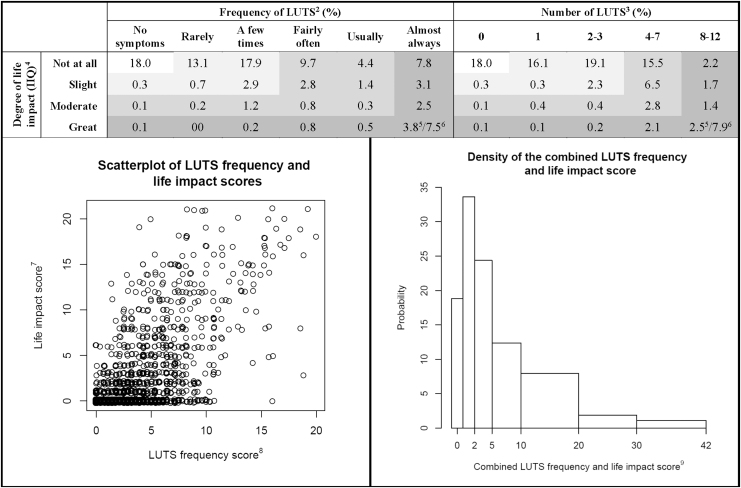
Background: Little research to date has investigated the spectrum of bladder health in women, including both bladder function and well-being. Therefore, we expanded our previous baseline analysis of bladder health in the Boston Area Community Health (BACH) Survey to incorporate several additional measures of bladder-related well-being collected at the 5-year follow-up interview, including one developed specifically for women. Methods: At follow-up, participants reported their frequency of 15 lower urinary tract symptoms (LUTS), degree of life impact from and thought related to urinary symptoms or pelvic/bladder pain/discomfort, and perception of their bladder condition. Prevalence ratios were calculated by generalized linear models with robust variance estimation, adjusting for LUTS risk factors and individual LUTS. The BACH Survey was approved by the New England Research Institutes Institutional Review Board and all participants provided written informed consent. Results: Generally similar findings were observed in the 5-year cross-sectional analysis as at baseline, irrespective of how we categorized LUTS or measured bladder-related well-being. Approximately one in five women (16.2%-18.0% of 2527 eligible women) reported no LUTS and no diminished bladder-related well-being, the majority (55.8%-65.7%) reported some LUTS and/or diminished well-being, and a further one in five (16.9%-26.6%) reported the maximum frequency, number, or degree of LUTS and/or diminished well-being. Measures of storage function (urinating again after <2 hours, perceived frequency, nocturia, incontinence, and urgency) and pain were independently associated with bladder-related well-being. Conclusions: Our similar distribution of bladder health and consistent associations between LUTS and bladder-related well-being across multiple measures of well-being, including a female-specific measure, lend confidence to the concept of a bladder health spectrum and reinforce the bothersome nature of storage dysfunction and pain.
Keywords: bladder; health; women.
Conflict of interest statement
No competing financial interests exist.
Figures
References
-
- World Health Organization. Constitution of the World Health Organization. Basic Doc, 45th ed., Geneva: WHO, 2006
-
- Lloyd-Jones DM, Hong Y, Labarthe D, et al. . Defining and setting national goals for cardiovascular health promotion and disease reduction: The American Heart Association's strategic Impact Goal through 2020 and beyond. Circulation 2010;121:586–613 - PubMed
Publication types
MeSH terms
Grants and funding
LinkOut - more resources
Full Text Sources
Medical
Miscellaneous
