Review
. 2020 Jul 31:2020:9524635.
doi: 10.1155/2020/9524635. eCollection 2020.

Understanding Diabetic Neuropathy: Focus on Oxidative Stress

Affiliations
Review

Understanding Diabetic Neuropathy: Focus on Oxidative Stress

Lei Pang et al. Oxid Med Cell Longev. .

Abstract

Diabetic neuropathy is one of the clinical syndromes characterized by pain and substantial morbidity primarily due to a lesion of the somatosensory nervous system. The burden of diabetic neuropathy is related not only to the complexity of diabetes but also to the poor outcomes and difficult treatment options. There is no specific treatment for diabetic neuropathy other than glycemic control and diligent foot care. Although various metabolic pathways are impaired in diabetic neuropathy, enhanced cellular oxidative stress is proposed as a common initiator. A mechanism-based treatment of diabetic neuropathy is challenging; a better understanding of the pathophysiology of diabetic neuropathy will help to develop strategies for the new and correct diagnostic procedures and personalized interventions. Thus, we review the current knowledge of the pathophysiology in diabetic neuropathy. We focus on discussing how the defects in metabolic and vascular pathways converge to enhance oxidative stress and how they produce the onset and progression of nerve injury present in diabetic neuropathy. We discuss if the mechanisms underlying neuropathy are similarly operated in type I and type II diabetes and the progression of antioxidants in treating diabetic neuropathy.


Conflict of interest statement

The authors declare that they have no conflicts of interest.

Figures
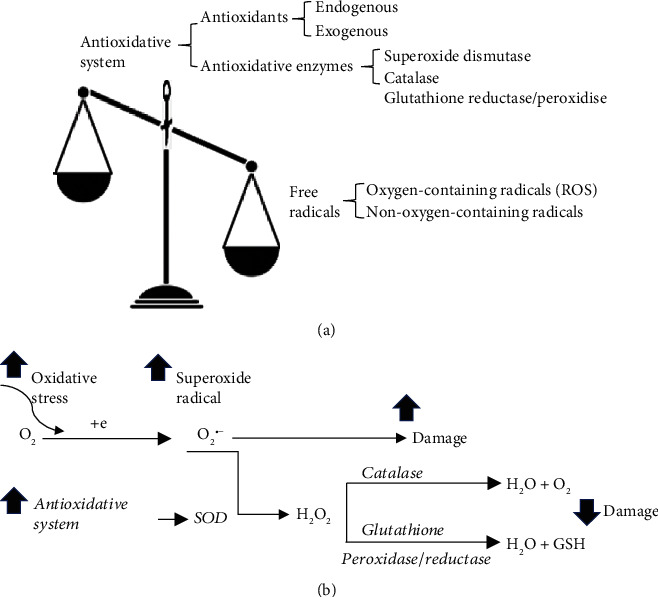
Figure 1
Figure 1
Components of oxidative stress and working mechanism of antioxidative system. (a) Oxidative stress consists of two components as the free radicals and the antioxidative system. The term of oxidative stress describes a condition when the generation of free radicals and the antioxidative system is imbalanced. Free radicals can be the radicals with or without reactivity of oxygen. Antioxidative system consist of antioxidants, that are derived either endogenous or exogenous, and antioxidative enzymes, such as superoxide dismutase, glutathione reductase/peroxidise, and catalase. (b) Antioxidative system works through mechanisms suppressing and scavenging not only free radicals but also de novo antioxidant. Superoxide (O2•−) is the major ROS produced in the mitochondria with increased oxidative stress. However, conversion of O2•− to H2O by coupled reactions of superoxide dismutase (SOD), catalase, and glutathione reductase/peroxidise is accompanied by the formation of GSH and elimination of the detrimental effect of O2•− on damage the cells.
Figure 2
Figure 2
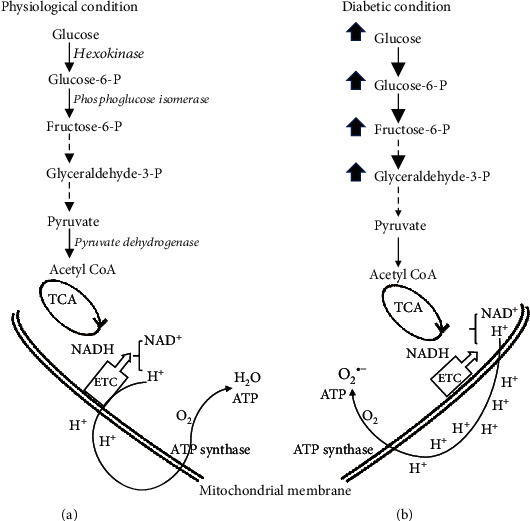
Major glucose metabolism pathway under physiological condition and diabetic condition. (a) Under a physiological condition, intracellular glucose is converted to glucose-6-phosphate, via hexokinase, then following isomerization to fructose-6-phosphate. Along glycolysis pathway, glyceraldehyde-3-phosphate travels down to pyruvate and acetyl CoA via pyruvate dehydrogenase, which then enters tricarboxylic acid (TCA) cycle. NADH, as electron carrier and generated during the process of glycolysis and glucose oxidation, can donate reducing equivalents to the mitochondrial electron transport chain (ETC), thereby creating a proton gradient that is used by ATP synthase to produce ATP and converting O2 to H2O. (b) Under diabetic condition, glucose metabolism is impaired, causing accumulation of glucose and the glycolytic intermediates, resulting mitochondrial injury, thereby converting O2 to superoxide radical (O2•−) instead of H2O. As a result, ATP production is reduced.
Figure 3
Figure 3
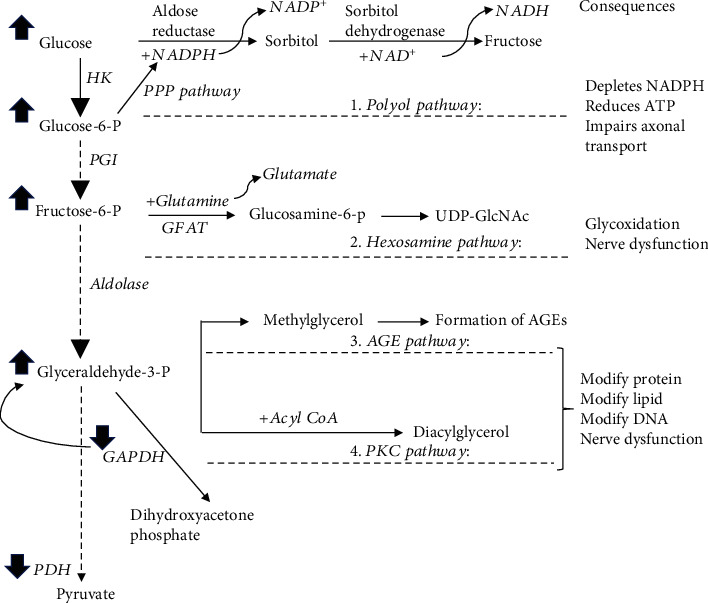
Four damaging pathways that can explain the detrimental effects of ROS in hyperglycaemia-induced diabetic neuropathy. The impaired glucose metabolism in diabetic condition causes an accumulation of glucose and glycolytic intermediates, which, instead of travel along glycolysis pathway, shunts to other metabolic or nonmetabolic pathways, resulting activation of the polyol pathway, hexosamine pathway, and AGE and PKC pathway. Superoxide inhibits glyceraldehyde-3-phosphate dehydrogenase (GAPDH) activity, which is proposed to be a reason causing accumulation of all the glycolytic intermediates. Pentose phosphate pathway (PPP pathway) is to generate NADPH, which is used in polyol pathway. GFAT: glutamine-fructose-6-phosphate aminotransferase; GAPDH: glyceraldehyde-3 phosphate dehydrogenase; PDH: pyruvate dehydrogenase.
Figure 4
Figure 4
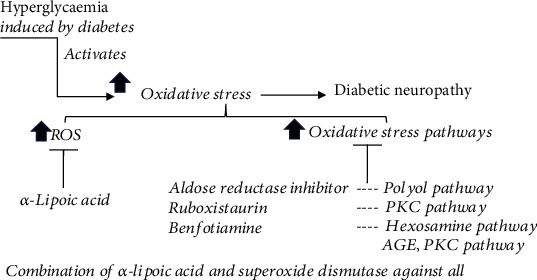
Strategies of antioxidative drugs in treating diabetic neuropathy include directly against ROS and against individual oxidative stress pathways. The listed drugs showed effect on improving symptoms of diabetic neuropathy. However, none of them have been FDA-approved due to the lack of clinical significance.
Figure 5
Figure 5
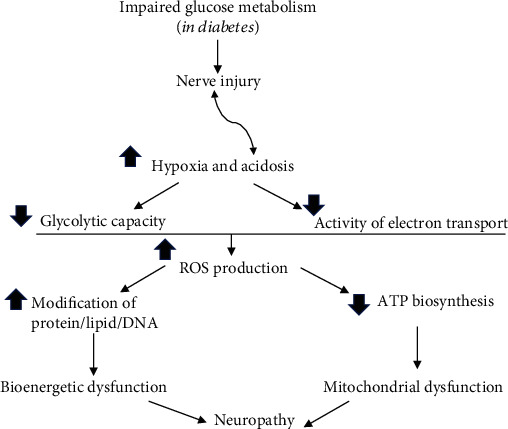
Summary of the major contributors to diabetic neuropathy. Diabetes-induced impairment of glucose metabolism causes hypoxia and acidosis, which contributes to and exacerbates the nerve injury. As a result, both glycolytic capacity and activity of electron transport chain are reduced, leading to overproduction of ROS, which, not only reducing ATP production but also initiating various modifications on protein/lipid and DNA. Thus, mitochondrial and bioenergetic dysfunction leads to neuropathy.

References

    1. Callaghan B. C., Cheng H. T., Stables C. L., Smith A. L., Feldman E. L. Diabetic neuropathy: clinical manifestations and current treatments. Lancet Neurology. 2012;11(6):521–534. doi: 10.1016/S1474-4422(12)70065-0. - DOI - PMC - PubMed
    1. Boulton A. J., Vinik A. I., Arezzo J. C., et al. Diabetic neuropathies: a statement by the American Diabetes Association. Diabetes Care. 2005;28(4):956–962. doi: 10.2337/diacare.28.4.956. - DOI - PubMed
    1. Little A. A., Edwards J. L., Feldman E. L. Diabetic neuropathies. Practical Neurology. 2007;7(2):82–92. - PubMed
    1. Vinik A. I., Maser R. E., Mitchell B. D., Freeman R. Diabetic autonomic neuropathy. Diabetes Care. 2003;26(5):1553–1579. doi: 10.2337/diacare.26.5.1553. - DOI - PubMed
    1. Vinik A. I., Mehrabyan A. Diabetic neuropathies. The Medical Clinics of North America. 2004;88(4):947–999. doi: 10.1016/j.mcna.2004.04.009. xi. - DOI - PubMed

MeSH terms

Substances