


Climate change mitigation as a co-benefit of regenerative ranching: insights from Australia and the United States
- PMID: 32832070
- PMCID: PMC7435039
- DOI: 10.1098/rsfs.2020.0027
Climate change mitigation as a co-benefit of regenerative ranching: insights from Australia and the United States
Abstract
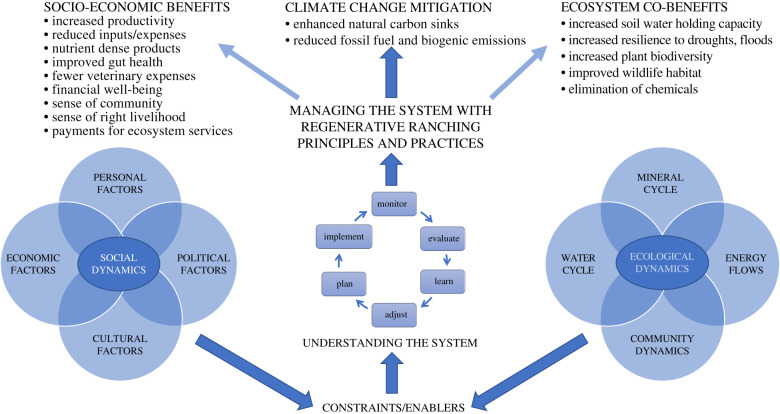
'Managed grazing' is gaining attention for its potential to contribute to climate change mitigation by reducing bare ground and promoting perennialization, thereby enhancing soil carbon sequestration (SCS). Understanding why ranchers adopt managed grazing is key to developing the right incentives. In this paper, we explore principles and practices associated with the larger enterprise of 'regenerative ranching' (RR), which includes managed grazing but infuses the practice with holistic decision-making. We argue that this broader approach is appealing due to a suite of ecological, economic and social benefits, making climate change mitigation an afterthought, or 'co-benefit'. RR is challenging, however, because it requires a deep understanding of ecological processes along with a set of skills related to monitoring and moving livestock and feeding the soil microbiome. We review the literature regarding links between RR and SCS, then present results of qualitative research focused on motivators, enablers and constraints associated with RR, drawing on interviews with 52 practitioners in New South Wales, Australia and the western United States. Our analysis is guided by a conceptual model of the social-ecological system associated with RR that identifies determinants of regenerative potential. We discuss implications for rancher engagement and conclude with a consideration of leverage points for global scalability.
Keywords: holistic planned grazing; natural climate solutions; regenerative agriculture; resilience; social–ecological systems; soil carbon sequestration.
© 2020 The Authors.
Conflict of interest statement
We declare we have no competing interests.
Figures
References
-
- FAO. 2012. Livestock and landscapes. Sustainability pathways. Rome, Italy: FAO. See http://www.fao.org/3/ar591e/ar591e.pdf.
-
- Booker K, Huntsinger L, Bartolome JW, Sayre NF, Stewart W. 2013. What can ecological science tell us about opportunities for carbon sequestration on arid rangelands in the United States? Glob. Environ. Change 23, 240–251. ( 10.1016/j.gloenvcha.2012.10.001) - DOI
-
- Asner GP, Elmore AJ, Olander LP, Martin RE, Harris AT. 2004. Grazing systems, ecosystem responses, and global change. Annu. Rev. Environ. Resour. 29, 261–299. ( 10.1146/annurev.energy.29.062403.102142) - DOI
-
- Desjardins R, Worth D, Vergé X, Maxime D, Dyer J, Cerkowniak D. 2012. Carbon footprint of beef cattle. Sustainability 4, 3279–3301. ( 10.3390/su4123279) - DOI
LinkOut - more resources
Full Text Sources