


Intrauterine growth restriction alters growth performance, plasma hormones, and small intestinal microbial communities in growing-finishing pigs
- PMID: 32832077
- PMCID: PMC7437023
- DOI: 10.1186/s40104-020-00490-x
Intrauterine growth restriction alters growth performance, plasma hormones, and small intestinal microbial communities in growing-finishing pigs
Abstract
Background: The interaction of the gut microbiota with key metabolic and physiological processes may be associated with poor growth outcomes in animals born with intrauterine growth restriction (IUGR).
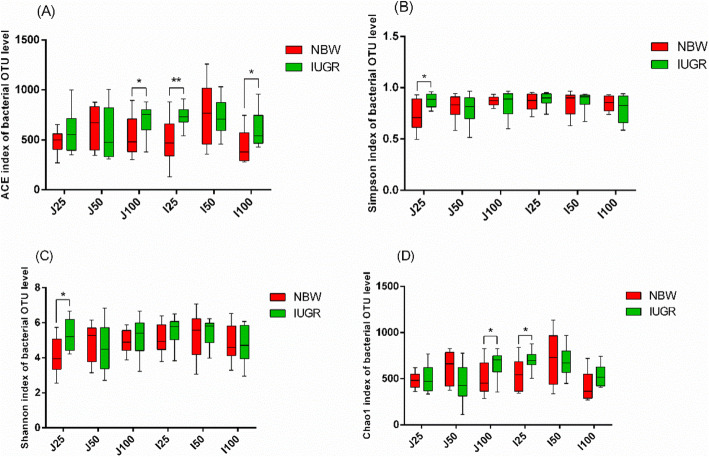
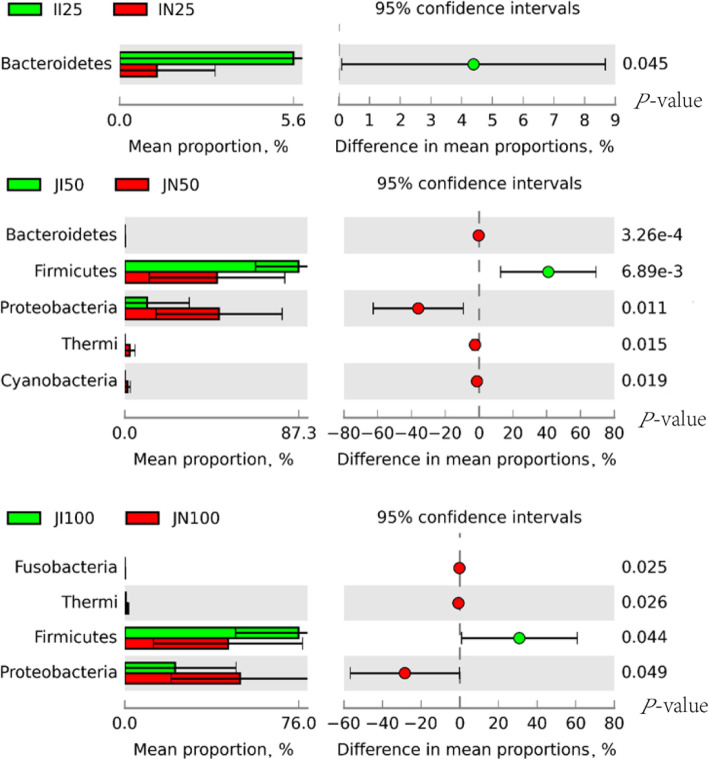
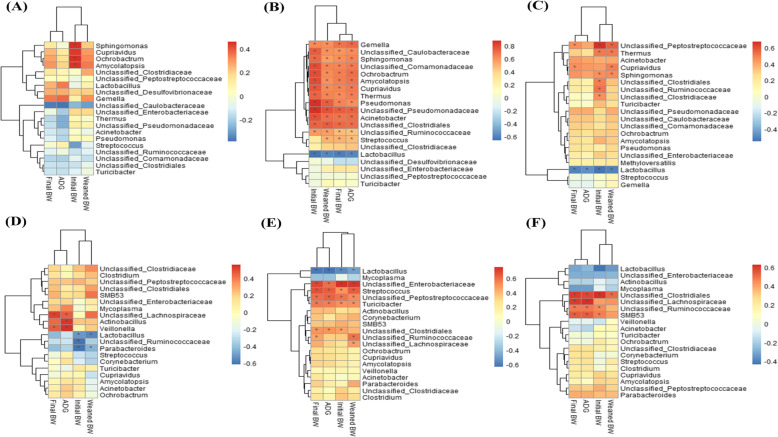
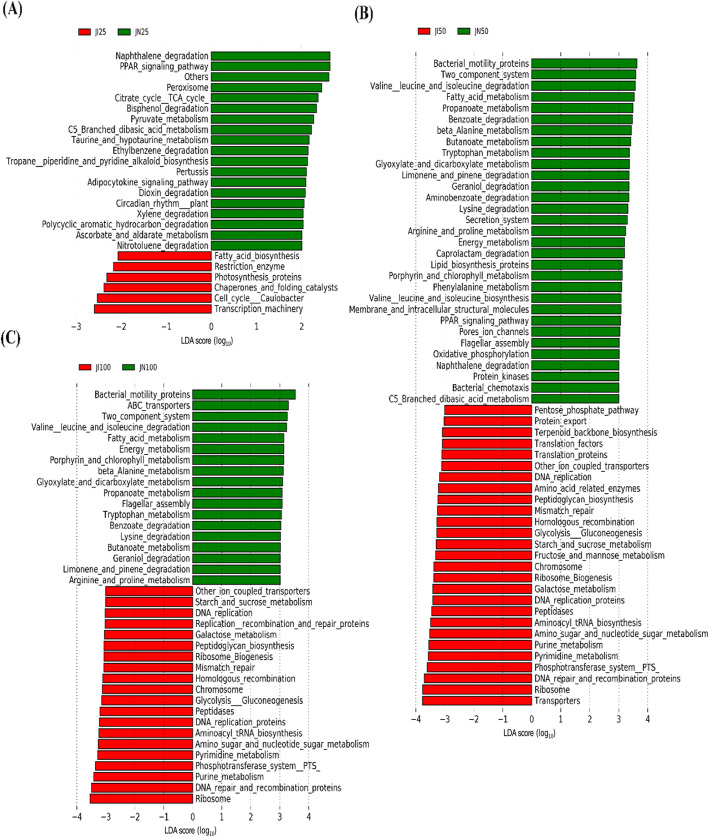
Results: Growth performance, plasma hormone concentrations, and intestinal microbiota composition were analyzed in IUGR pigs and in normal birth weight (NBW) pigs when the NBW pigs reached 25, 50, and 100 kg of body weight (BW). Compared to NBW pigs, IUGR pigs had lower initial, weaned, and final BW, and lower average daily gain and average daily feed intake in all the considered time points. In the 25 kg BW group, IUGR pigs had higher concentrations of plasma ghrelin and pancreatic polypeptide (PP), but lower insulin concentration than NBW pigs, while the situation was reversed in the 50 kg BW group. As compared to NBW pigs, IUGR pigs had higher microbial alpha diversity in the jejunum and ileum; in the 50 and 100 kg BW groups, IUGR pigs had higher Firmicutes abundance but lower Proteobacteria abundance in the jejunum, and lower Lactobacillus abundance in the jejunum and ileum; in the 25 kg BW group, IUGR pigs showed higher unclassified Ruminococcaceae abundance in the ileum; and in 25 and 50 kg BW groups, IUGR pigs showed lower Ochrobactrum abundance in the jejunum. Spearman's correlation revealed that Lactobacillus was negatively correlated with growth performance, while unclassified Ruminococcaceae was positively correlated. Predictive metagenomic analysis detected significantly different expression of genes in the intestinal microbiota between IUGR and NBW pigs, suggesting different metabolic capabilities between the two groups.
Conclusions: Growing-finishing IUGR pigs showed lower growth performance, higher microbial alpha diversity, and differences in plasma hormone concentrations compared to NBW pigs. Alterations in the abundance of Firmicutes, Proteobacteria, Ruminococcaceae, Lactobacillus, and Ochrobactrum in the small intestine may be associated with IUGR, and may therefore serve as a future target for gut microbiota intervention in growing-finishing IUGR pigs.
Keywords: Growing-finishing pigs; Growth performance; Intrauterine growth restriction; Microbial community; Small intestine.
© The Author(s) 2020.
Conflict of interest statement
Competing interestsThe authors declare that no competing interests exist. The manuscript has not been published previously.
Figures
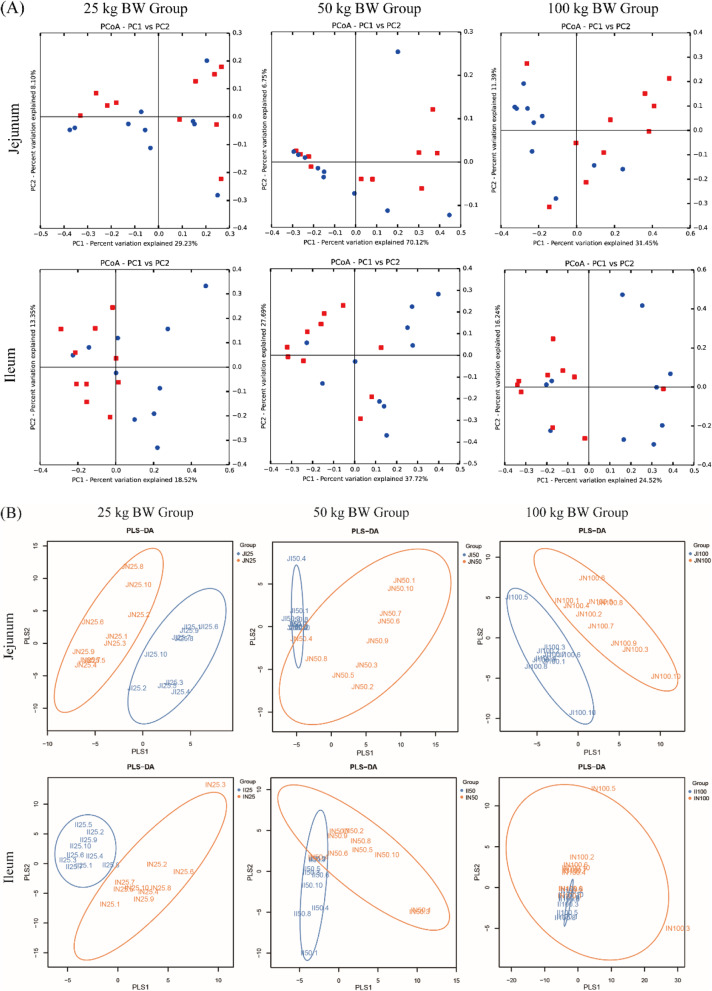
 IUGR) pigs and normal birth weight (
  NBW) pigs in the 25, 50, and 100 kg BW groups, and each symbol represents the intestinal microbiota of one pig. The data presented are obtained from 10 animals in each group (n = 10). a Principal coordinate analysis (PCoA) along the axes IUGR and NBW. b Partial least square discriminant analysis (PLS-DA) based on an unweighted UniFrac distances score plot of jejunum and ileum microbiota. Each point represents the microbial community of one pig



References
-
- Wu G, Bazer FW, Cudd TA, Meininger CJ, Spencer TE. Maternal nutrition and fetal development. J Nutr. 2004;134:2169–2172. - PubMed
-
- Pallotto EK, Kilbride HW. Perinatal outcome and later implications of intrauterine growth restriction. Clin Obstet Gynecol. 2006;49:257–269. - PubMed
-
- Wu G, Bazer FW, Wallace JM, Spencer TE. Board-invited review: intrauterine growth retardation: implications for the animal sciences. J Anim Sci. 2006;84:2316–2337. - PubMed
-
- Aw TY. Intestinal glutathione: determinant of mucosal peroxide transport, metabolism, and oxidative susceptibility. Toxicol Appl Pharmacol. 2005;204:320–328. - PubMed
-
- Xu RJ, Mellor DJ, Birtles MJ, Reynolds GW, Simpson HV. Impact of intrauterine growth retardation on the gastrointestinal tract and the pancreas in newborn pigs. J Pediatr Gastroenterol Nutr. 1994;18:231–240. - PubMed
LinkOut - more resources
Full Text Sources
Research Materials
Miscellaneous
