Effect of Exercise on NAFLD and Its Risk Factors: Comparison of Moderate versus Low Intensity Exercise
- PMID: 32832391
- PMCID: PMC7438352
- DOI: 10.14218/JCTH.2019.00012
Effect of Exercise on NAFLD and Its Risk Factors: Comparison of Moderate versus Low Intensity Exercise
Abstract
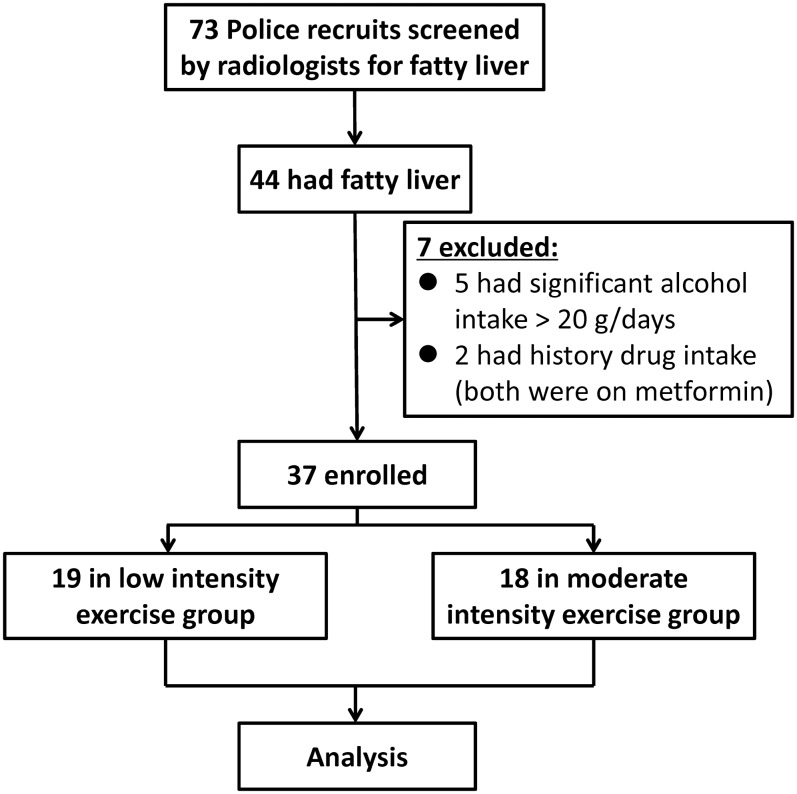
Background and Aims: Lifestyle (exercise and dietary) modification is the mainstay of treatment for non-alcoholic fatty liver disease (NAFLD). However, there is paucity of data on effect of intensity of exercise in management of NAFLD, and we aimed to study the effect of variable intensities of exercise on NAFLD. Methods: The study was performed in the Department of Gastroenterology of the SCB Medical College, Cuttack and the Biju Patnaik State Police Academy, Bhubaneswar. The subjects were police trainees [18 in a moderate intensity exercise group (MIG) and 19 in a low intensity exercise group (LIG)] recruited for a 6-month physical training course (261.8 Kcalorie, 3.6 metabolic equivalent in MIG and 153.6 Kcalorie, 2.1 metabolic equivalent in LIG). NAFLD was diagnosed by ultrasonography, with exclusion of all secondary causes of steatosis. All participants were evaluated by anthropometry (weight, height, body mass index (BMI), waist circumference), assessed for blood pressure and biochemical parameters (blood glucose, liver function test, lipid profile, serum insulin), and subjected to transabdominal ultrasonography before and after 6 months of physical training, and the results were compared. Results: Both the groups had similar BMI, fasting plasma glucose, AST, gamma-glutamyl transpeptidase, insulin, and homeostatic model assessment-insulin resistance (known as HOMA-IR) (p>0.05). However, subjects in the LIG were older and had lower alanine transaminase, higher triglycerides and lower high-density lipoproteins than MIG subjects. There was a significant reduction in BMI (27.0±2.1 to 26.8±2.0; p=0.001), fasting blood glucose (106.7±21.6 to 85.8±19.0; p<0.001), serum triglycerides (167.5±56.7 to 124.6±63.5; p=0.017), total cholesterol (216.8±29.2 to 196.7±26.6; p=0.037), low-density lipoprotein cholesterol (134.6±21.4 to 130.5±21.9; p=0.010), serum aspartate transaminase (39.3±32.2 to 30.9±11.4; p<0.001), serum alanine transaminase (56.6±28.7 to 33.0±11.3; p<0.001) and HOMA-IR (2.63±2.66 to 1.70±2.59; p<0.001) in the MIG. However, changes in these parameters in the LIG were non-significant. Hepatic steatosis regressed in 66.7% of the NAFLD subjects in the MIG but in only 26.3% of the LIG NAFLD subjects (p=0.030). Conclusions: Moderate rather than low intensity physical activity causes significant improvement in BMI, serum triglycerides, cholesterol, serum transaminases and HOMA-IR, and regression of ultrasonographic fatty change in liver among NAFLD subjects.
Keywords: Exercise; Intensity; NAFLD; Physical activity.
© 2020 Authors.
Conflict of interest statement
The authors have no conflict of interests related to this publication.
References
LinkOut - more resources
Full Text Sources
Research Materials